Sensory Water Play: The Ocean Bin Toddlers Beg For

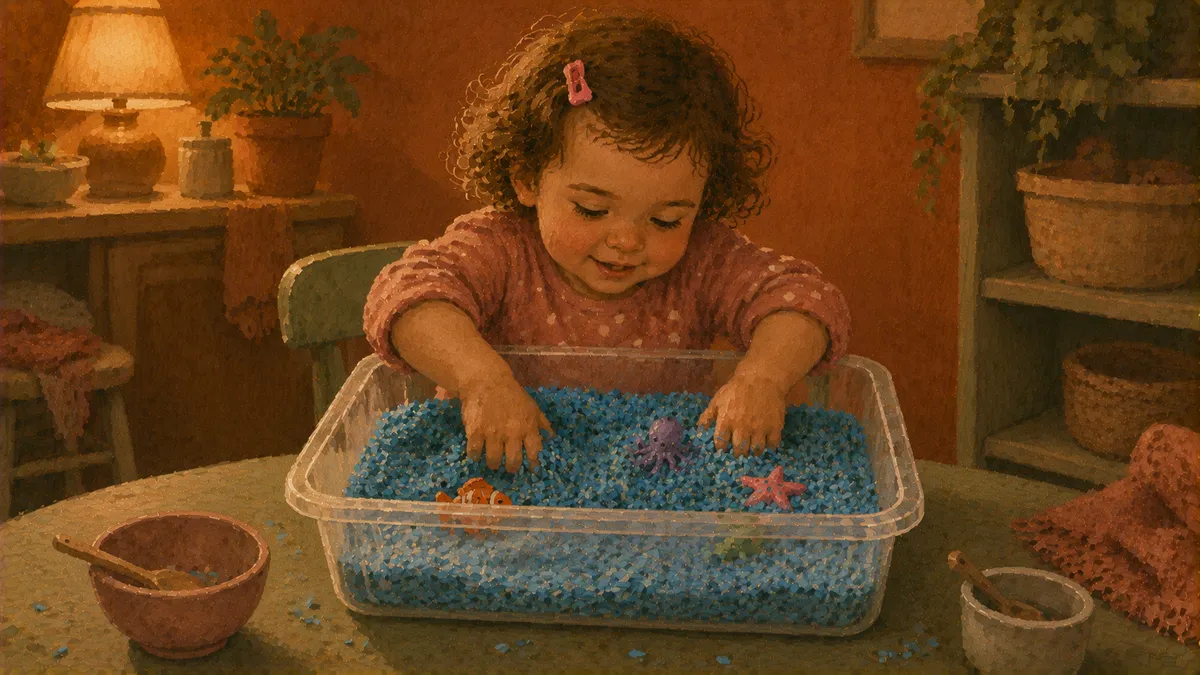
An ocean sensory water play bin is a tub of blue-dyed rice (or water) with little sea creatures, scoops, and shells hidden inside for your toddler to dig out, pour, and sort. I’m Nora Hayes, a former preschool aide and mom of a sensory-seeker, and I keep coming back to this one because it busies a wound-up kid for a real stretch while their hands do the work that Michigan State University Extension calls the foundation of reading, writing, and math.
Below I’ll walk you through what makes the bin tick, how to dye the rice blue at your kitchen sink, ten sea-themed things worth hiding inside, and how to set it up without the cleanup eating your whole afternoon.
What an Ocean Sensory Water Play Bin Is
A sensory bin is a shallow container filled with a base material (rice, water, sand, dried pasta) plus a handful of objects to scoop, sort, and discover. The ocean version swaps in blue-dyed rice or actual water for the base and fills it with small sea creatures, shells, and other things that belong on the ocean floor.
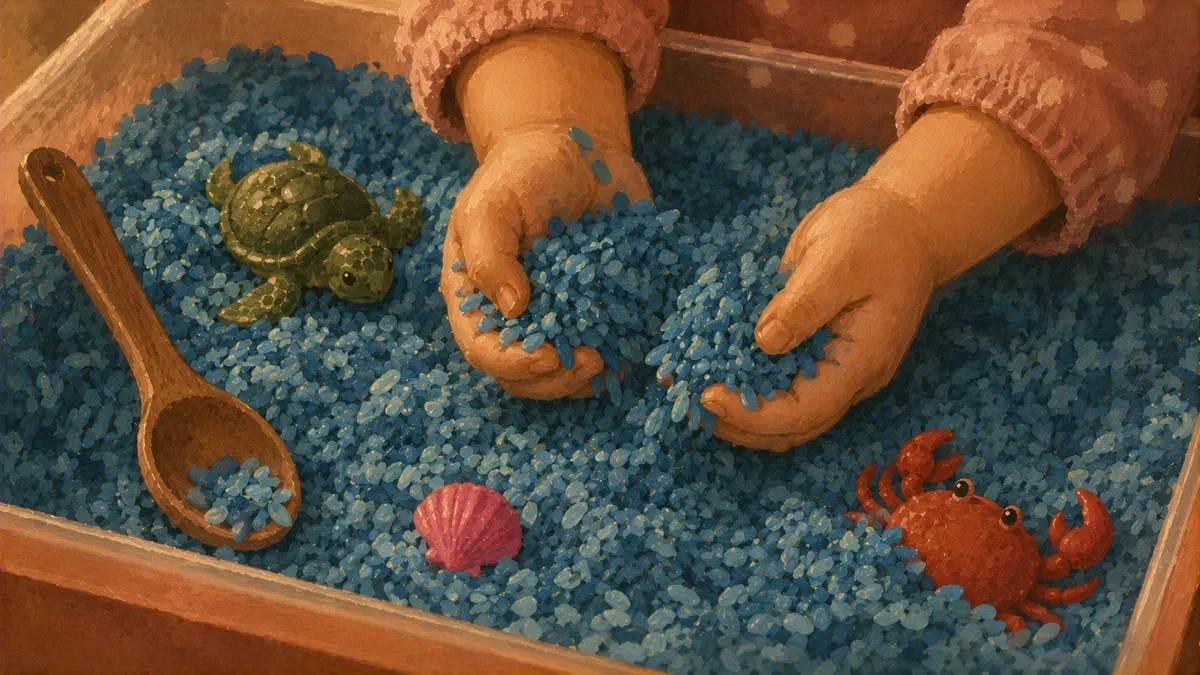
That’s the whole setup. Pour the base in, hide the objects, hand a toddler a spoon. The exploration handles itself.
What makes it worth the five minutes of prep is what happens once the lid comes off. Digging through sensory bins for toddlers gives little hands something real to do: scooping, pouring, pinching, burying. That’s hands-on learning at its most direct, and it holds attention longer than most toys. It’s open-ended play in the truest sense because there’s no right way to do it and no way to lose.
These sensory bins also work across a wider age range than you’d expect. June at three is running the same water play bin Eli used at eighteen months, just with more elaborate stories about sharks now.
Why Ocean Bins Build Real Toddler Skills
Watch a toddler dig through that blue rice for two minutes and you’ll spot it: this is not just busywork buying you a breather. Three things are happening at once under the splashing and the shark voices, and each one earns its place.
- Fine motor work: scooping, pinching, and pouring build the small hand muscles that matter for writing and dressing
- Sensory regulation: the repetitive feel of rice gives the nervous system steady, predictable input
- Language and imagination: naming creatures, sorting colors, and making up stories is vocabulary practice wearing a costume
Strengthening Tiny Hands and Focus
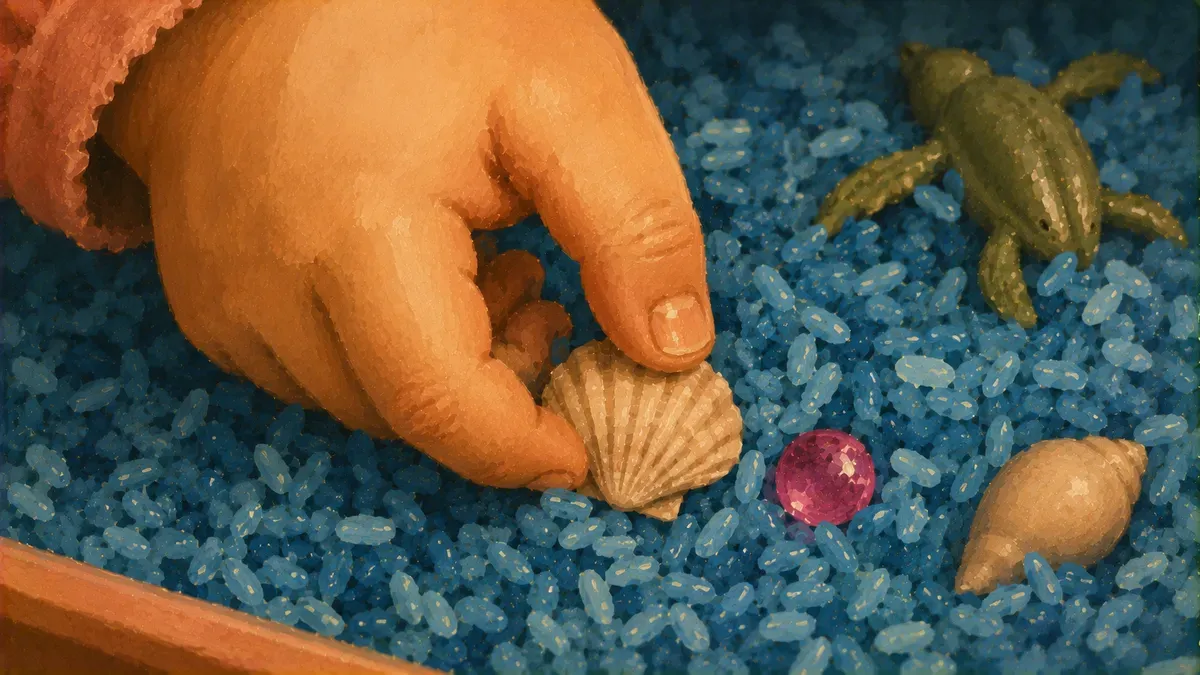
Every scoop, pour, and pinch is a tiny workout for hands that are still figuring themselves out. When a toddler pinches a shell out of the rice or tips a scoop into a cup, they’re building the small muscles that will one day hold a crayon and zip a coat.
Occupational therapist Colleen Beck points out that toddlers usually start managing a small scooping tool around 15 months, and that even just gripping a scoop helps build the arches of the hands and the intrinsic muscles. That’s real fine motor work, disguised as play.
The quieter win is focus. A bin that asks a kid to find five hidden shells keeps littles parked in one spot, concentrating, longer than almost anything else I’ve handed them.
Calming the Sensory System
There’s a reason an overstimulated child often goes quiet once their hands hit the rice. The repetitive feel of scooping and sifting gives the body steady, predictable input, the kind of proprioceptive and vestibular feedback that helps a nervous system settle.
This is the same sensory-rich exploration occupational therapy leans on. A NIH StatPearls entry on sensory integration notes that this kind of input reduces stress and supports adaptive responses, concentration, and social interaction.
In plain terms: the bin gives an overwhelmed body something simple and steady to chew on. I keep one ready for the late-afternoon stretch, when everyone in the house is fraying at the edges.
A few minutes of hands-in-the-rice quiet is not a fix, but it buys regulation, and that counts.
Sparking Language and Imagination
Hand a toddler an octopus and a whale and the narration starts on its own. Naming the creatures, sorting the colors, deciding the shark is “the daddy one”, all of that is language practice wearing a costume.
This is open-ended play, the kind with no script and no wrong answer, and it does quiet work on a growing vocabulary. Research by Stagnitti and Lewis, cited by the Child Mind Institute, found that kids whose play involves elaborate make-believe stories tend to have more advanced vocabularies and story-retelling skills.
Color recognition rides along for free. “Find the orange crab, now the blue fish” turns into a game, not a flashcard drill. June learned her colors fishing them out of the bin long before I thought to teach them, and the imagination she brings to it is entirely her own.
How to Make Blue Rice for the Bin
Making the base takes less than ten minutes of actual effort. Most of it is waiting for the rice to dry. Here’s how to get the color right, plus a few swaps if rice doesn’t work for your kid.
Dyeing the Rice Blue
You need plain white rice, blue food coloring, and white vinegar. That’s it.
The vinegar locks the color so it doesn’t rub off on little hands later.
- Combine one cup of white rice with a half-teaspoon of white vinegar and several drops of blue food coloring in a lidded container or a zip-lock bag.
- Seal it and shake until every grain is coated.
- Spread the dyed rice flat on a baking sheet or parchment in a thin, even layer and let it air-dry for a few hours, or overnight.
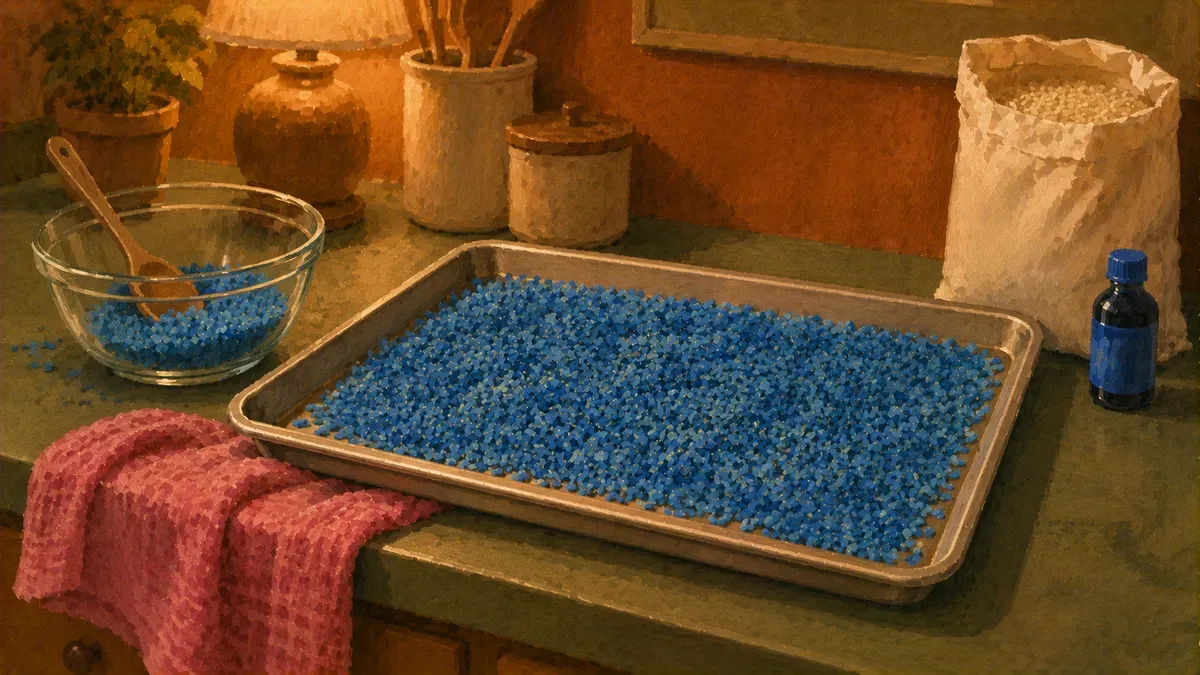
Once dry, it runs through fingers just like sand. For deeper ocean blue, use more drops. For turquoise, add one small drop of green to the mix. More color combos and troubleshooting are in our full guide on how to dye rice for sensory play.
Taste-Safe and Allergy-Friendly Swaps
Rice works for most toddlers, but not all. A few household materials cover the gaps.
If your littles are still mouthing everything, plain water with a few drops of blue food coloring is genuinely the simplest version of this bin. Drop in the sea animals and let them fish. Nothing to prep, nothing to dry.
Dyed chickpeas are the grain-free option for kids with rice allergies. Same vinegar method, same drying process, just a bit longer to dry all the way through.
Water beads come up constantly in sensory bin content, and I’d skip them for toddlers. The American Academy of Pediatrics warns that swallowed beads expand inside the body and can cause blockages serious enough to require surgery. There are plenty of safer options that do the same job. For a broader look at what’s actually safe, our taste safe sensory play roundup has you covered.
10 Sea-Themed Things to Hide Inside
Once your base is safe, the bin is only half built. The other half is what you bury in it, so here is what to hide and what to hand your kid to dig it out.
Sea Creatures and Treasures to Bury
You do not need a themed kit. Most of this is a raid of the toy basket and the junk drawer, and that is the point of good summer sensory activities: cheap, on hand, ready in five minutes.
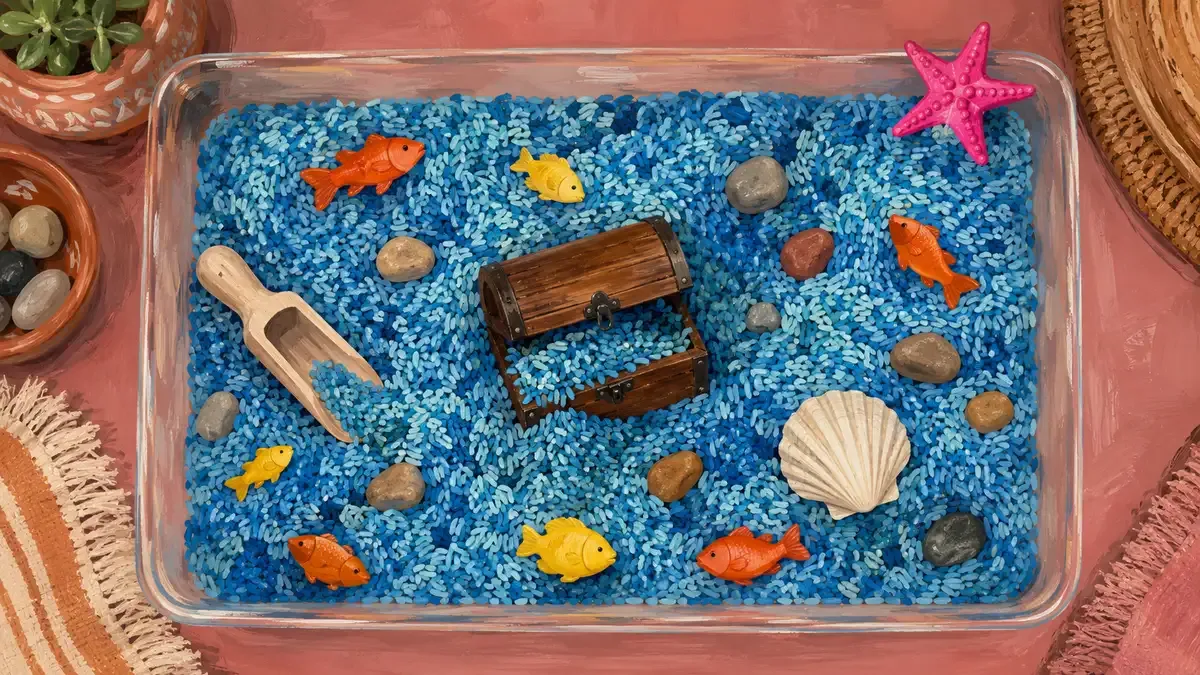
Bury ten things and let the hunt do the work:
- Toy fish in a few colors, so naming the catch sneaks in some early color talk
- Real shells for texture, the ridged and the smooth together
- Sea glass (or smooth craft gems), pretty to fish out and easy to count
- A plastic octopus with legs that grab the rice and make him hard to find
- Plastic pearls strung on a closed loop, never loose for the under-twos
- A mini treasure chest, the prize at the bottom that keeps the digging going
- A toy crab or starfish that hides flat against the bottom
- Smooth pebbles for heft, a different weight in a small hand
- Seashell-shaped scoops that double as a buried find
- A diver or mermaid figure to anchor the pretend story
The mix matters more than the count. Different shapes and weights keep the scooping interesting. June lines every shell up by size; Eli just plunges both arms in. For more raid-the-house ideas, our list of sensory bin fillers you already have reaches past the ocean theme.
Scoops and Tools That Extend Play
The tools turn a quick dig into twenty minutes. Finding a shell is fun once. Scooping ten of them into a cup, dumping it, and starting over is the part that holds.
Keep the hands-on learning simple:
- A spoon or ladle for scooping and pouring rice between cups
- Kitchen tongs to pinch out the bigger finds, real work for little hands
- Cups and a muffin tin for sorting the catch by color
- A small net if you switch to a water sensory bin instead of rice
Tongs are worth including because pinching out a heavier pebble or the octopus takes real effort, which stretches the hunt instead of ending it in two minutes. Go the water route and a water sensory bin makes the net useful for chasing floating fish.
Setting Up Safe, Low-Mess Ocean Play
Two things determine whether a bin becomes part of your weekly routine: whether it’s safe enough to run without anxiety, and whether cleanup takes three minutes.
Supervision and Choking-Hazard Checks
Never leave a toddler alone with a sensory bin.
Per toddler choking-hazard safety guidance, the CPSC defines a small part as any object that fits into a cylinder roughly 2.25 inches long by 1.25 inches wide, approximating the throat of a child under 3. If a shell, pebble, or plastic fish clears that cylinder, it stays out of the bin.
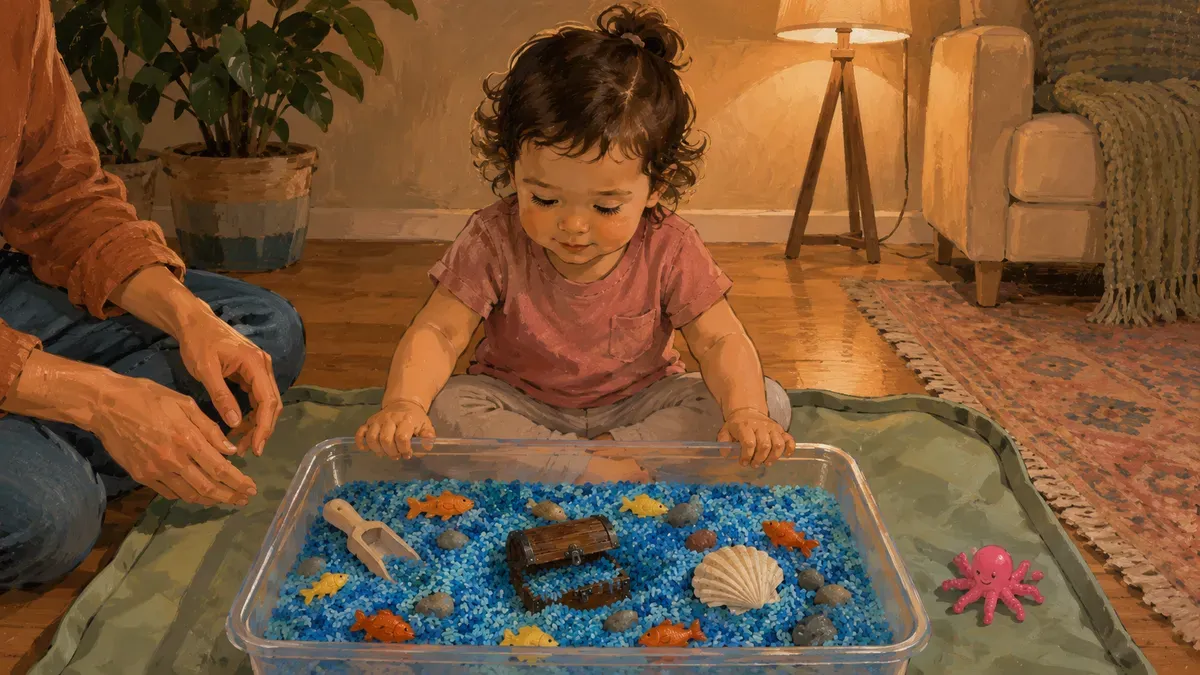
Before you set the bin out, run through this quick checklist:
- You or another adult will stay in the room the whole time
- Every shell, figure, or tool passes the 1.25-inch-wide cylinder test (too big to swallow)
- If your toddler still mouths things, the base is taste-safe (blue water, dyed chickpeas)
- A splash mat or upside-down storage tub is under the bin
- A sealed ziplock or container is ready for storing the rice after
Mess Containment and Quick Cleanup
A splash mat under the bin catches most of the spill. Outdoors, skip the mat and let the grass handle it.
After the session, pour the blue rice back into a ziplock or sealed container; stored dry, it lasts weeks.
Stored dry, it lasts weeks. One batch of blue rice, used again and again, is the real win.
Found this useful? Save it for the next rough afternoon.
Questions parents ask me about this
What age can toddlers start an ocean sensory bin?
Most kids are ready around 12 to 18 months, when they can sit independently and bring things to their mouths intentionally rather than reflexively. Under 12 months, stick to supervised water-only play in a shallow dish. By 18 months, the whole bin with scoops and hidden objects is fair game with an adult right there.
Is dyed blue rice safe if my toddler eats it?
Plain rice colored with food coloring and white vinegar is generally considered food-safe, since all three ingredients are edible. That said, a mouthful of dry rice is a choking risk for under-3s, so stay right beside them. If your child is in an especially mouthy phase, swap to plain blue water instead and save the rice for six months later.
How do I store blue rice between play sessions?
Let any damp rice dry completely before storing, then seal it in a zip-top bag or airtight container. Kept dry, it holds for a few weeks. If it smells off or shows any moisture, toss it and dye a fresh batch. A full resupply takes about 20 minutes and costs almost nothing.
What can I use instead of rice for sensory water play?
Plain water is the simplest swap and completely taste-safe. Dyed chickpeas work well for toddlers who need a chunkier, less chaffy base. Kinetic sand, cloud dough, or dried pasta are other common stand-ins.
How do I keep my toddler from dumping the whole bin?
A heavier, low-sided container helps, but honestly some dumping is going to happen. Giving them a cup and a muffin tin to pour into channels the urge to dump into something more deliberate.
Can an ocean sensory bin work for a sensory-averse child?
Yes, with a lower-intensity start. Begin with dry blue rice and no water, or offer tools so their hands never have to touch the material directly. Let them watch you dig before they try. Some sensory-averse kids warm up in two minutes; others need several sessions over a few weeks before they reach in. Follow their lead and don't push contact.
How long does a homemade ocean sensory bin last?
A water-based bin should be emptied and dried after each session to prevent mildew. Blue rice, stored dry, is good for a few weeks of repeated use. The shells, plastic sea creatures, and scoops last indefinitely. The bin itself is the same container every time, so the only thing you're refreshing is the base material when it runs low.
Written by
Nora Hayes
Mom of two and a former preschool aide. I share the screen-free sensory play and calm-down ideas I test at my own kitchen table, plus what the moms in my little meet-up swear by. A parent passing on what works, not a doctor or a therapist.
More about NoraKeep going
All Sensory Bins-
 Sensory Bins
Sensory Bin Fillers: 20 Pantry Items You Own Now
Skip the craft store: 20 sensory bin fillers already in your pantry tonight, sorted by texture, mess level, and age. Start one in minutes.
-
 Sensory Bins
sensory integration occupational therapy intervention: ADHD
Turn sensory integration OT into a home calm-down bin for ADHD kids. Task cards, bin ideas, and a setup that works on the hard days.
-
 Sensory Bins
Indoor Sensory Play: 18 Low-Mess Setups That Work
Dreading the cleanup? These indoor sensory play setups stay on the mat, work in apartments, and reset in minutes. Start tonight.
-
 Sensory Bins
Sensory Play 2 Year Olds: 12 Bins That Hold Focus
Most sensory bins lose a 2-year-old in 90 seconds. These 12 sensory play ideas for 2 year olds actually hold attention. Start one tonight.