Autism Visual Schedule: Charts That Actually Stick

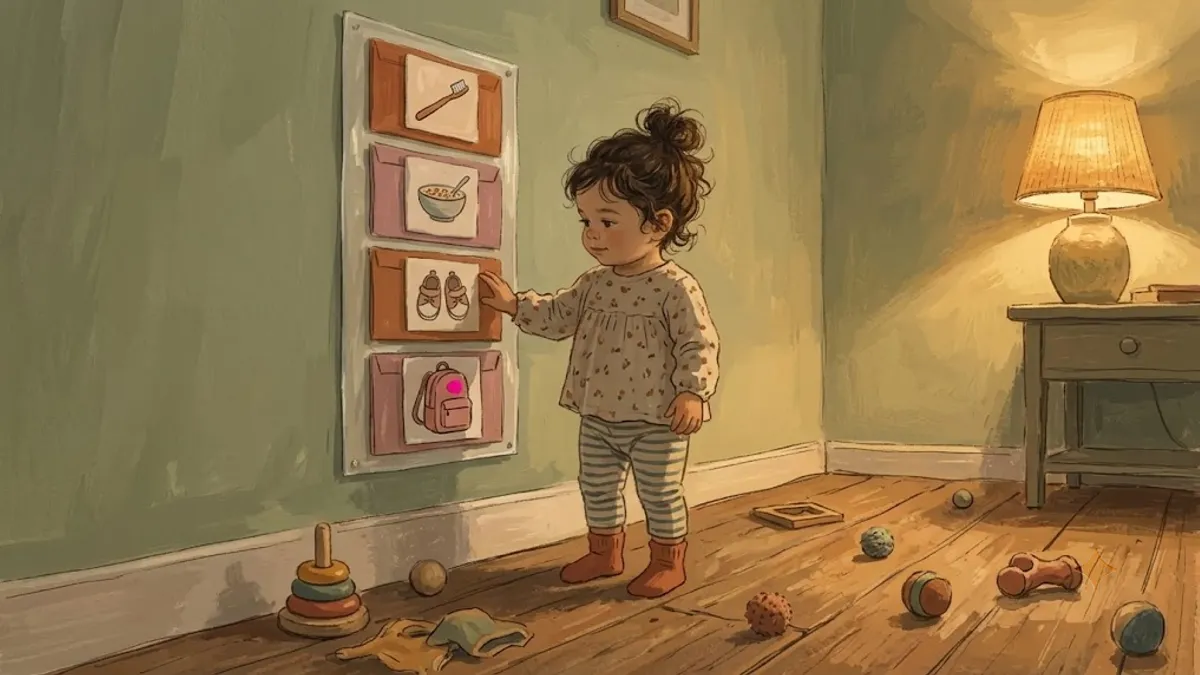
An autism visual schedule shows your kid what’s coming next in pictures instead of words, so the day stops feeling like one surprise after another. I’m Nora Hayes, a former preschool aide and mom to Eli (autistic, 7) and June (3), and the visual schedules I’m walking you through are the ones my living-room group and I have run with our own kids for years, keeping what worked and tossing the rest.
This guide covers how to build one, which format fits your kid, what to do when they flat-out refuse it, and how to grow it as they get older.
The plan in brief:
- Pick 4 to 6 daily anchor moments and put one picture to each.
- Add a clear ‘all done’ or ‘next’ step so transitions never surprise them.
- Run the same schedule for two weeks before you change anything.
Why Visual Schedules Calm Autistic Kids Down
Spoken words disappear the second they leave your mouth. A picture stays.
That’s the core of why visual schedules work so well for autistic kids.
- Verbal instructions ask a child to hold the sequence, read your tone, and filter out everything else in the room, all at once.
- A picture schedule offloads the remembering to the wall.
- The child can glance back at it whenever they need to, instead of holding it all in their head.
The predictability piece matters just as much.
- Transitions are hard not because the next activity is bad, but because what’s coming is invisible.
- When the day has no visible shape, every change feels like an ambush.
- Anxiety spikes at that boundary between known and unknown, and that spike is often what tips a rough moment into a full meltdown.
A schedule makes the unknown visible. It shows the steps in order, one at a time, in pictures your child already understands. That alone changes the nervous system’s read on the situation.
The research lines up with what parents find at home: guidance on supporting autistic children with predictable routines notes that autistic children showed stronger visual working memory compared to typically developing peers, which is part of why visual supports click where verbal reminders keep sliding off.
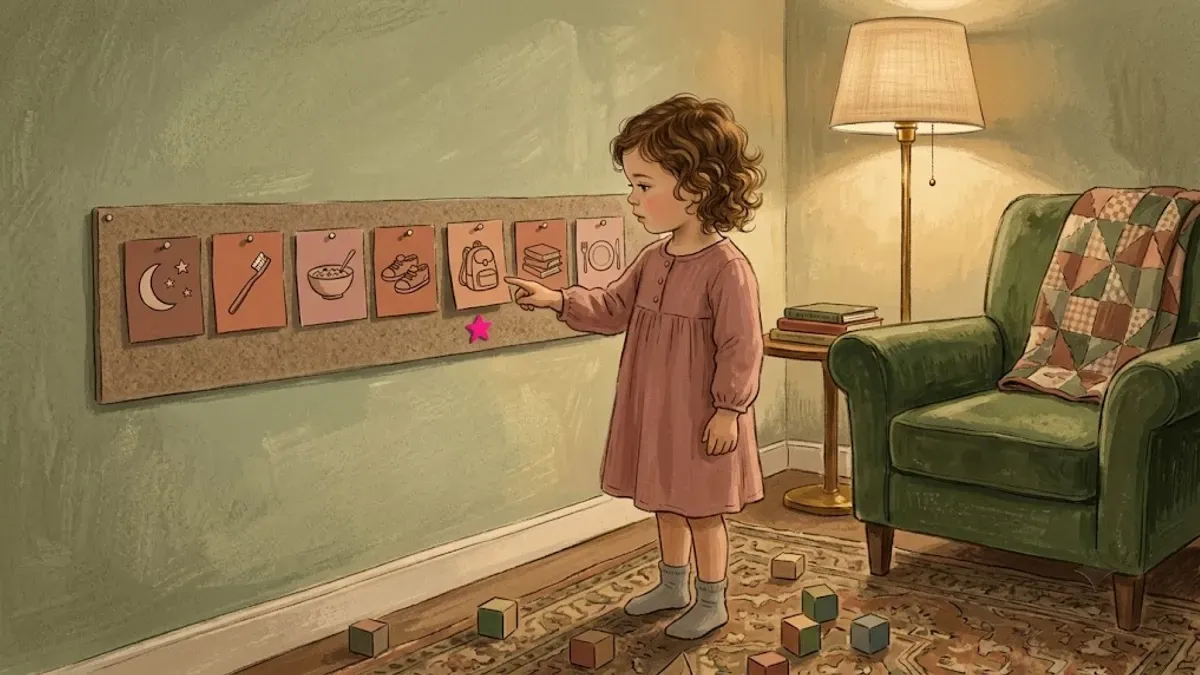
Visual supports also hand the child some control. Instead of waiting to be told what’s next, they can check the schedule themselves. That small act of self-checking builds regulation from the inside, which is more durable than a parent narrating every transition out loud.
You can explore more about building these routines in our guide to visual schedules routines, and get a closer look at setting one up for home in this overview of a visual schedule autism setup. The goal isn’t a perfect laminated chart. It’s a kid who feels less surprised by their own day.
How to Build an Autism Visual Schedule Step by Step
So where do you actually start? Not with the whole day. You start with the moments that already go sideways, pick a symbol your kid can read on their worst day, and teach the routine while everyone’s calm.
- Zero in on the two or three transitions that already fall apart. Skip the easy parts of the day.
- Find the symbol level your child can read when they’re already stressed, not when they’re calm.
- Run through the chart together at first, then pull back your help week by week until they check it solo.
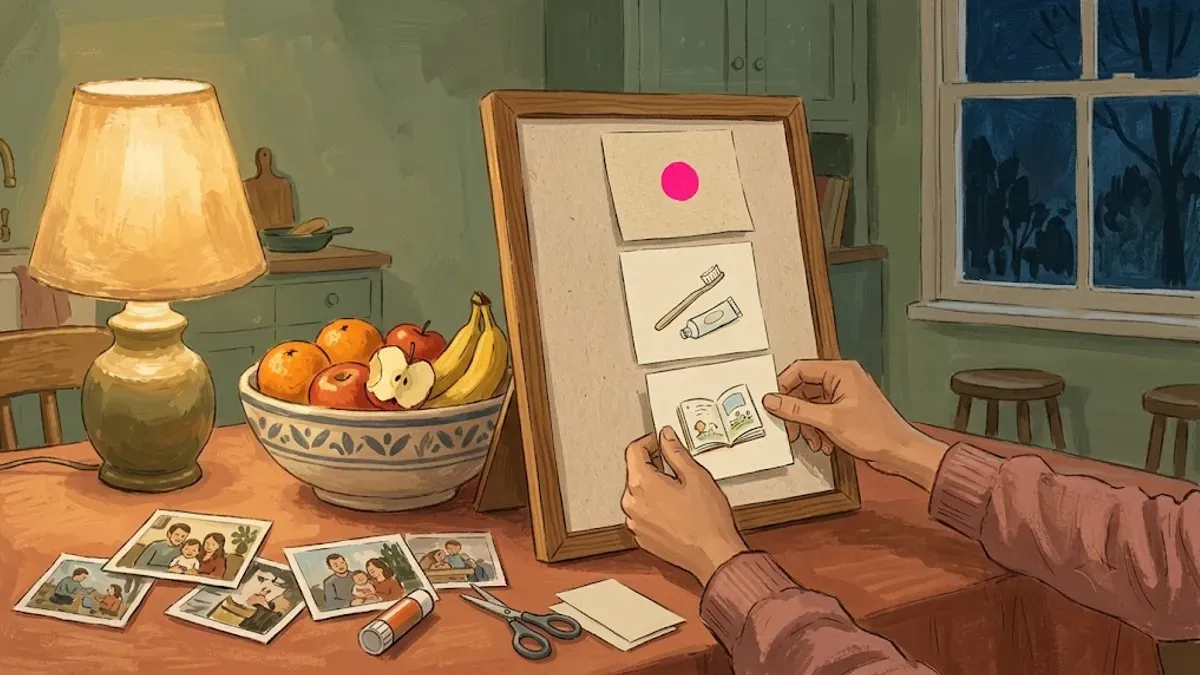
Pick the Routines Worth Mapping First
The instinct is to map every hour from wake-up to lights-out. Don’t. A wall-sized chart nobody can keep up with overwhelms you before it ever helps your kid.
Find your trouble spots instead. The same handful of transitions cause most of the daily friction, and one writeup on building predictable routines points to three that tend to blow up for autistic kids: morning into the first big activity, the shift out of the afternoon into evening, and the wind-down into bedtime.
Start there. Pick four to six anchor moments where a transition reliably ends in tears or a standoff at your house, and map only those.
Map your worst transitions first, leave the calm stretches of the day alone.
Morning rush. The hand-off from play to dinner. Bath and bed. Those are the spots where a little predictability does the heaviest lifting. You can always add to the routine later, once the first few moments are running themselves.
Choose Objects, Photos, or Icons
The symbol on the schedule only works if your kid actually knows what it means. Pick one that’s too abstract and you’ve built a chart they can’t read.
Reading Rockets, drawing on research on picture-based communication used with autistic students, lays out four levels of representation and a rule I keep coming back to: choose the form your child can understand on their worst day, not their best. Anxiety eats comprehension, and a fancier picture-based schedule isn’t automatically a better one.
The levels run from concrete to abstract:
- Real objects for the youngest or earliest learners. A toothbrush means bathroom. A spoon means dinner.
- Photographs of your actual kid doing the actual thing. Their real boots, their real plate.
- Icons or line drawings, which lean on stronger visuospatial skills to read a simplified picture.
- Words on their own, once reading is solid.
Match the symbol to where your child is now, then move up only when they’re clearly ready. With Eli, photos of his own stuff clicked when generic clip art never did. Start where they can succeed and trade up later.
Teach It With Prompts, Then Fade Them
Don’t unveil the schedule mid-meltdown and expect it to land. Introduce it during a calm, ordinary moment, when nobody’s dysregulated and there’s nothing riding on it.
Walk through it together first, then step back a little at a time. Point to the first picture, do the thing, flip it to all-done, point to what’s next. You’re the one running it at the start, and that’s fine. The prompts are scaffolding, not a permanent fixture.
The fading sequence that works consistently:
- Wait a beat before jumping in.
- Gesture toward the board if they hesitate.
- Point to the next picture.
- Say a quiet word only if pointing didn’t move them.
Give the least help that gets them moving, then pull back a little more each day until they’re checking the board without waiting for you. A study on prompt fading in autistic children found a least-to-most approach, where you give the smallest nudge first and only add more if they’re stuck, was the most consistently efficient across every kid in it.
In plain terms: wait, then gesture, then point, then a quiet word, in that order. Give the least help that gets them moving, and a bit of warm reinforcement when they check it themselves. Independence is the whole point.
If you want a step-by-step layout guide, this visual schedule walkthrough walks you through building one on a blank grid in about five minutes. The first week will be clumsy. Run it anyway, fade slowly, and let your kid surprise you.
Which Visual Schedule Format Fits Your Child
There is no one right format, only the one your kid will actually use. The three that earn their keep at my house and in our living-room group sort out by how much your child can hold at once, where they need the schedule, and whether paper or a screen wins.
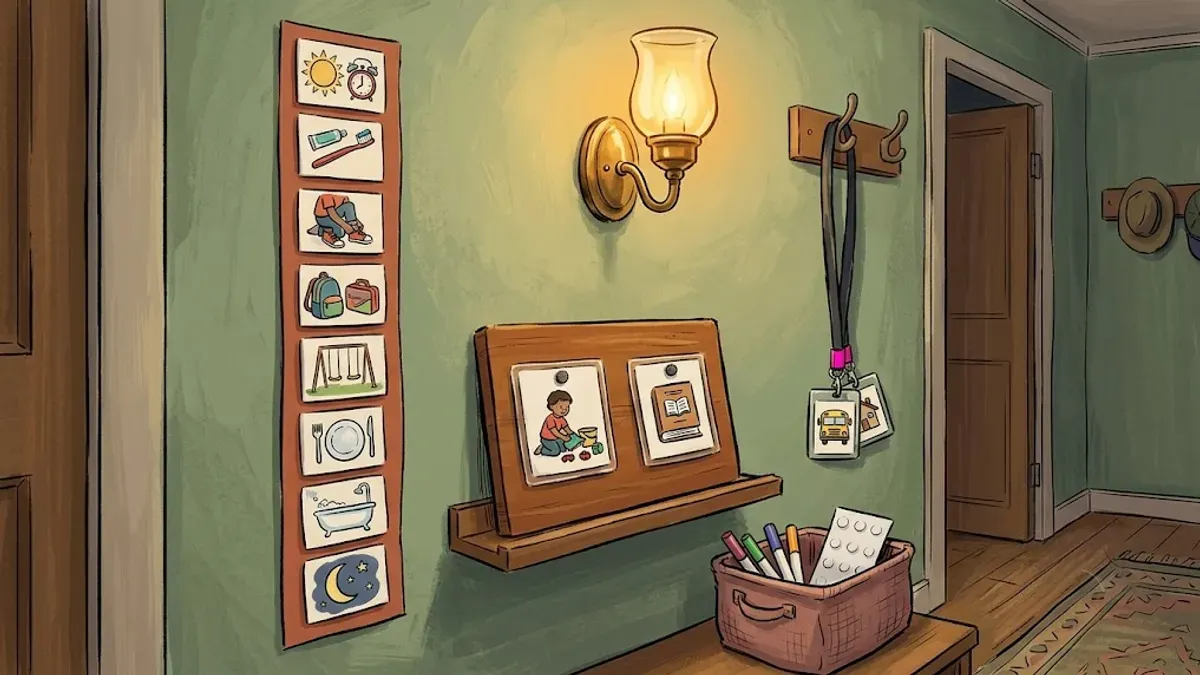
First-Then Boards and Full-Day Strips
Start small if a full strip overwhelms your kid. A first-then board shows two cards only: do this, then that.
- Brush teeth → then a show
- Coat on → then the park
- Shoes on → then the car
It tackles one hard transition at a time, which is the whole point when a busy strip just reads as noise.
The Structured Teaching framework for visual supports at OCALI describes the first-then board as the right call for a child not yet ready for a more complex schedule, since it shows only two sequential steps instead of a whole row of activities.
A full-day strip is the trade-up. It lays out the morning in order and gives a kid the predictability of seeing what is coming before it arrives.
- Some kids find that predictability calming
- Others see a row of cards and shut down
Read your own child: if a single first-then gets a smoother handoff than the strip, stay there a while longer. The guide to first-then boards shows exactly how to make one in a few minutes — run a single transition tonight before you commit to anything bigger.
Portable Versus Wall-Mounted Schedules
Where the schedule lives matters as much as what is on it. A wall-mounted strip is your centralized home base: it stays put by the door or the bathroom, everyone knows where to look, and you are not hunting for it mid-meltdown. For visual schedules used in an autism classroom, that fixed spot does a lot of quiet work, since a stationary setup suits students who work at one desk or one rug spot.
The catch is the wall cannot come to the grocery store. A child may need their own portable version even when the room already has a shared wall schedule.
| Format | Best for | Travels? |
|---|---|---|
| Wall strip | Home base, classroom | No |
| Lanyard or pocket card | Outings, appointments | Yes |
| Clipboard | Any location, any age | Yes |
Most families I know end up running both: the wall strip at home, a stripped-down lanyard for the outings that go sideways.
Run a centralized strip where your kid stays put, and clip on a short portable version for anywhere the wall can’t follow.
Digital and App-Based Schedules
Paper is not the only answer, and for some kids a tablet wins outright. A digital schedule app handles the parts I always botch.
- It dings a built-in timer before a transition hits
- Finished steps tick off with a tap, no Velcro reset on Sunday night
- Gentle prompts reach the kid who tunes out a static picture but answers a chime
A 2014 research review of 31 studies on visual activity schedules by Knight and colleagues documented real success teaching skills with tablet and smartphone schedules, sometimes in surprisingly few sessions.
Here is the honest caveat. The screen that runs the schedule is the same screen that runs the games. If the tablet becomes a fight every time a non-preferred step pops up, paper sidesteps that whole battle. Try digital if your kid already lives on a device and follows it without bargaining; reach for paper if the screen itself is the trigger.
What to Do When Your Kid Refuses the Schedule
Refusal usually means the schedule found a nerve. Not that it isn’t working.
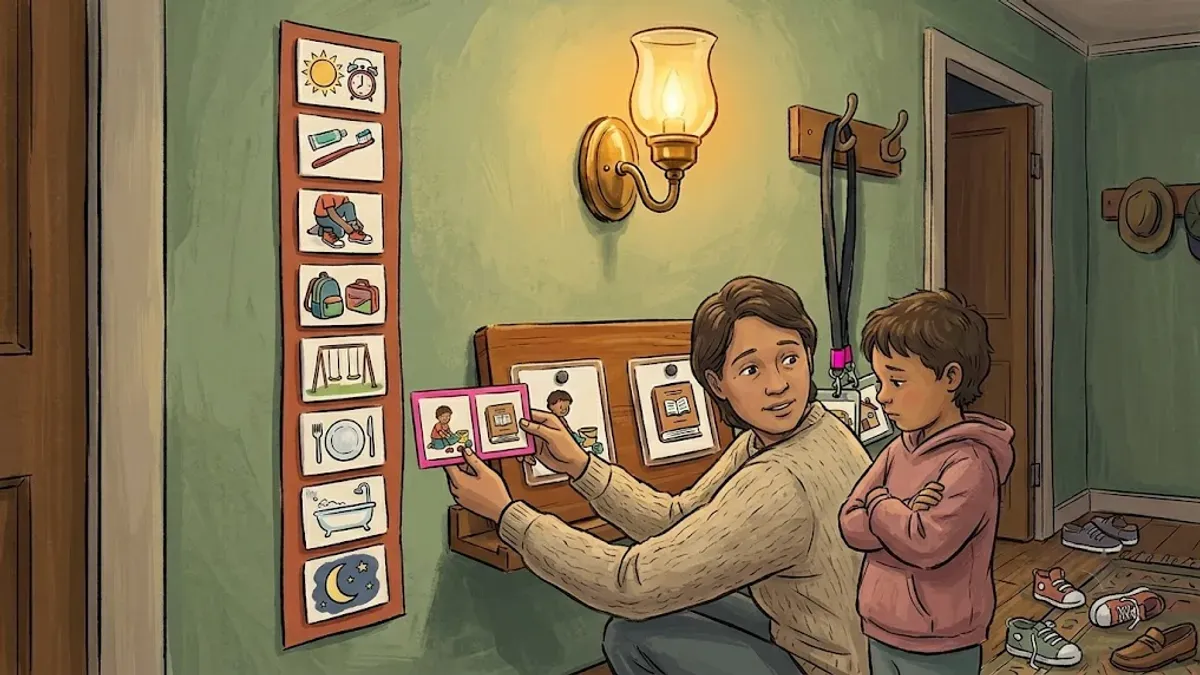
The most common trigger is a non-preferred activity sitting right there in plain sight. A picture of bath time does not make bath time welcome. When Eli was six, he’d knock the whole strip off the wall rather than touch the “bath” card. The schedule wasn’t broken. He needed more support at that specific transition, not a new format.
A 2021 study in Behavior Analysis in Practice found that for transitions from preferred to non-preferred activities, visual schedules alone weren’t enough to reduce challenging behavior. What reduced it was pairing the schedule with reinforcement for completing the hard step, and a planned response that didn’t accidentally reward the refusal.
The schedule is a clarity tool, not a behavior plan on its own. When the nervous system is already flooded at that step, a picture card doesn’t override it. You need something worth arriving at on the other side.
When a student or child refuses a step, try this before scrapping the whole schedule:
- Slide in a choice. “Do you want bath before or after PJs?” Both options land in the same place, but the child just made the call.
- Add a first-then mini-board for the hard step only. “First bath, then show.” Keep the main schedule running as-is.
- Shrink the step into smaller cards. “Get in the tub” may be too big. Break it: “walk to bathroom,” then “turn on water,” each its own card.
- Check the flexibility of the sequence itself. If meltdowns cluster around one step every single time, that step may need a permanent workaround, not more repetition.
If the schedule is new, give it two full weeks before judging. A refused schedule on day three is normal. Hang it, use it, don’t make it a standoff.
For students with autism who push back on visual supports at school too, it helps to know whether the format or the sequence is the real issue. The breakdown of visual schedules for adhd versus autism can clarify whether what you’re seeing is a flexibility problem or a design problem.
One thing that rarely helps: switching the whole system every time there’s pushback. Familiarity with a schedule builds over weeks, and swapping formats resets that clock.
Adapting Schedules as Your Child Grows
The schedule that got Eli through preschool mornings looks nothing like what he uses at seven. That’s not a flaw in the system. That’s the system working.
When kids are young, the picture schedule does most of the heavy lifting. Big photos, one step at a time, an adult nearby to point and prompt. The goal at that stage isn’t independence. It’s familiarity. Get the routine into the body before you worry about who’s running it.
As comprehension grows, you pull back on prompts. That progression looks like this: - Week one: you point to each card
- Week two: you just gesture toward the board
- Eventually: your kid checks it on their own
The format changes too. A toddler who needed a photo of their own cup can often shift to simple line icons by kindergarten, then to a written list by early elementary. Each trade-up is a test. If they stall out, you’ve moved too fast. Back up a level and try again in a few weeks. A neuroaffirming approach means following their actual pace, not the one on a developmental chart.
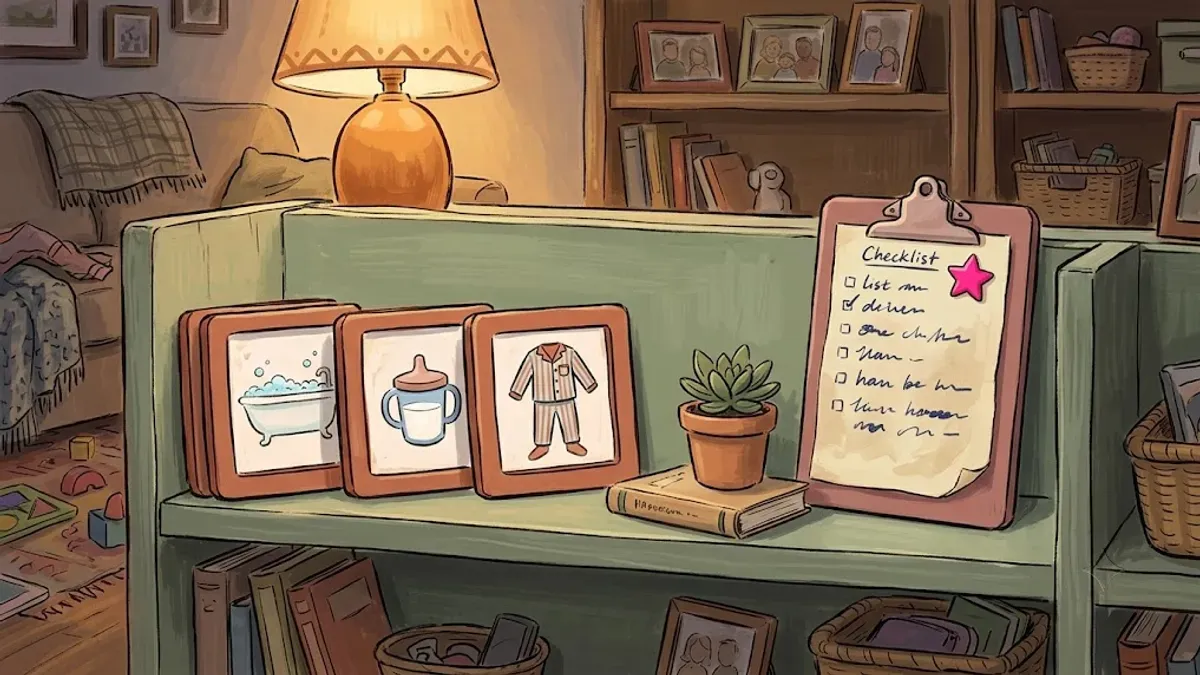
A 2011 review of 23 peer-reviewed studies found visual schedules used successfully from preschool through adulthood, covering everything from toothbrushing to job-related tasks. The format shifted across those ages; the underlying need for structure didn’t disappear.
Flexibility comes later, and it shows up as generalization: a kid who reads the home schedule and transfers that same self-checking habit to a new classroom or a visit to grandma’s. That’s the long game. It doesn’t happen because you pushed for it; it happens because the routine got deep enough to travel.
For more on building these at every stage, our full set of visual routine guides covers the formats in detail.
Found this useful? Save it for the next rough afternoon.
Questions parents ask me about this
Which visual schedules actually work for autistic children?
The ones that match what the child can actually read on a hard day. Photo-based schedules tend to be the most reliable starting point because they're concrete and don't require decoding symbols or text. From there, you can trade up to icons or written words as comprehension grows. There's no single correct format. What works is what your child will independently check.
At what age can an autistic child start using a visual schedule?
Many autistic children begin benefiting from simple two-card first-then boards as toddlers, well before they can read or recognize standard icons. A first-then board is the right entry point for any child not yet ready for a full sequence. There's no minimum age. The cue is whether your child can look at a photo and recognize what it represents.
How is a visual schedule for autism different from one for ADHD?
Both kids benefit from predictability, but the underlying need differs. For autistic children, schedules reduce anxiety tied to not knowing what comes next. The unknown is the problem, and making it visible solves most of it. For a child with ADHD, the bigger challenge is often holding a sequence in working memory and resisting distraction mid-task. Visual schedules help both.
How do I keep the same schedule working across home, school, and outings?
Use the same symbols in every setting. If your child's schedule at home uses photos, the school version and the outing version should use the same photos, not a different icon set. A portable lanyard or pocket schedule that travels with the child closes the gap between home and community. Loop in the teacher directly so symbols stay consistent, because mismatched visuals across settings slow down the independence you're building at home.
What materials do I need and how much does a visual schedule cost?
You can start for almost nothing: printed photos, a piece of card stock, and some velcro dots. A small binder ring or a lanyard adds portability. Laminating adds durability but is optional at first. If you prefer a digital route, free and low-cost apps handle the whole setup without printing. The most important investment is your time building the symbol set, not the hardware.
How can parents and teachers keep the schedule consistent together?
Send photos of your home schedule to the teacher, and ask for photos of the classroom version in return. When symbols differ, agree on a shared set and both switch. A quick weekly check-in catches the moments when school routine has shifted and the home schedule needs to catch up. Consistency across adults matters more than the format you pick.
Should a visual schedule for autism be added to an IEP?
If a visual schedule is already helping your child at home, get it written into the IEP so the school is required to implement it consistently. You can specify the format (photos, icons, portable vs. wall), the check-in routine, and prompt-fading goals. Without IEP language, implementation is at the teacher's discretion and can disappear when staff changes.
Written by
Nora Hayes
Mom of two and a former preschool aide. I share the screen-free sensory play and calm-down ideas I test at my own kitchen table, plus what the moms in my little meet-up swear by. A parent passing on what works, not a doctor or a therapist.
More about NoraKeep going
All Visual Schedules-
 Visual Schedules
Visual Schedule Printable: 20 Picture Cards + Free PDF
Visual schedule printable with the 20 picture cards every toddler home needs. Free PDF to download, print, and start using tonight.
-
 Visual Schedules
Visual Schedules: A Beginner's Guide for Parents
Most visual schedules fail before day three. Learn how they work and build your first board in 5 steps your child will actually follow. Start today.
-
 Visual Schedules
Toddler Schedule: Build One With Picture Cards
Your 2-year-old can't read a clock yet. Build a toddler schedule with picture cards in 5 steps that stop nap fights and meltdowns. Start today.
-
 Visual Schedules
Free Printable Daily Routine Chart Kids Will Follow
Grab a free printable daily routine chart your child will actually follow, plus picture cards and tips to make any routine stick. Download now.