Visual Schedule Printable: 20 Cards Every Toddler Home Needs

Some links here are affiliate links. If you buy through one, I may earn a small commission at no extra cost to you. As an Amazon Associate I earn from qualifying purchases. I only point to things I'd actually use with my own two.
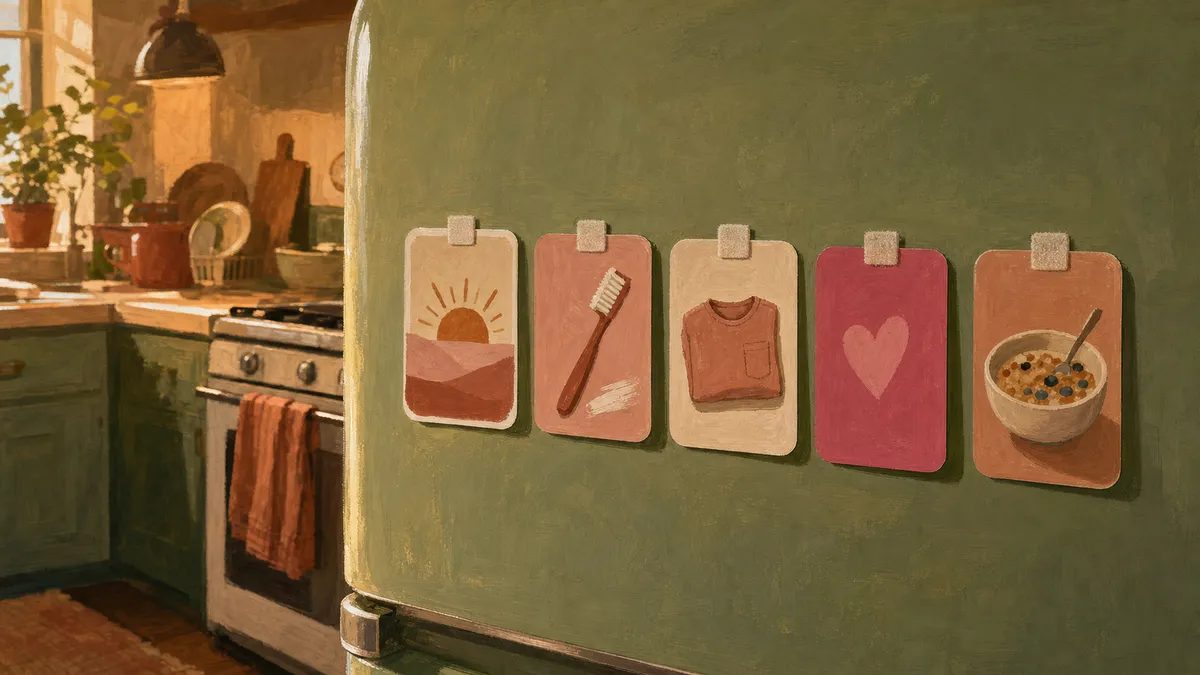
The 20 daily routine pictures your toddler actually needs are the ones for the moments that go sideways: wake up, get dressed, brush teeth, snack, potty, nap, clean up, shoes on. I’m Nora Hayes, a former preschool aide raising a sensory-seeking 7-year-old and a 3-year-old, and these are the schedule images I print, laminate, and rearrange on my fridge every single week.
Below you’ll find the free printable, the exact 20 cards to start with, and how to put them in front of your kid so they actually follow them.
The plan in brief:
- Download and print the free 20-card visual schedule PDF on card stock.
- Cut, laminate, and add Velcro dots so the cards become movable icons.
- Post 3 to 6 cards in order for the next routine and slide each one off as your toddler finishes it.
How to Print and Assemble Your Picture Cards
Here is the whole assembly, start to finish, in the order I do it at my kitchen table:
- Grab the file and choose full-size print. Use 80 lb cover weight so the pages hold up when little hands grab them.
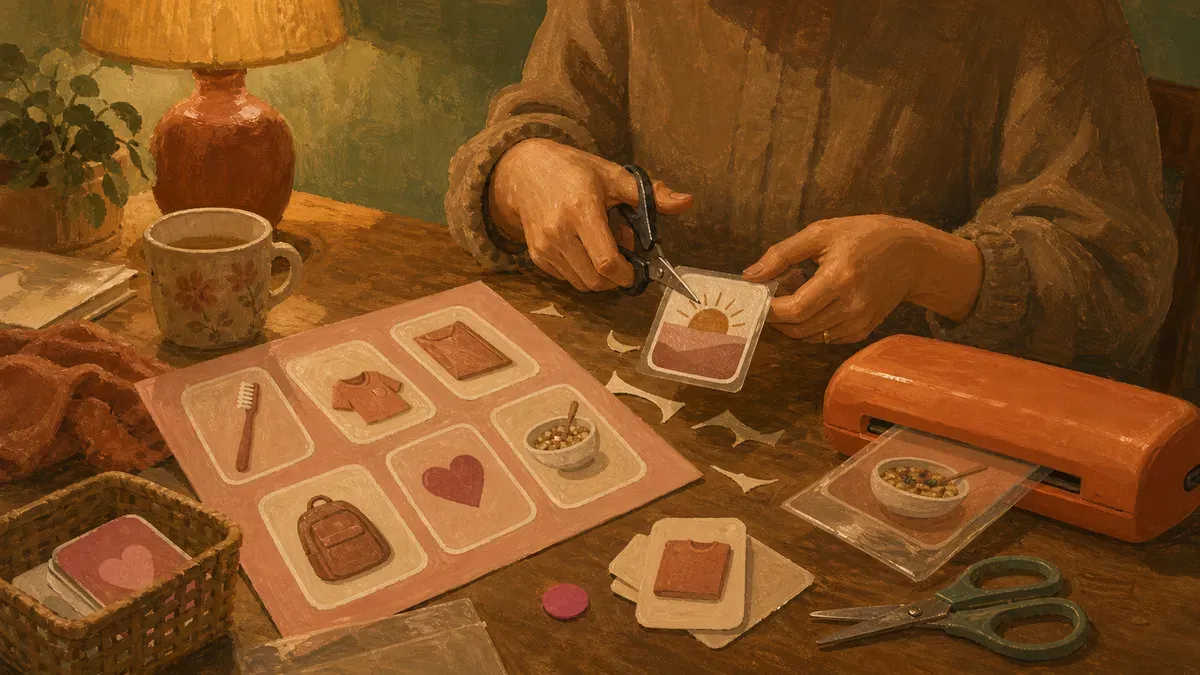
- Trim the pages, seal them in a 5 mil laminating pouch, then snip every corner. That corner step takes ten seconds and keeps sharp edges away from small fingers.
- Press Velcro onto each card and your board. Hook side on the card back, loop side on the board, and give the adhesive overnight to bond properly.
- Mount the board at your child’s eye level and arrange the first sequence. Pick one predictable routine so the system starts with a clear beginning and end.
Two things go in the cart before you print a single page: card stock and laminating pouches. Everything else you probably already have in a drawer. Here’s what earns a spot in my supply closet, and how other parents rate it.
| Supply | Why this one | Parents’ rating |
|---|---|---|
| 80 lb cover card stock | 216 gsm, sails through any home printer, 250 sheets a pack | 4.7★, 2,600+ reviews |
| 5 mil laminating pouches | Letter-size, 100 to a box, thick enough to survive teeth | 4.9★, 13,000+ reviews |
Both wear Amazon’s Choice badges, so you’re not gambling on a no-name. Prices bounce around, so check the current price on Amazon.
Download and Print on Card Stock
The free printable visual schedule pictures live as a PDF you download and open with any reader, no fancy software. Print the PDF templates at full size (don’t “fit to page,” or your cards shrink and the Velcro won’t line up).
Regular printer paper curls and tears in a week of toddler hands. PrintingCenterUSA calls 80 lb cover weight the standard for DIY cards, and that heft is exactly what keeps a card flat after the hundredth peel.
Cut, Laminate, and Add Velcro
Cut along the lines with scissors or a paper trimmer if you’ve got one.
For flash cards a kid handles daily, Lamination Depot recommends a 100 to 125 micron pouch (about 5 mil), durable but still bendy. Round every corner with scissors after laminating, a tiny safety habit that keeps sharp points away from little hands.
Stick the hook (rough) side on the back of each icon and the loop (soft) side in a row on your board. VELCRO Brand says its sticky-back adhesive reaches full strength after 24 hours, so press firmly and let it set overnight before the first peel.
Set Up the Board and Post the First Routine
Your board can be a strip of foam core, a cookie sheet, or a ribbon taped to the wall. Texas Rising Star, a state childcare-quality program, specifies that schedule cards be displayed at children’s eye level so kids can see and reach them on their own.
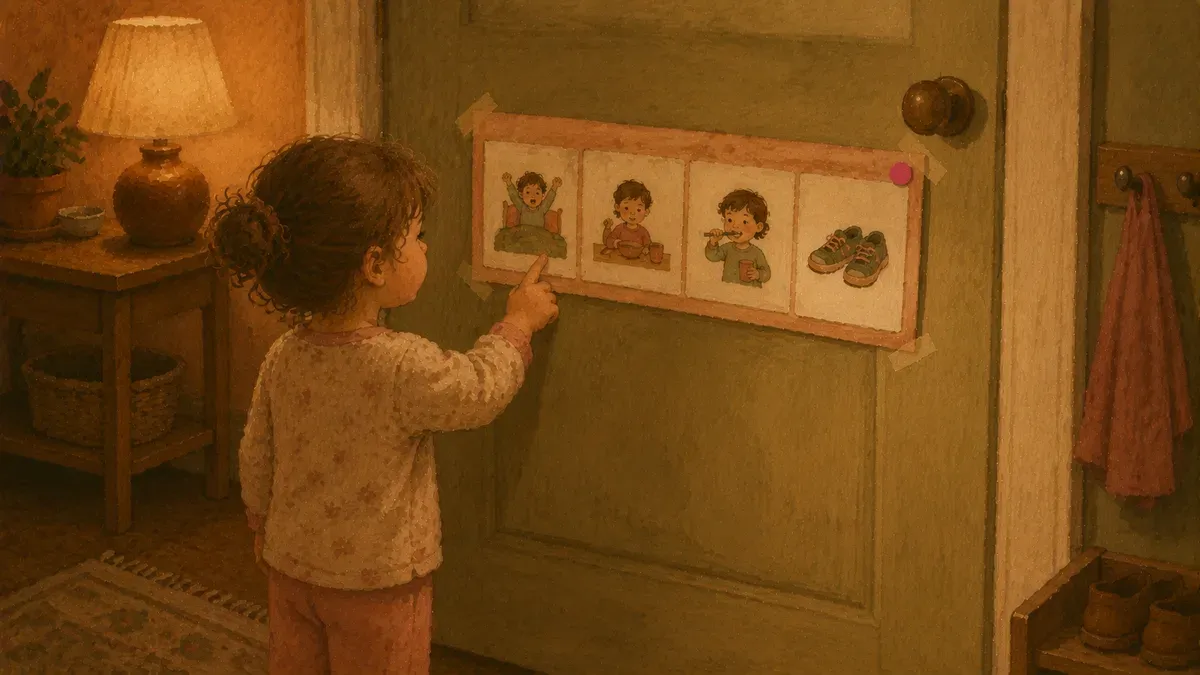
Load three to six routine cards in order, left to right. As each task finishes, your toddler peels the card off, and that little physical action is what makes the transitions land.
For the design science behind which icons to pick, the visual schedules routines guide and the visual schedule template walkthrough cover it.
The 20 Picture Cards Every Toddler Home Needs
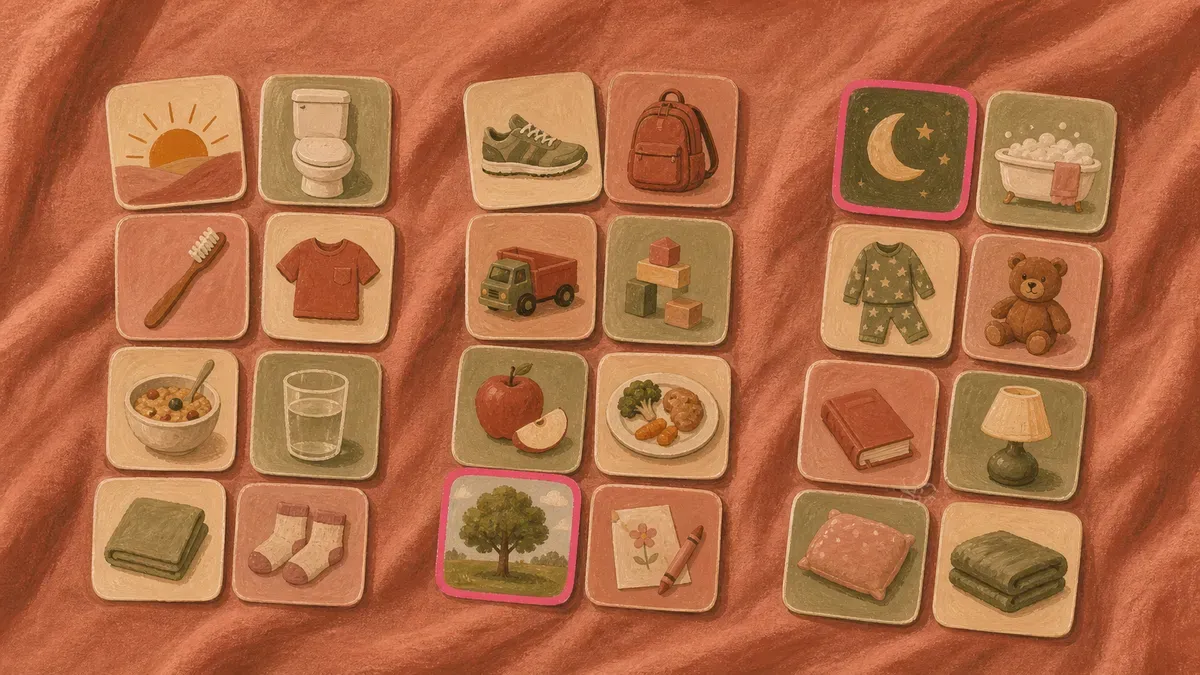
You don’t need a card for every minute of the day. You need one for the moments that blow up, and these twenty cover the flashpoints from the first groggy stretch in the crib to lights-out.
Morning and Getting-Ready Cards
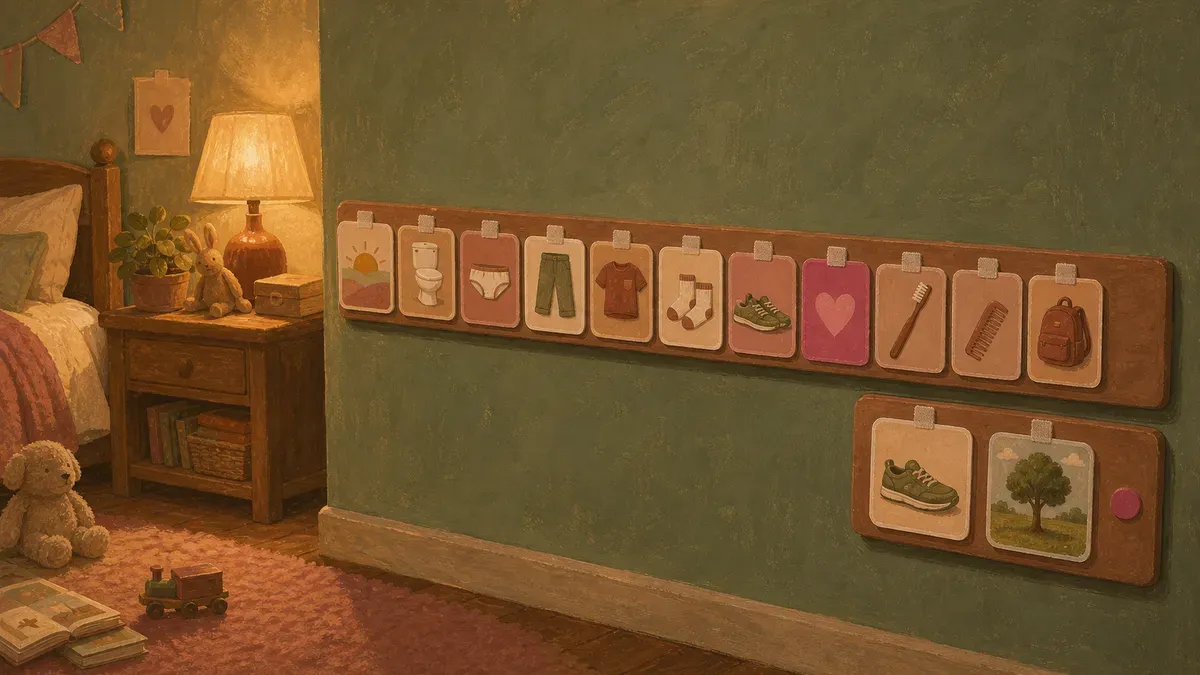
Mornings are where most meltdowns start, so this is where a schedule with pictures earns its keep. The seven that carry a toddler from groggy to out-the-door are simple and concrete:
- Wake up (sun, or a kid sitting up in bed)
- Potty (toilet)
- Get dressed (shirt and pants)
- Breakfast (a bowl)
- Brush teeth (toothbrush)
- Get shoes on (sneakers by the door)
- Pack bag (backpack)
Keep the morning routine in that order and the schedule icons do the nagging for you. June used to fight getting dressed every single day. Once the picture sat between potty and breakfast, she started peeling it off herself, because she could see what came next. That’s the whole point of these little transitions: the kid reads the wall instead of reading your mood.
Daytime, Play, and Mealtime Cards
The long middle stretch is the hardest to structure, and it’s where a vague day turns into six small standoffs. These schedule images give that floppy afternoon some bones. Seven cards hold the afternoon together:
- Play
- Snack
- Lunch
- Outside time
- Quiet time
- Clean up
- Screen time
The one parents skip is clean up, and it’s the one that does the heavy lifting. Pairing a clean-up schedule picture right after play tells a toddler the fun has a natural end, so you’re not the bad guy announcing it.
Same logic applies to screen time.
Screen time gets its own slot too, on purpose. Put it in the daily routine where you actually want it, snap it off when the show’s over, and screens become a scheduled thing with a finish line instead of a fight. If you want the design logic behind each icon, I broke it down in our picture schedule starter set.
Wind-Down and Bedtime Cards
Bedtime is the one sequence worth being almost rigid about, because a predictable wind-down is what makes the lights actually go out. These pictures for a picture schedule run the evening on rails: dinner, bath, pajamas, brush teeth, story, then lights out.
The order matters more here than anywhere else. The schedule cues a toddler’s body to start slowing down before the bath card even arrives. Story sits second-to-last for a reason, the calm thing right before the dark thing.
These visual schedule images aren’t magic, and some nights the bath card gets thrown across the room. That’s a normal night, not a failure. Post the bedtime routine, keep the same icons in the same spots, and the predictability does more than any new trick. Twenty cards, three stretches of the day, and the worst transitions finally have a script.
Why Picture Cards Beat Text-Only Schedules for Toddlers
Text doesn’t mean anything to a three-year-old. Pictures do. Here’s why that matters, and how predictable image cues change the math on daily transitions.
Pictures Toddlers Can Read Before They Read Words
A daily routine built around pictures meets kids exactly where they are. Research published on PubMed Central found that by 18 months, approximately 69% of toddlers successfully extended labels learned from pictures to real objects, which means picture-symbol comprehension is a real cognitive skill, not a workaround.
Daily schedule clipart works the same way. The icon for “brush teeth” communicates the task instantly. A printed word does not. That’s why a visual schedule builds independence long before a child can read. That’s the payoff: a child who stops waiting to be told what’s next and just moves.
Fewer Transition Meltdowns and More Independence
The meltdown almost always happens at the switch. Lunch ending. Screens turning off. Leaving the park. Toddlers don’t have the executive functioning to anticipate change, so the change feels like an ambush.
Picture cues give the transition a shape. When your kid can see that “lunch” comes before “rest,” the ending isn’t a surprise.
- Seeing “lunch” before “rest” tells your child what’s coming next.
- Consistent order means children learn to anticipate each step and move through it without a prompt from you.
- The result: fewer tantrums at handoffs and less nagging overall.
Consistency matters: when the same pictures appear in the same order every day, children learn what’s coming and can handle it.
How Many Cards to Use and How to Introduce Them
The hardest part isn’t printing the cards. It’s figuring out where to start and what to do when your toddler looks at the board like it’s furniture. Here’s a simple way into both.
Start Small: 3 to 6 Cards at a Time
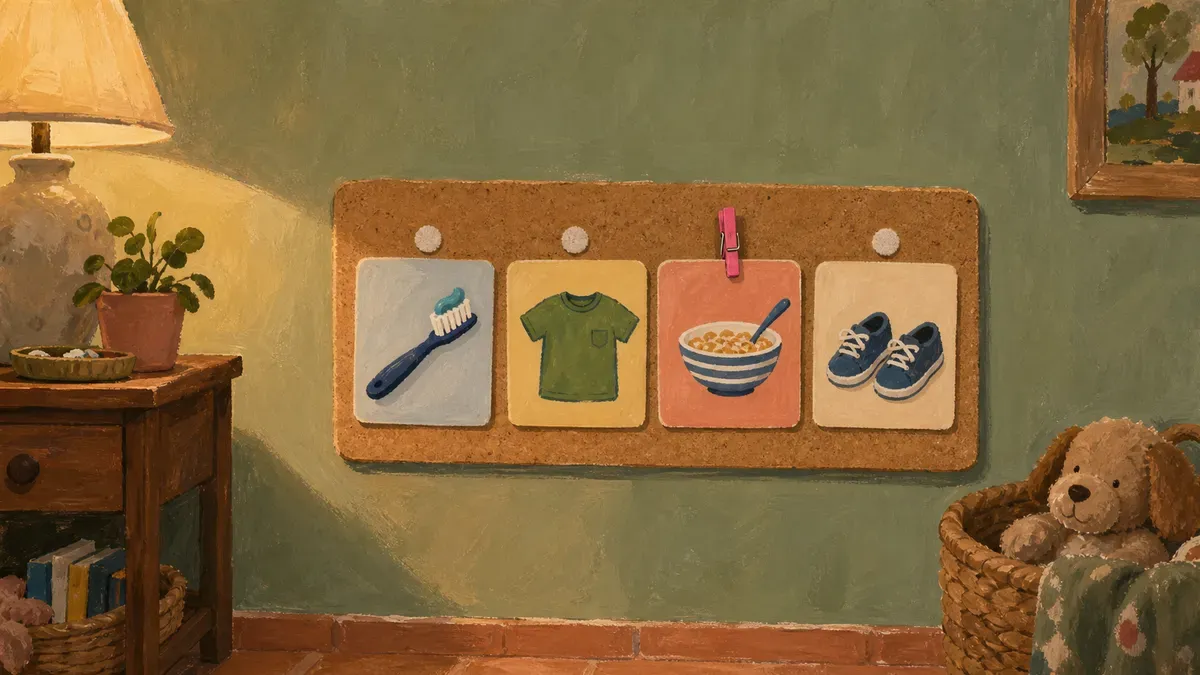
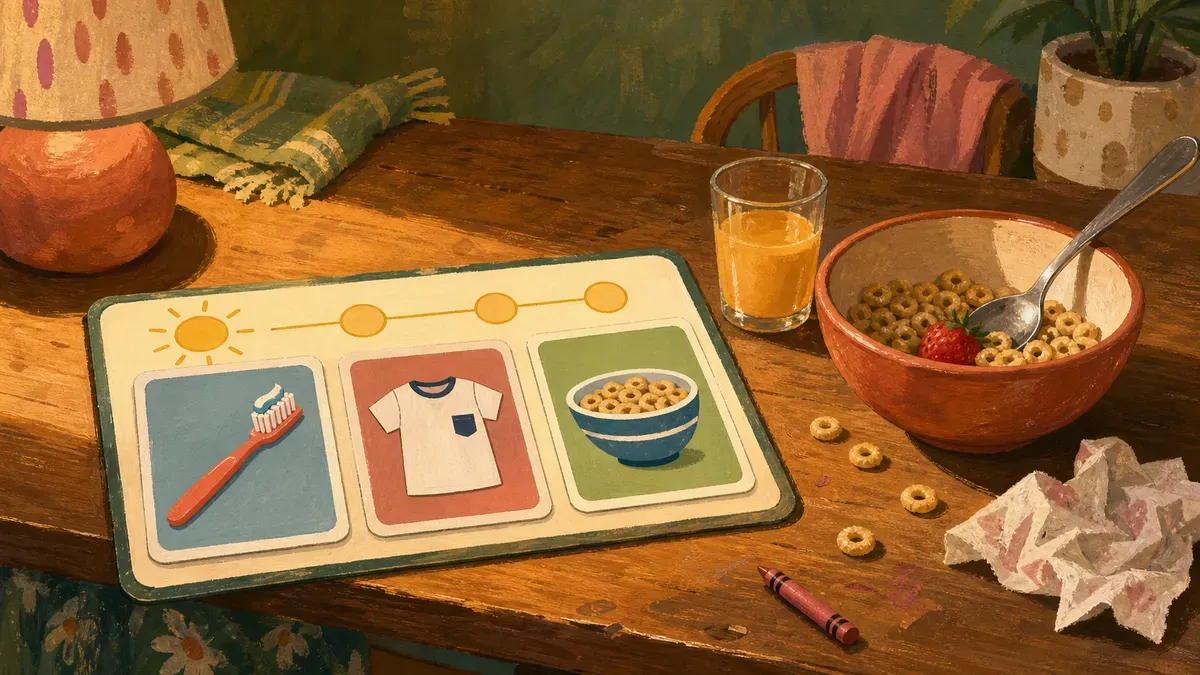
Posting all 20 cards at once overwhelms most toddlers. Stick to the next 3 to 6 in any given routine, so the board shows what’s happening in the next hour, not the whole day. Think of it as a first-then board scaled up just slightly: breakfast, teeth, shoes. That’s enough.
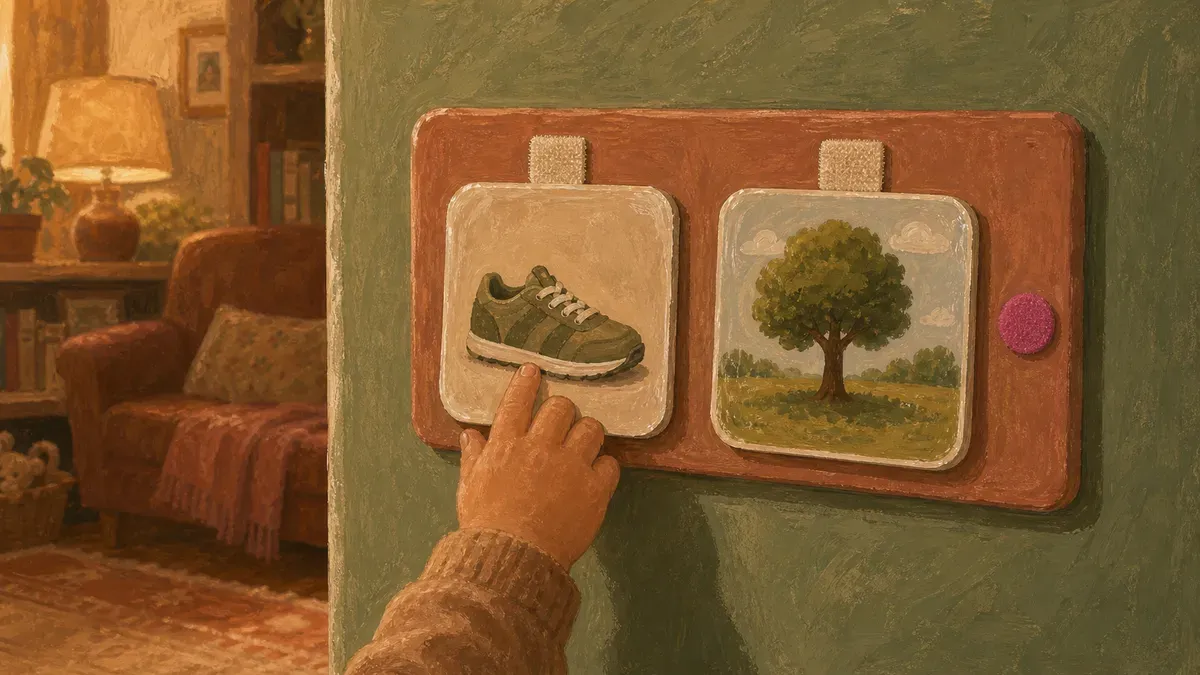
As the routine sticks over a week or two, you can add a card. The movable icons make this easy. You’re just sliding one more into place. When your toddler starts peeling the routine cards off confidently without prompting, that’s the signal to expand. If she freezes or skips the board entirely, pull it back to three. The goal is a sequence short enough to feel doable, not a chore.
For more on sizing the board, read up on many pictures should toddlers visual schedule to find the right count for your child’s routine.
Introducing Cards to a Resistant Toddler
Some kids ignore the board for a week. That’s normal. Don’t force it.
Start by pointing to each card yourself before the transition happens, with no expectation that your toddler will do anything. “Look, the picture says snack. Let’s go get snack.” You’re modeling, not demanding. Eli’s OT called it “letting the wall do the talking.” You just need a visual cue repeated calmly, not a power struggle.
After a few days of consistency, try waiting a beat before you name the card. See if your child glances at it first. When they do, make a thing of it. “You looked at your schedule!” counts.
The first time they finish a routine without you prompting each step is when the board starts working. It usually comes in week two, not day one.
Adapting the Cards for Autism, ADHD, and Special Needs
The 20-card set is a starting point, not a ceiling. Some kids need steps broken smaller before any of it clicks.
When to Add More Detail or a First-Then Board
If your child stalls at a card instead of acting on it, the task is too big. “Get dressed” is four tasks. Break it into individual visual schedule icons: underwear, pants, shirt, shoes, in order. That’s making the invisible steps visible.
For a child with autism or ADHD who struggles with anxiety around transitions, add a first-then board: one icon on the left (first: shoes), one on the right (then: outside). It shrinks the demand to one step at a time. The TEACCH program, developed at UNC, is built on this logic: explicit sequential steps, visual supports, repeated structure.
If your child has an IEP, a first-then board is often already written in as a support. Our visual schedule autism guide has a printable version, and our complete visual routines hub covers the full system.
Found this useful? Save it for the next rough afternoon.
Questions parents ask me about this
Where can I find a free visual schedule printable for toddlers?
The free printable in this post includes all 20 cards covering morning, daytime, and bedtime routines. Print it at home on card stock, laminate, and it's ready to use. Most free versions you find are printable PDFs you can download immediately and print the same day.
What size should I print the picture cards?
Print at full size, which typically comes out around 3x3 or 4x4 inches per card. Big enough that your toddler can see the picture clearly, small enough to handle easily. Scaling down loses detail in the clipart; scaling up makes the board unwieldy.
Do I have to laminate the cards?
You don't have to, but cards without lamination get wrecked fast. Toddlers peel, chew, and wave them around. A quick run through a home laminator keeps them intact for months. If you don't own one, most office supply stores laminate for a few cents a sheet.
What age should a toddler start using a picture schedule?
Most toddlers around 18 months can begin recognizing picture cards and understanding what they represent, even before they can talk about them. The card-count guidance in the morning routine section above applies here too, so start there and add cards gradually.
Are digital picture cards as effective as printed ones?
For most toddlers, a physical card on the wall beats a screen. A printed card doesn't require a device, doesn't ping, and doesn't accidentally switch to a video. Some kids respond well to tablet-based schedules, especially if a device is already part of their communication toolkit. Try print first and add digital only if it clicks better for your child.
How do I keep the schedule consistent between home and daycare?
Print a second set and send it with your child. Most teachers are happy to post a small personal schedule at the child's cubby. Take a photo of your home board so the daycare version matches the same pictures in the same order. Consistency between environments is what makes the cards click faster.
Can I use these cards for an after-school or bedtime routine too?
Absolutely. Pull the bedtime cards covered earlier, mount them near the bedroom, and run the same sequence every night. Once the routine is automatic, the cards can come down or stay up as a comfort anchor.
Written by
Nora Hayes
Mom of two and a former preschool aide. I share the screen-free sensory play and calm-down ideas I test at my own kitchen table, plus what the moms in my little meet-up swear by. A parent passing on what works, not a doctor or a therapist.
More about NoraKeep going
All Visual Schedules-
 Visual Schedules
Visual Schedules: A Beginner's Guide for Parents
Most visual schedules fail before day three. Learn how they work and build your first board in 5 steps your child will actually follow. Start today.
-
 Visual Schedules
Toddler Schedule: Build One With Picture Cards
Your 2-year-old can't read a clock yet. Build a toddler schedule with picture cards in 5 steps that stop nap fights and meltdowns. Start today.
-
 Visual Schedules
Free Printable Daily Routine Chart Kids Will Follow
Grab a free printable daily routine chart your child will actually follow, plus picture cards and tips to make any routine stick. Download now.
-
 Visual Schedules
Morning Routine Printable: Make One Kids Follow
Stop the morning yelling. This morning routine printable gets kids out the door on their own in 15 minutes. Grab the free chart and build it today.