Children's Schedules That Lower Back-to-School Stress

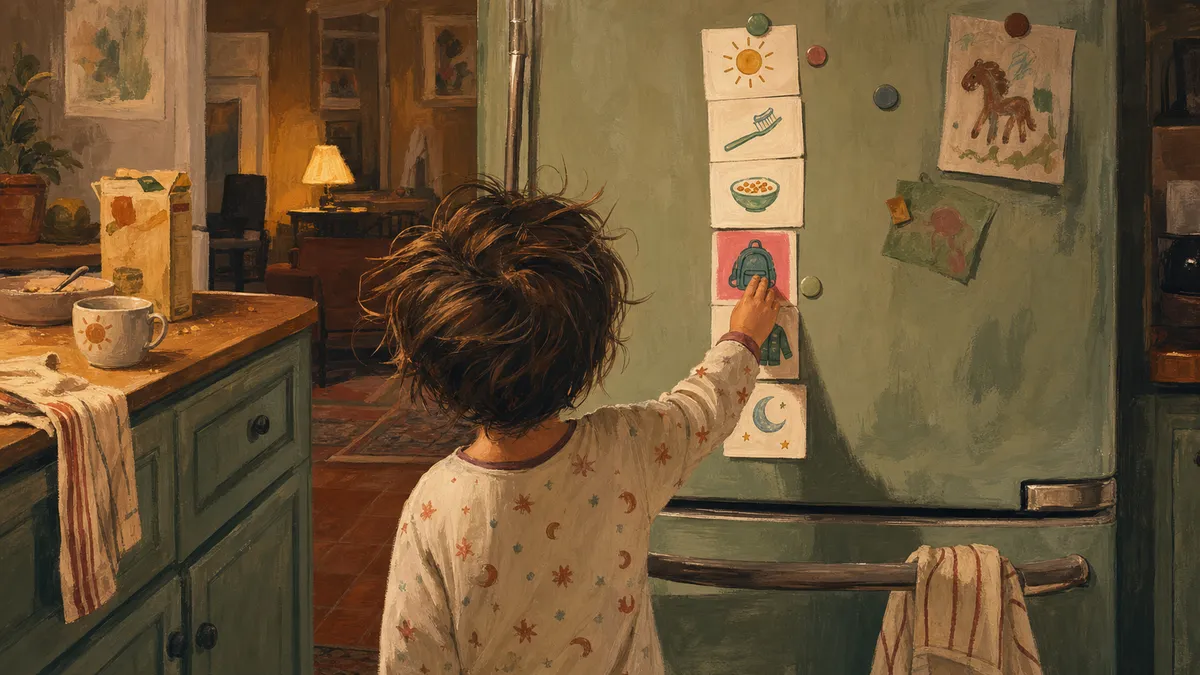
A back-to-school routine chart turns a chaotic morning into a sequence your kid can run themselves, with no nagging required. I’m Nora Hayes, a former preschool aide and mom of two, and when kids own the chart, mornings get calmer fast because the chart carries the instructions instead of you. Below I’ll walk you through building one step by step, sample children’s morning schedules by age, and what to do when your kid flat-out refuses the thing.
The plan in brief:
- List every morning task on a card, wake-up to out-the-door, in the order they happen
- Start the school-year wake time two weeks before the first day
- Hand the chart to your child and let them check off each step themselves
Why a Routine Chart Calms the Morning Rush
The morning chaos isn’t a discipline problem. It’s an information problem, and a chart solves it at the source.
The Hidden Cost of Nagging Through Every Step
Here’s what the nagging loop actually looks like:
- Every repeated “put your shoes on” transfers responsibility back to you, not them.
- The child learns the reminder is coming, so waiting costs nothing.
- Over weeks: you manage, they follow, independence stalls.
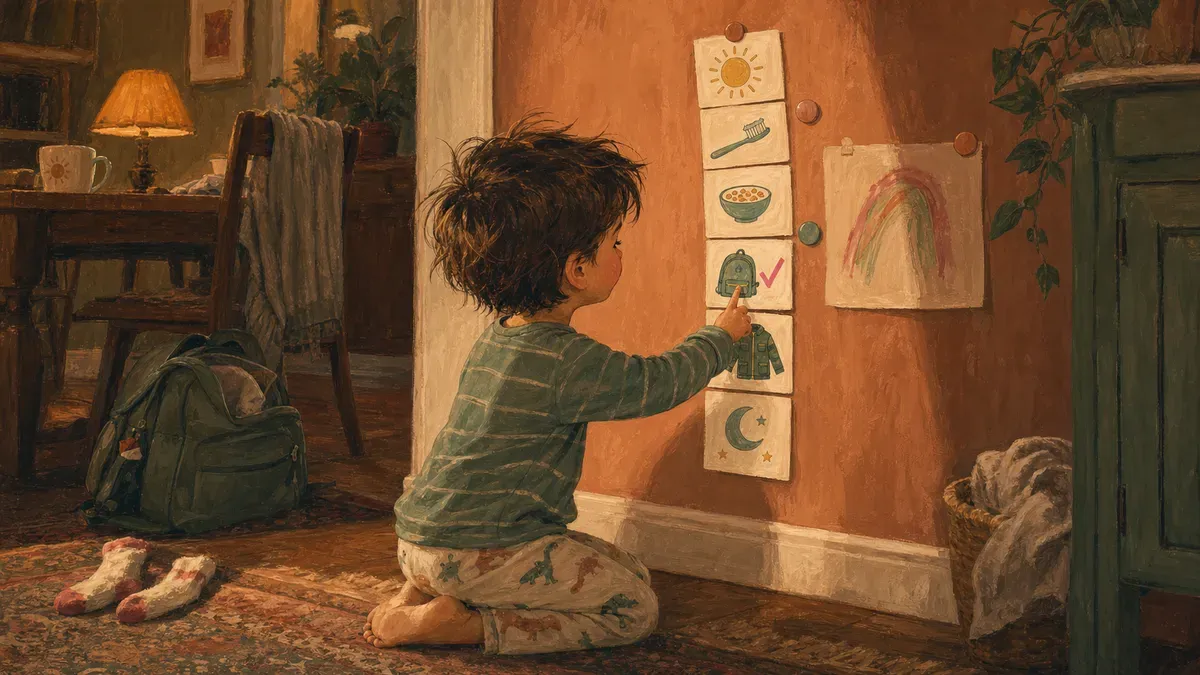
A visible chart flips that. When the next step is on the wall, your kid can check it without asking you. They’re not waiting for instruction; they’re running their own morning. That shift in ownership matters more than the chart looks. Kids who feel in control of their routine have fewer behavioral challenges at transition time, not because the chart is magic, but because it removes the friction of not knowing what comes next.
Pull them into building it using visual schedules and the buy-in multiplies. A child who picked the pictures and the order tends to actually use the thing.
How Predictability Lowers a Child’s Anxiety
Uncertainty is exhausting for kids. When a child doesn’t know whether breakfast comes before getting dressed, or if there’s time to finish the puzzle before the bus, that open loop runs as background noise all morning.
A routine chart closes those loops. Same steps, same order, every day. That predictability supports child development at this stage, and the evidence is specific: a 2024 study on routines and child wellbeing found children in consistent-routine households scored 5.0 points lower on emotional and behavioral difficulties, and parents’ own anxiety dropped 4.3 points too.
For sensory-sensitive or anxious kids, predictability matters even more. When the chart says “shoes, then backpack, then wait by the door,” the morning stops being a series of surprises. You can find more on building that structure with visual schedules routines that hold up past the first week.
Build Your Back-to-School Routine Chart in 5 Steps
The whole method fits in one breath: write down every morning step in order, put a picture next to each one, and hang it at your kid’s eye level where the morning actually happens.
- Sequence the steps from wake-up to door-close
- Give every step a picture so pre-readers can follow it
- Mount the chart at child height where the action happens
- Do the first walkthrough together, out loud
- Back off once the sequence sticks and let them run it

Map Each Morning Task in Order
Sit down on a quiet evening and walk your real morning, not the one in your head.
A solid backbone to steal: wake up, bathroom, get dressed, eat breakfast, pack the bag and check homework, then leave. That sequence comes from the Raising Children Network’s school morning routine guide, which also flags two easy wins, a predictable wake time and a little buffer before you head out the door.
Write each step on its own card.
Five or six steps is plenty. A twelve-step chart is a chart nobody reads.
If your kid melts down at socks every single day, give socks its own card and plan around it.
Pair Words With Pictures
A toothbrush by “brush teeth,” a bowl by “breakfast,” shoes by “shoes on.” This is the step that turns a list into a real visual schedule.
Here’s why it matters: a three-year-old can’t read “get dressed,” but she knows the shirt photo means go put clothes on. Pictures hand the chart to pre-readers and to the older kid who can read but stalls at a wall of text.
Clip art, a printed photo of your own kid doing the task, a quick doodle. Real photos win on engagement, because a picture of their toothbrush in their bathroom lands harder than a generic icon.
For a done-for-you version with the pictures already paired, this children’s morning routine chart saves you the print-and-cut night.
Post It Where Mornings Happen
A chart in the hallway nobody walks past is a poster, not a tool. Hang it low and where the routine actually unfolds: by the closet for dressing, by the door for the bag.
Texas Rising Star, a state-accredited early-childhood quality program, recommends posting materials at children’s eye level, noting it helps kids feel connected and sparks conversation around what’s posted. Tape it at their height and the chart becomes something they work from, not look up at.
Run It With Your Kid the First Morning
Don’t just hang it and hope. The first morning, walk through the chart together out loud: “Okay, what’s next?” Point to each card, let them flip it or check it off, and stay close.
That first walkthrough is the one that matters. After a few days of doing it together, most kids start glancing at the chart on their own before you say a word.
Let Your Kid Take It Over
Step five isn’t something you do. It’s something you wait for. Once they’ve got the sequence in their body, they stop asking you what comes next.
Give them a way to mark each step done: a velcro check, a flip card, a dry-erase tick. That small physical action is what makes the chart theirs instead of yours.
Sample School-Morning Schedules by Age
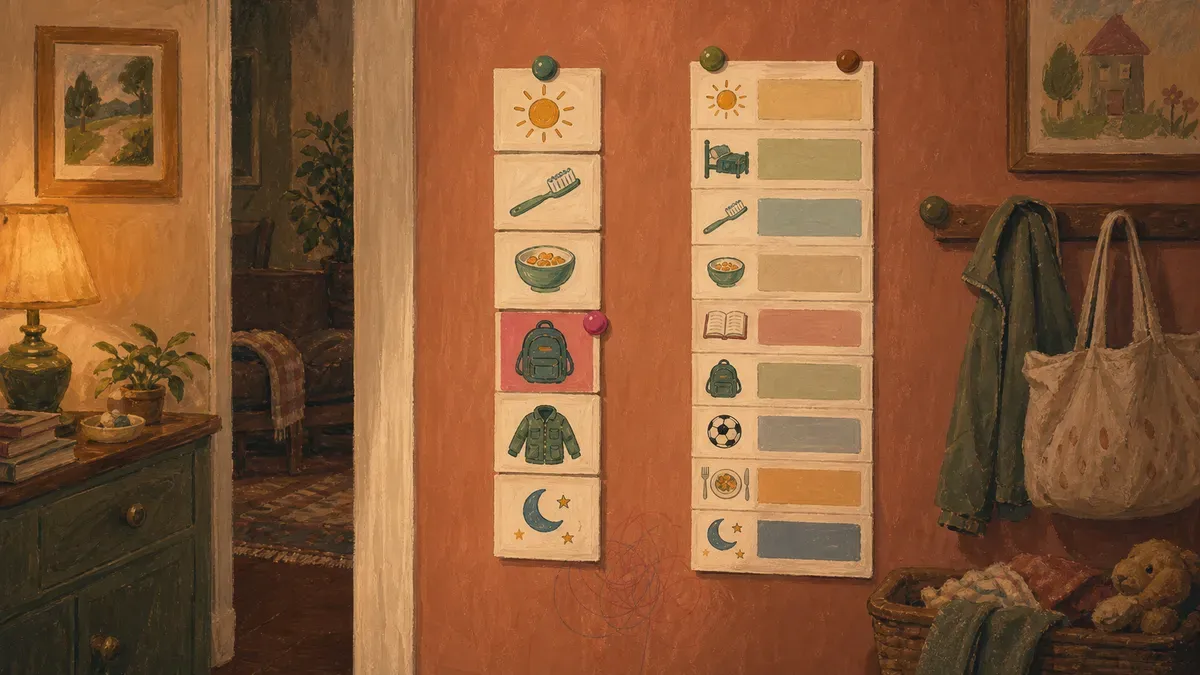
A five-year-old and a fourth-grader need different charts, so here are two starting points you can copy tonight and tweak by Friday, plus a way to stretch the whole thing across the week.
Preschool and Kindergarten Mornings
Little kids move slow and they get stuck on every step, so keep it short and picture-heavy. Five or six cards is plenty here, each with a photo big enough to read across the room.
- Wake up and a morning hug
- Potty and wash hands
- Get dressed (clothes laid out the night before)
- Breakfast
- Shoes and backpack
- Out the door
Give a preschooler extra cushion on the clock. A four-year-old can hold focus for roughly 8 to 12 minutes at a stretch, per child attention-span guidance from CNLD, so an age-appropriate visual schedule expects wandering and builds that slow pace in instead of fighting it.
Elementary-Age Mornings
Older kids can carry more, so the chart grows. Add the steps that actually trip up a school morning: the homework folder nobody packed, the dish nobody cleared.
- Wake up, bed made
- Bathroom and dressed
- Breakfast and clear your plate
- Pack homework and water bottle
- One quick chore (feed the dog, wipe the counter)
- Shoes, coat, out
By second or third grade, swap some pictures for word labels as reading clicks in. The chart stops being something you read to them and becomes something they read alone, which is the whole point: an age-appropriate setup that hands over independence one notch at a time.
Building the Whole Week, Not Just Mornings
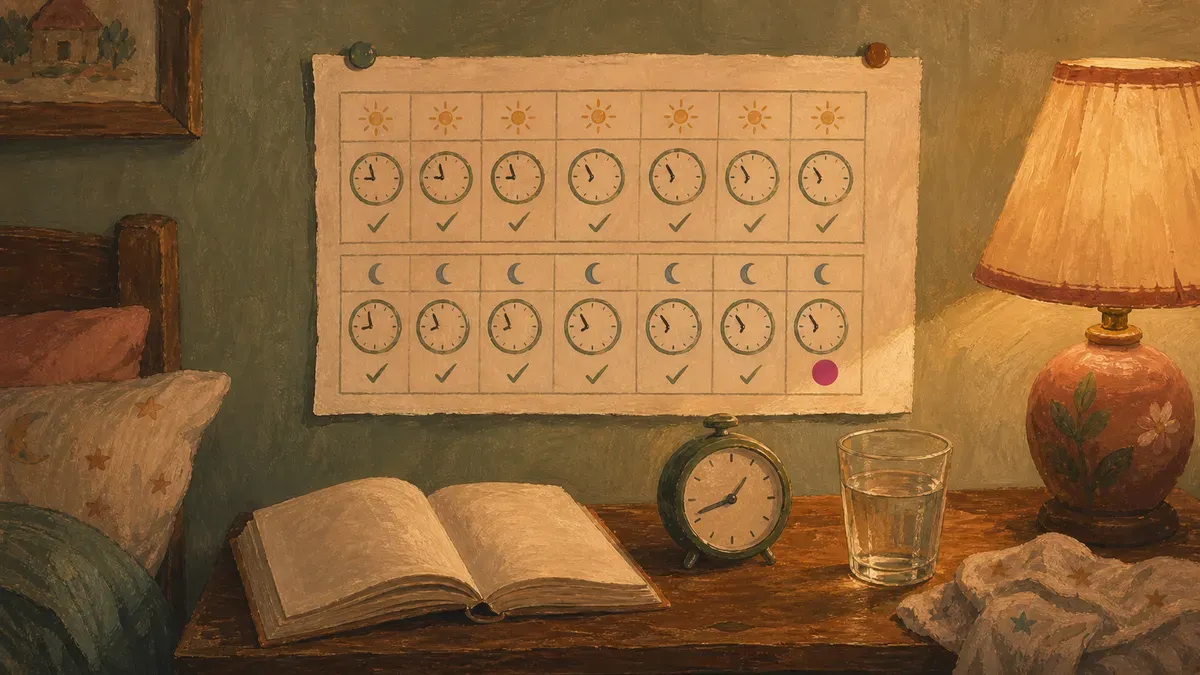
Mornings are the hard part, but a kid runs smoother when the rest of the day has the same shape. Turn the morning chart into a children’s weekly planner and you cover the other rough patches too.
The after-school landing is its own minefield: backpack dumped, snack, the screen time negotiation. Spelling it out with after school routine cards kid falls back on settles that fight before it starts. Add a bedtime row and you close the loop.
Consistency here pays off at night. A 2018 review found that keeping a steady bedtime routine five or more nights a week was tied to earlier bedtimes and fewer night wakings in young kids, summarized in this Sleep Medicine Reviews analysis. Same rhythm, fewer fights, all week long.
Easing the Summer-to-School Transition
A chart only lands if your kid’s body is ready for it, so the two weeks before day one matter as much as the chart itself. Start with sleep, then do a dry run of the whole thing.
Shift Wake and Bedtimes Gradually
Don’t yank a kid from 9am summer wake-ups to a 7am alarm on the first morning of school. That first day is brutal enough. Instead, nudge it. Dr. Allison H. Clarke, a pediatric psychologist at Lurie Children’s, suggests waking kids about 15 minutes earlier than their summer wake time, then moving that wake-up another 15 minutes earlier every few days until you hit the school-day time, in these recommended sleep guidelines for school-age children. Start a few weeks out and it’s barely noticeable.
Bedtime follows the same slow creep earlier.
- Pull lights-out back in the same small steps so they’re actually tired at the new hour, not lying there wired.
- An earlier wake-up only sticks if bedtime moves with it.
- Hold the rhythm on weekends too. One Saturday sleeping in undoes a week of nudging.
Do a Practice Run Before Day One
A couple of days before school, run the whole chart for real.
- Same wake time, same sequence: breakfast, dressed, backpack at the door
- Real conditions, no pressure: the predictability of the real thing without the stakes
- You’ll catch the snag (the missing shoes, the step that runs twice as long) while there’s still time to fix it
Familiarity is the point. The Child Mind Institute notes that letting kids visit the new building ahead of time, dropping off a form or just walking the halls, helps them cope ahead and shrinks first-day nerves. Your home practice run does the same job for the morning itself.
- Build in a little flexibility and swap a step if it flops.
- For the full reset, walk through our back school routine reset guide.
Run it once, and the real first morning feels like the second.
When Kids Resist the Chart
Even a tested chart hits a wall when your kid decides it’s your idea, not theirs. Two fixes usually melt the standoff: hand them part of the wheel, and make finishing feel a little like winning.
- Let your child pick the order, choose pictures, and color the cards. Ownership beats arguments.
- Add a small sticker or Friday treat for a full week, so finishing feels like winning.
- Keep the reward tiny; the chart stays the star.
Let Your Child Help Build It
The fastest way to lose a kid is to hang a finished chart and announce the new rules. Hand them the decisions instead. Let them pick the order of the morning, choose the pictures, color the cards, decide whether the dog gets a square. Suddenly it’s their plan, not your rule, and the power struggle has nowhere to go.
That shift isn’t just a nice feeling. Letting kids make real choices is a core piece of autonomy support, and guidance on routines for kids with ADHD in Frontiers in Psychology ties that kind of provided choice to stronger executive-function skills, the very planning muscles a chart is trying to build.
A chart your kid helped design is one they’ll argue to keep, not argue to ditch.
Keep their input visible. June drew lopsided suns on her wake-up card and points to them every morning. The wobbly art is half the engagement, and her motivation to run her own plan beats any tidier version I’d have made.
Add Light Rewards Without Bribery
For an ADHD or strong-willed kid, the chart sometimes needs a little spark.

Keep it light. Checking off each finished card is its own small hit of done. Add a sticker, or a Friday treat for a full week, and you’ve gamified the routine without turning it into a paycheck.
Rewards land especially well with ADHD brains. ADDitude Magazine, citing peer-reviewed research, notes these kids learn tasks faster under steady positive reinforcement, because the reward helps the brain connect to the task.
The line to hold: the reward stays small and the chart stays the star. If the prize gets bigger than the routine, you’ve bought a bribe. Keep it tiny, keep it consistent, and let finishing be most of the win.
Found this useful? Save it for the next rough afternoon.
Questions parents ask me about this
What daily schedules work best for young children at home?
Simple and short beats elaborate and thorough. Preschoolers do well with five or six picture cards covering the basics: wake up, bathroom, get dressed, breakfast, pack bag, out the door. Elementary kids can handle a few more steps and can start reading word labels alongside pictures. The key is keeping each card to one task and posting the chart where the routine actually happens.
How long does it take for a routine chart to actually work?
Most families notice the nagging drops after about two weeks of consistent use. The first few days are the learning curve. You're still prompting, the child is still checking with you. Once they've run the chart enough times to internalize the sequence, they start checking the chart instead of you. Consistency across all seven days matters here; weekends that skip the chart restart the clock.
Should the chart use velcro, dry-erase, or laminated cards?
All three work. The format matters less than whether your child can interact with it. Velcro cards let kids physically move completed tasks, which adds a satisfying kinesthetic element. Dry-erase works well for kids who like checking off. Laminated cards with a wet-erase marker split the difference. Pick the one you'll actually set up and maintain.
How do I keep the routine going on weekends and holidays?
Hold the same wake time and the same basic sequence, even if the destination changes. The chart doesn't have to list "school." It lists the tasks, and those stay the same. On weekends without school, swap the pack-bag card for something else, but keep the morning flow intact. A routine that only runs five days a week takes longer to stick than one that runs seven.
What if my child can't read yet?
Pictures are the whole point for pre-readers. Use real photos of your child doing each task: getting dressed in their actual room, eating at your actual table. Generic clip art works, but real photos get more engagement and feel more personal. By first or second grade most kids naturally start reading the word labels you add underneath, so the pictures quietly double as a bridge to print literacy.
Do routine charts work for kids with ADHD or autism?
Visual schedules are one of the most widely used supports for both. For autistic kids, a predictable visual routine takes the guesswork out of what comes next, which is often where the anxiety lives before transitions. For kids with ADHD, the chart externalizes the sequence so the planning work shifts from their working memory to the wall. Pair the chart with small, consistent positive feedback and keep adjusting until the format matches how your specific child takes in information.
Written by
Nora Hayes
Mom of two and a former preschool aide. I share the screen-free sensory play and calm-down ideas I test at my own kitchen table, plus what the moms in my little meet-up swear by. A parent passing on what works, not a doctor or a therapist.
More about NoraKeep going
All Visual Schedules-
 Visual Schedules
Visual Schedule Printable: 20 Picture Cards + Free PDF
Visual schedule printable with the 20 picture cards every toddler home needs. Free PDF to download, print, and start using tonight.
-
 Visual Schedules
Visual Schedules: A Beginner's Guide for Parents
Most visual schedules fail before day three. Learn how they work and build your first board in 5 steps your child will actually follow. Start today.
-
 Visual Schedules
Toddler Schedule: Build One With Picture Cards
Your 2-year-old can't read a clock yet. Build a toddler schedule with picture cards in 5 steps that stop nap fights and meltdowns. Start today.
-
 Visual Schedules
Free Printable Daily Routine Chart Kids Will Follow
Grab a free printable daily routine chart your child will actually follow, plus picture cards and tips to make any routine stick. Download now.