Visual Schedule Autism at Home: The No-Overwhelm Setup

Some links here are affiliate links. If you buy through one, I may earn a small commission at no extra cost to you. As an Amazon Associate I earn from qualifying purchases. I only point to things I'd actually use with my own two.
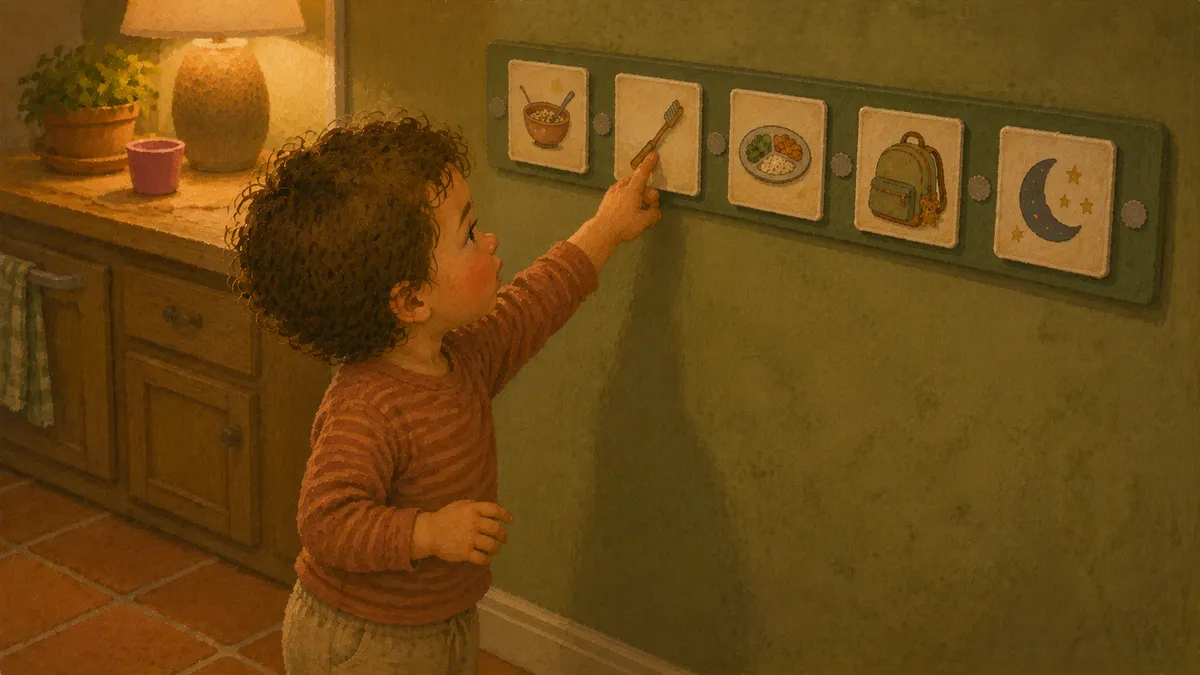
A visual schedule autism families use at home is simpler than it sounds: four or five picture cards on a strip showing what comes next. I’m Nora Hayes, former preschool aide and mom to autistic Eli, and a schedule taped to our bathroom wall took our mornings from chaos to calm. This guide covers how to build one, what to put on it, and what to do when your kid ignores it.
The plan in brief:
- Choose one stressful routine and photograph or draw 3-5 picture cards for it.
- Mount the strip at your child’s eye level where the routine happens, and walk through it together twice.
- Fade your prompts over 1-2 weeks until your child checks the schedule independently.
Why Visual Schedules Work for Autistic Kids at Home
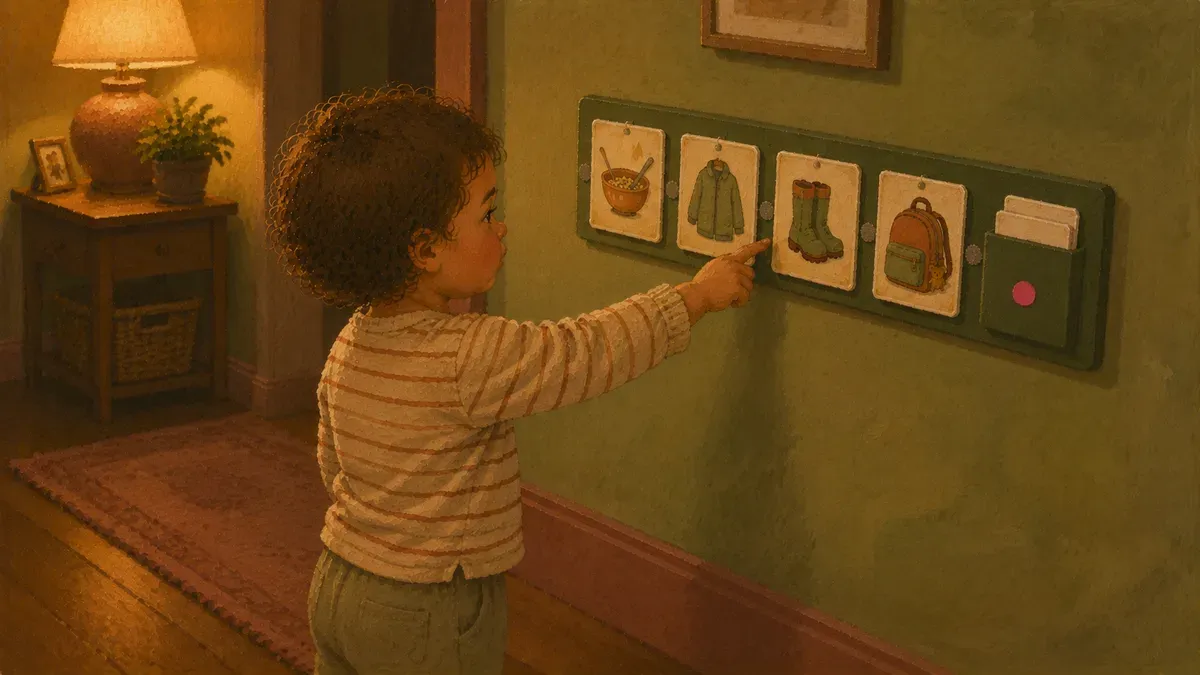
Most autistic kids aren’t resistant to routines. They’re resistant to surprises. When Eli was four, transitions sent him into a spiral almost every time, not because he was being difficult but because he genuinely couldn’t predict what was coming next. A visual schedule fixes that: it makes the invisible sequence of the day visible, concrete, and reliable.
The research backs this up. The National Professional Development Center reviewed 18 single-case design studies and found visual supports effective for preschoolers through high school-age learners with ASD. And the 2020 NCAEP report, the most comprehensive review of autism interventions to date, listed Visual Supports as one of 28 evidence-based practices, covering schedules, first-then boards, and visual cues across settings.
What makes visual schedules and autism such a good match at home specifically? A few things.
Visual schedules work at home for three connected reasons:
- Memory-free — pictures don’t require your child to hold verbal instructions in working memory, which is a hard ask for many autistic kids.
- Always consistent — the schedule doesn’t have a bad day, forget to warn about the dentist, or change its tone depending on how stressed you are.
- Builds independence — once it’s running, your child stops depending on you to announce what’s next.
Anxiety around transitions goes down when the sequence is predictable, and predictability is something you can create tonight with a printer and some velcro.
How to Set Up a Visual Schedule for Autism Step by Step
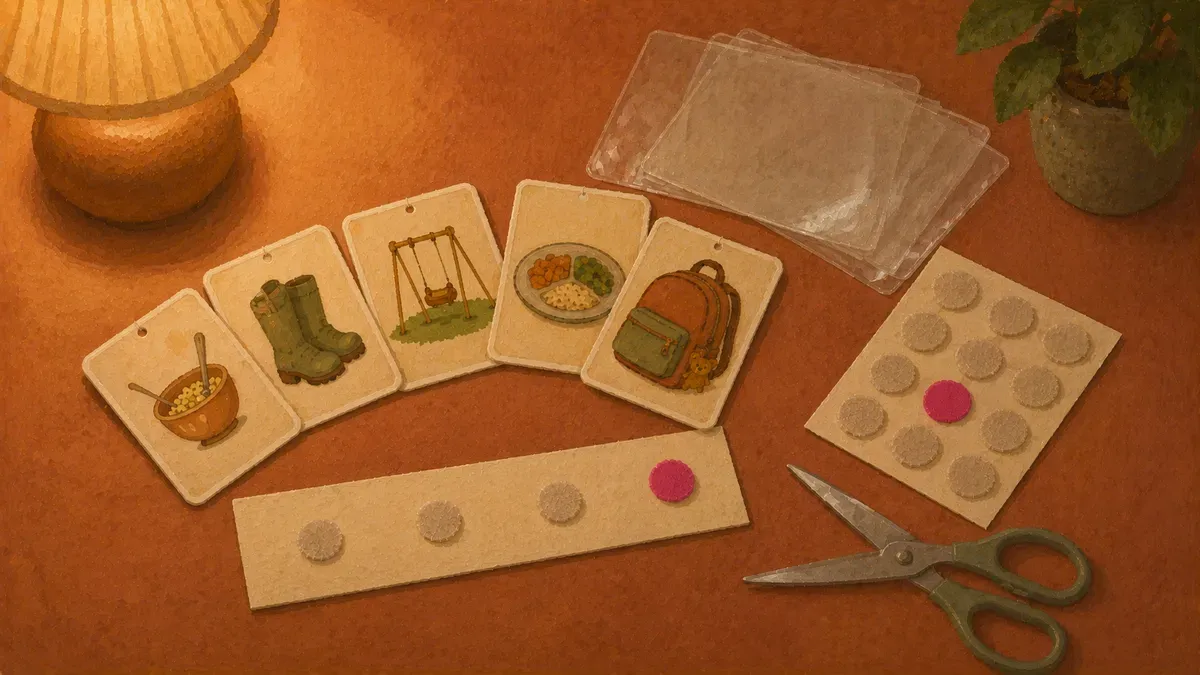
Knowing visual schedules work is different from actually having one on your wall. Here’s how to get from zero to a working autism schedule in three steps. Use this as your visual schedule template whether you’re starting completely fresh or rebuilding something that stopped working.
- Pick one routine — choose the single most stressful routine, keep it to 3-5 picture cards.
- Choose the right visual format — objects for young/nonverbal kids, photos next, then icon drawings.
- Mount it and model it daily — place it at eye level where the routine happens, walk through it together, then fade your prompts over 1-2 weeks.
Step 1: Pick One Routine and Keep It Small
Don’t try to schedule the whole day on week one. Pick the single routine causing the most friction — mornings for most families, but after-school or bedtime for others. Keep the first schedule to 3-5 picture cards, or start with a first-then board (just two cards) if your child has never used visuals. A working 4-card schedule beats an ignored 12-card one.
Step 2: Choose the Right Visual Format for Your Child
There are three progressive levels, and the right one depends on your child’s developmental level (not their age):
- Object schedule — an actual object represents each activity (a cup for snack, a towel for bath). Best for very young or nonverbal children who need something concrete.
- Photo schedule — real photographs of your child doing each activity, or of the actual items in your home. Works well once a child reliably recognizes images.
- Icon schedule — line drawings or symbols, which is what most printable autism picture schedule cards use. Ready for this when your child understands that a drawing stands in for the real thing.
If you’re unsure which level fits, ask your child’s OT or ABA therapist — they’ve already assessed where your child sits developmentally, and matching the visual type to that level is the standard recommendation.
Step 3: Mount It and Model It Daily
Place the strip where the routine actually happens and at your child’s eye level — not in a folder somewhere.
For the first week, walk through it together every single time: point to each card, name the activity, do it, flip or remove the card. The hook-and-loop dots let your child physically move the card to a “finished” pocket — a concrete done-signal for kids who need clear start/stop cues.
Prompt-fading sequence over 1-2 weeks:
- Week 1: you point and name each card.
- Week 1-2: you just point, no narration.
- Week 2+: you wait. They check it themselves.
When your child walks to the board unprompted, points to the first card, and starts the task on their own — that’s the whole system working.
What Goes on a Visual Schedule: A Simple Materials List
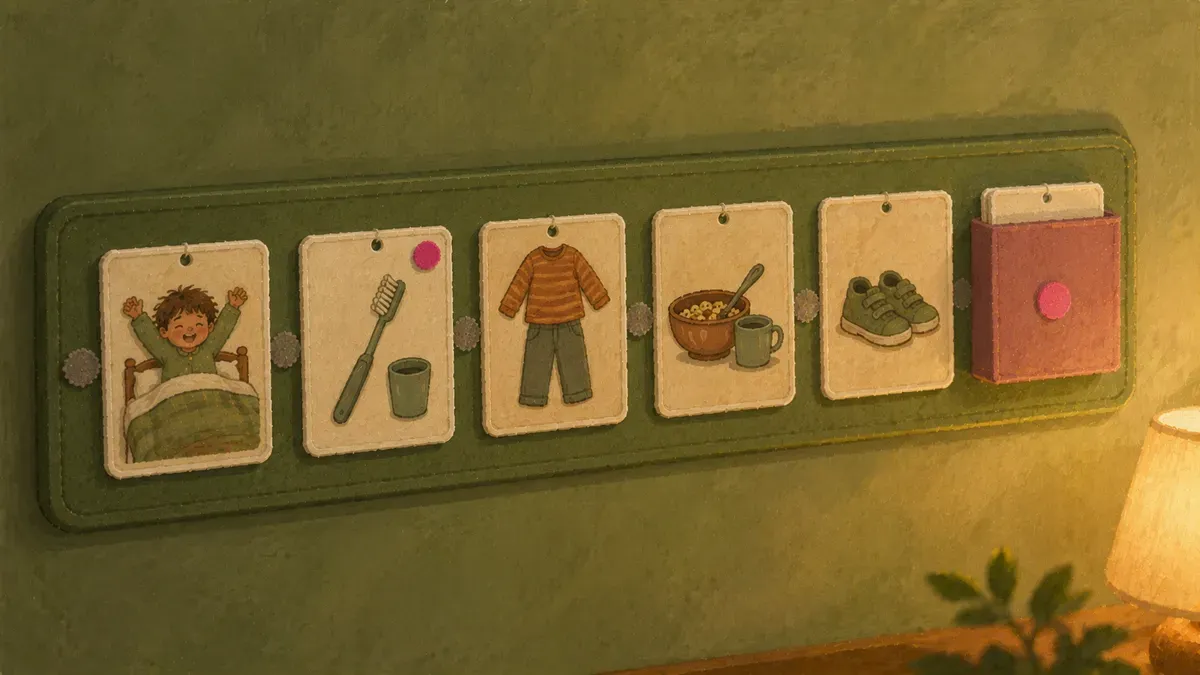
You don’t need a specialty kit or a therapy supply catalog. Here’s what actually goes into a functional home visual schedule, and you probably already own half of it.
What you need:
- Cardstock, not regular paper — printer paper tears the first week; cardstock survives the daily pull-off-and-put-back. I keep a multipack of colored cardstock around (100 sheets, 50 colors, 4.8 stars from 700-plus buyers) so I can color-code by routine, one shade for morning cards, another for bedtime.
- A printer — color is better but not required. Black-and-white icons work fine for many kids.
- A laminator — borrow one or grab a cheap home model. You can skip it, but laminated cards last months instead of days; an un-laminated card peels apart by day two and gets abandoned by day three.
- Laminating pouches — one 100-pack of letter-size pouches outlasts every schedule you’ll build this year. The box I reach for is an Amazon’s Choice pick with over 100,000 reviews, which is really just every teacher and therapist buying the same one.
- Hook-and-loop dots (velcro) — rough side on the board strip, soft side on the back of each card. One bag of 1,000 self-adhesive dots (500 pairs, 4.7 stars) covers years of cards before you’ll reorder. This is what lets your child physically move cards to the “finished” spot.
- The picture cards themselves — printed icons, real photos you take with your phone, or hand-drawn images. The format depends on what level your child is at.
- A schedule strip or board — a laminated strip of cardstock, a cheap dollar-store picture frame, a piece of foam board, or a length of ribbon with pockets. This doesn’t have to be fancy. Eli’s first one was a strip of cardboard taped to the bathroom wall.
For a checklist on choosing between velcro, laminated, and dry-erase formats, see the printable blank visual schedule template guide — it breaks down which physical format holds up best for different kids and routines. You can also download a free printable visual schedule for autism directly from that page, including blank visual schedule pages sized for standard laminating pouches and free printable visuals for autism covering morning, meal, and bedtime activities.
A daily strip of 4-7 cards arranged left to right is the most common configuration for home ABA visual schedules. Left to right mirrors reading direction and makes the sequence feel natural for most kids. If your child scans vertically or uses a different format at school, match that.
When Your Child Ignores the Visual Schedule
Here’s the frustrating part nobody tells you: the schedule working on day three and being ignored on day ten is completely normal. It doesn’t mean the system is broken. It usually means one of a handful of specific things went sideways — and each one has a fix. A written schedule for autism homes needs the right conditions to take hold.
The most common reasons a visual schedule stops working:
- They were following you, not the board
- It was introduced during a stressful moment
- The reinforcement dropped off
- Too many cards added too fast
- The format no longer matches where they are developmentally
In the first week you were pointing, narrating, and walking them through every step. When you started backing off, there was nothing else pulling them to the board. The fix: stand behind them, guide their hand to point at the card, then step back.
Three common reset moves when the schedule loses traction:
- Reintroduce during a calm practice run before a preferred activity, not mid-chaos.
- Pair schedule-following with a small preferred reinforcer — a verbal acknowledgment or sticker chart works.
- Pull back to the card count that was working before, then expand again more slowly.
If you added cards as things went well, you may have crossed the overwhelm line. Pull back to the number that was working, then add up again more slowly.
Kids change. Visual schedules and autism work together best when the format reflects where your child actually is developmentally right now, not where they were six months ago. Regular updating is part of the system, not a sign it failed.
If you’re hitting a specific wall around a refusal, the toddler wont follow visual schedule 9 guide goes deeper into the behavioral side of schedule resistance and what to do when the standard troubleshooting isn’t moving the needle.
Free Printable Visual Schedule Cards for Autism
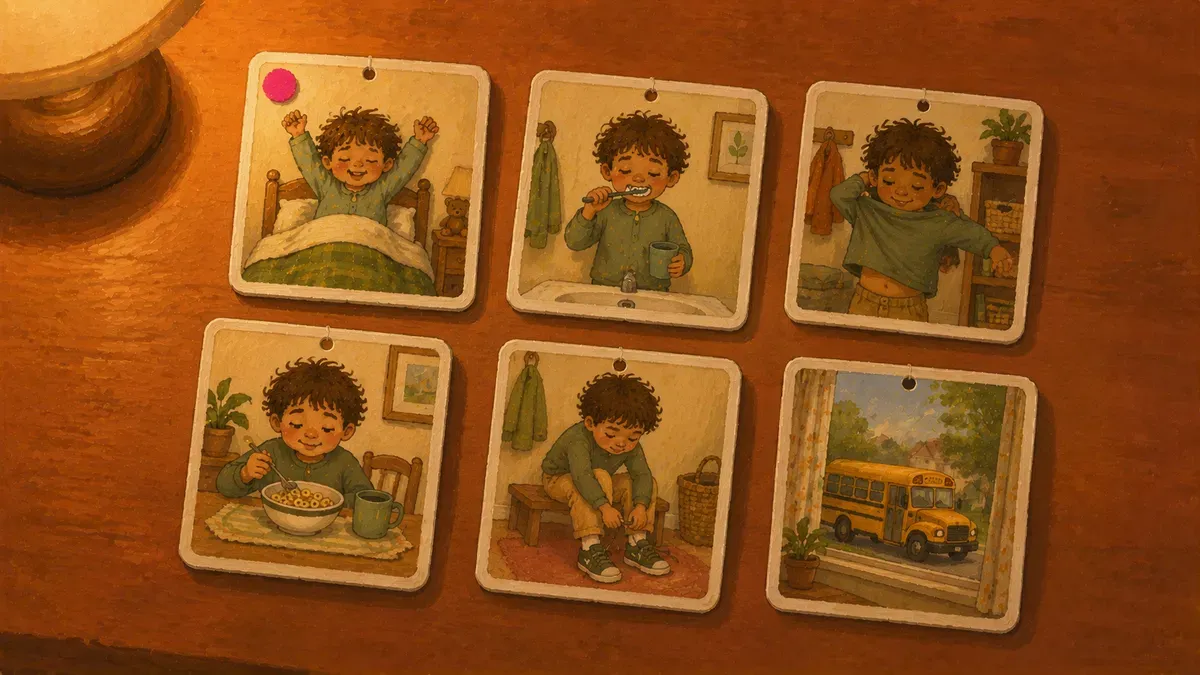
Before you buy anything, it’s worth knowing how much is free. Several reliable sources offer autism visual schedule printables at no cost — and some of what’s out there is genuinely good.
For free printable visuals for autism, the places I come back to:
- Do2Learn (do2learn.com) — has hundreds of free printable picture cards covering daily living, emotions, and community activities. Basic icons, functional, and easy to print.
- LessonPix — offers free sample packs and a searchable symbol library. The paid version lets you customize cards with your child’s name and photos, but the free tier covers the basics.
- Smarty Symbols — clean line drawings that work well for icon-level schedules. Free to search and download individual cards.
- CARD at University of Florida (card.ufl.edu) — parent resources including free visual support guides that pair well with the printable cards above.
If you want to make your own, phone photos of your actual child doing each activity are the best option for kids who need a photo schedule. Print on cardstock, laminate, add velcro.
For a bigger set of ready-to-use cards covering morning, after-school, and bedtime routines, the visual schedule printable collection on this site includes autism visual schedule printables in both icon and photo-realistic formats, sized for standard laminating pouches. Print once, laminate once, use for years.
Most sources above offer autism visual schedule printables as free PDF downloads — just print and go. If your child does better with more realistic images, free visual pictures for autism in PDF format are also available through Do2Learn and LessonPix’s sample packs, no account required.
Whatever source you use: print on cardstock, not regular paper. Cards that survive the daily pull-off-and-replace get used; ones that bend and tear get abandoned.
How Visual Schedules Fit Into ABA Therapy at Home
If your child is in ABA therapy, visual schedules aren’t a parallel track — they’re part of the same system. The 2020 NCAEP report lists Visual Supports as one of 28 evidence-based practices for autism, spanning preschool through adulthood. Your child’s therapist is almost certainly using visual supports during sessions already.
What that means at home: the more closely your home schedule mirrors what happens in sessions or at school, the faster the learning generalizes. Same icons, same left-to-right sequence, same finished pocket. When a child sees an identical schedule at home and at therapy, they’re not learning two systems — they’re reinforcing one. That’s the whole point of generalization, and it’s why ABA home therapy guidance consistently emphasizes using matching materials.
Three ways to align your home schedule with therapy or school:
- Ask the therapist or teacher which icon set they use and request a copy.
- Match the physical format (left-to-right strip vs. top-to-bottom column) to whatever your child sees at school.
- Use the same “finished pocket” or card-removal gesture the therapist uses so the cue means the same thing everywhere.
If you don’t know what your child’s therapist or teacher is using, ask. Most will happily share the icon set or send you home with a copy of the school schedule to replicate. The visual supports you build at home are most useful when they’re consistent with what your child encounters in every environment.
For more on building the full routine system that visual schedules sit inside, the visual schedules routines hub covers how morning, after-school, and bedtime schedules connect and how to layer them without overwhelming your child.
And if you’re weighing whether autism visual schedules or a different visual support approach fits your specific situation, the autism visual schedule guide looks at the research on what works across different autism profiles.
Found this useful? Save it for the next rough afternoon.
Questions parents ask me about this
How do visual schedules help autistic children at home?
Visual schedules make the sequence of daily activities visible and predictable, which reduces the anxiety that comes from not knowing what comes next. For many autistic children, the hardest part of transitions isn't the activity itself but the uncertainty around it. A picture strip removes that uncertainty without requiring verbal prompts every few minutes, and over time children learn to check the schedule themselves rather than waiting to be told.
At what age should you start a visual schedule for an autistic child?
Most families start as early as age 2 or 3, using simple two-card first-then boards before moving to longer strips. There's no minimum age -- the format just needs to match where the child is developmentally. A toddler who isn't yet recognizing pictures would start with an object schedule (a real object represents each activity) and move to photos and icons as their visual recognition develops.
How many pictures should be on an autism visual schedule?
Start with 3-5 cards for a brand-new schedule user. That's enough to create predictability without overwhelming. A first-then board -- just two cards -- is even simpler and a good starting point for children who have never used visuals before. As the routine becomes familiar, you can add cards gradually. Most functioning daily strips run 4-7 cards.
What is the difference between a first-then board and a full visual schedule?
A first-then board shows only two steps: what the child is doing right now, and what comes next. It's the simplest form of visual support and works well for children who aren't ready for a longer sequence, or as a bridge during an especially difficult transition. A full visual schedule shows the whole routine -- 4, 5, or more steps -- so the child can see the arc of the activity, not just the next move.
Can you use a visual schedule on a tablet or phone app?
Yes -- apps like Visual Schedule Planner, ChoiceWorks, and First Then Visual Schedule work well for some children, especially older ones who are already comfortable with devices. The main advantage is portability and easy editing. The main downside for younger or lower-tech kids is that a physical card they can touch and move is often more meaningful than a screen they tap. Many families use both: a physical strip at home and an app for transitions out in the community.
How long does it take for an autistic child to learn to follow a visual schedule?
Most children show meaningful engagement within 1-2 weeks of consistent daily use, but independent schedule-following -- checking it themselves without a prompt -- often takes 4-6 weeks of gradual prompt fading. The timeline depends heavily on how consistently the schedule is used and whether the format matches the child's current level. A schedule that's too complex or introduced inconsistently will take much longer to take hold.
Do visual schedules need to match what the child does at school or therapy?
Matching the format as closely as possible speeds up generalization -- when the child sees the same icons and the same sequence in multiple environments, they don't have to relearn the system each time. Ask your child's teacher or ABA therapist what icon set they're using and whether you can get a copy to replicate at home. Even matching the physical format (left-to-right strip versus top-to-bottom column) makes a difference.
Written by
Nora Hayes
Mom of two and a former preschool aide. I share the screen-free sensory play and calm-down ideas I test at my own kitchen table, plus what the moms in my little meet-up swear by. A parent passing on what works, not a doctor or a therapist.
More about NoraKeep going
All Visual Schedules-
 Visual Schedules
Visual Schedule Printable: 20 Picture Cards + Free PDF
Visual schedule printable with the 20 picture cards every toddler home needs. Free PDF to download, print, and start using tonight.
-
 Visual Schedules
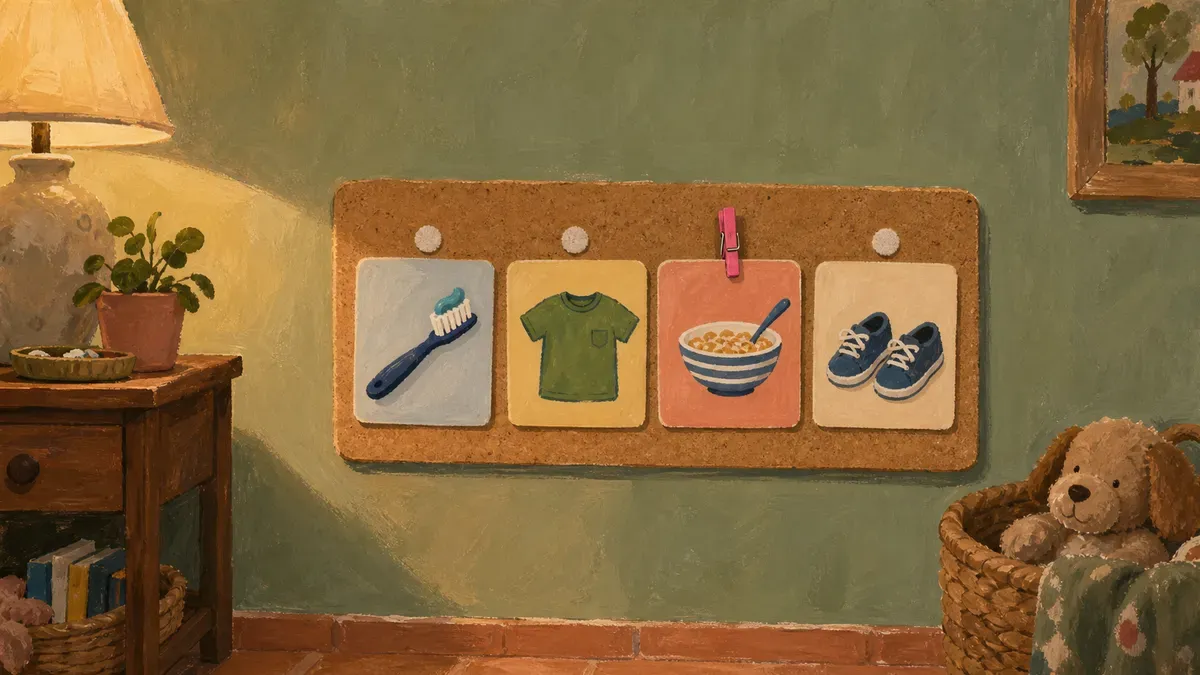
Visual Schedules: A Beginner's Guide for Parents
Most visual schedules fail before day three. Learn how they work and build your first board in 5 steps your child will actually follow. Start today.
-
 Visual Schedules
Toddler Schedule: Build One With Picture Cards
Your 2-year-old can't read a clock yet. Build a toddler schedule with picture cards in 5 steps that stop nap fights and meltdowns. Start today.
-
 Visual Schedules
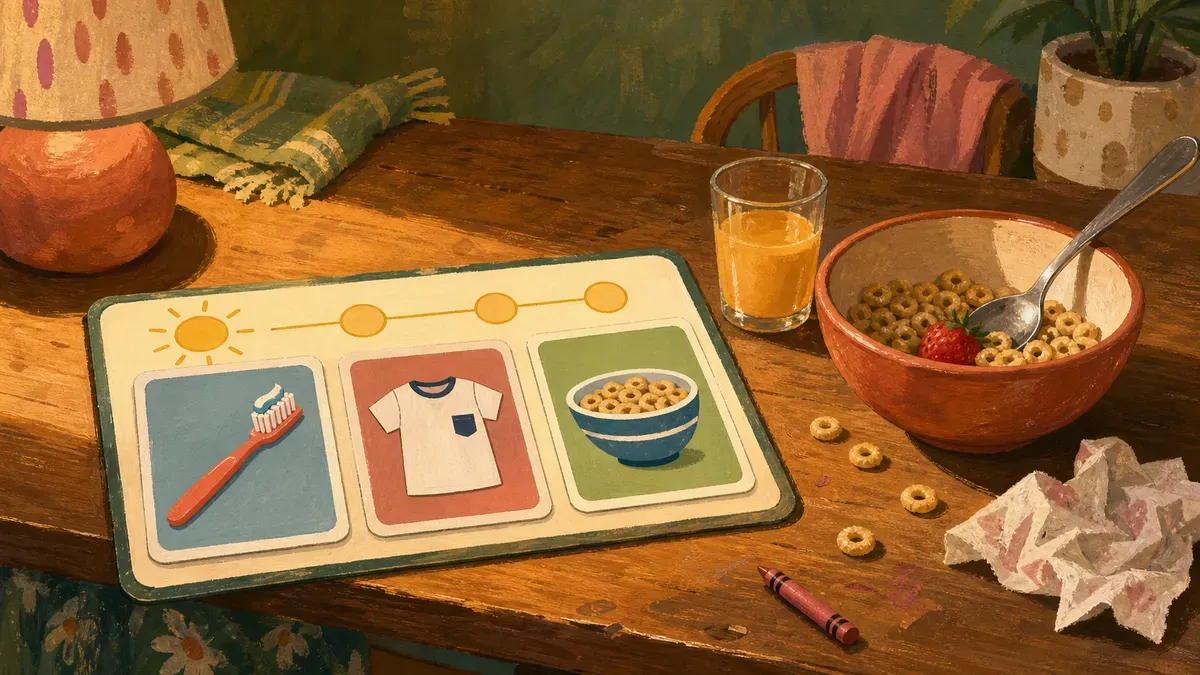
Free Printable Daily Routine Chart Kids Will Follow
Grab a free printable daily routine chart your child will actually follow, plus picture cards and tips to make any routine stick. Download now.