Bedtime Routines for 3 Year Olds That Stick

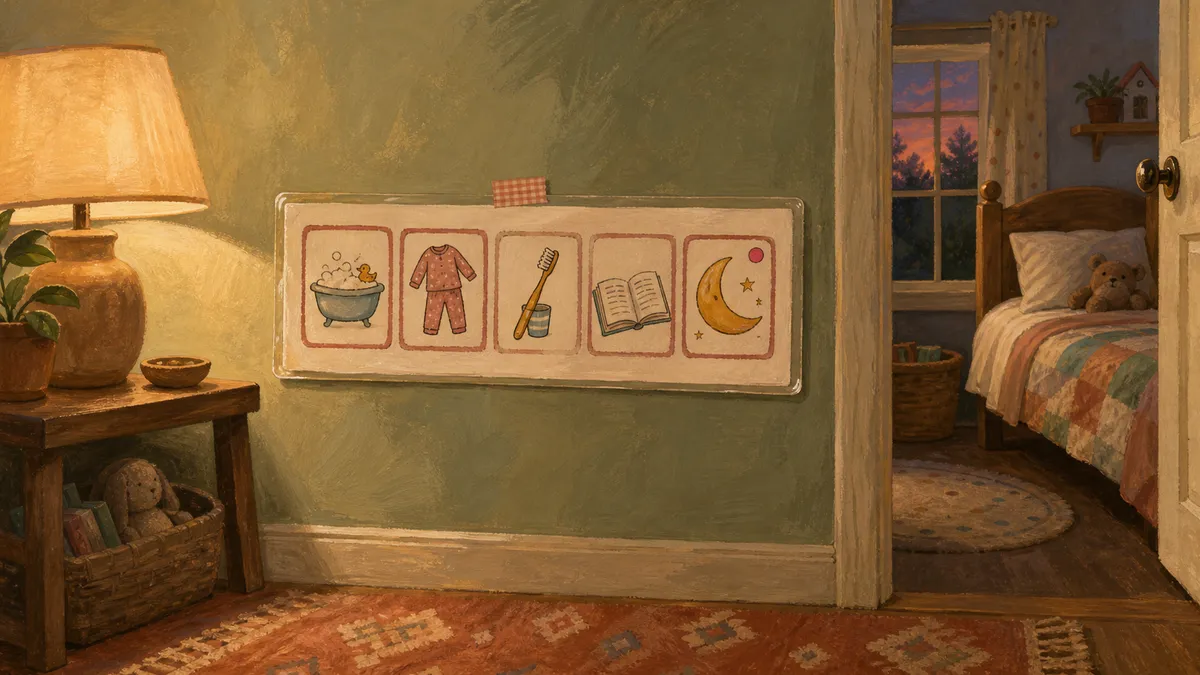
I’m Nora Hayes, former preschool aide turned stay-at-home mom, and I’ve discarded three bedtime routine charts before I understood why they kept failing. A study in the journal SLEEP found that a consistent nightly routine reduces night wakings and shortens how long toddlers take to fall asleep, and the research tracks: the chart itself rarely fails, the setup around it does. Here’s what finally worked for bedtime routines for 3 year olds (and younger toddlers), so you stop rebuilding from scratch every few weeks.
The plan in brief:
- Pick exactly 4-5 steps and put them in picture form on the chart. No more.
- Start the routine 45 minutes before target lights-out, every night including weekends.
- Let your toddler take charge of each step themselves so they own the sequence.
Why Most Bedtime Routine Charts Stop Working After a Week
Most toddler bedtime routine charts fail for the same three reasons:
- Too many steps (eight is not five)
- Hung where the parent can see it, not where the child can reach it
- No role for the kid in running it
The other thing parents don’t account for is the consistency gap. A bedtime routine chart works by training your toddler’s brain to expect a predictable sequence at a predictable time. Miss two nights in a row and that prediction breaks. Research published in Frontiers in Sleep found that consistency at 12 months predicted lower behavioral dysregulation three months later, which tells you the payoff isn’t just sleep tonight but regulation patterns over time.
Two signs your toddler is past the bedtime window, not being difficult:
Bedtime battles have a physical layer that gets missed. - Wired and climbing furniture at 7:30 PM (cortisol, not energy)
- Meltdown at dinner when they were fine at 5 Both mean the night time routine chart window has already passed. The fix isn’t a better chart design. It’s starting earlier and cutting steps.
For more on building predictable daily systems that actually hold, the hub on visual schedules routines covers the framework behind why visual sequences work for toddlers and when to use them.

The bottom line: a toddler bedtime routine chart fails when adults design it for adults. Fix the step count, the timing, and who runs it, and you have a different tool entirely.
The Bedtime Routine for 3 Year Olds That Actually Works
Once you fix the chart’s design problems, the routine itself is simple. Here’s what the five steps look like and why the timing and the child’s role matter as much as the sequence.
The 5 Steps (and Why Fewer Is More)
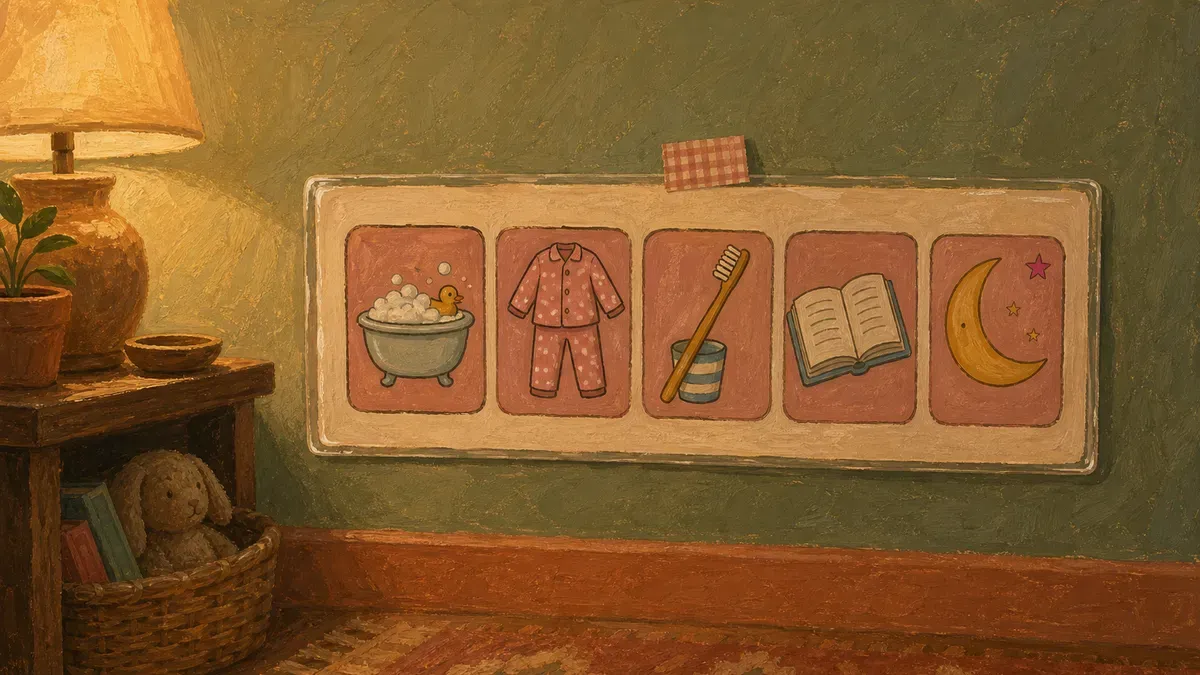
The routine that has held for June goes bath, pajamas, brush teeth, one book, lights out. That’s five steps. Not six, not seven. Five.
- Bath
- Pajamas
- Brush teeth
- One book
- Lights out
When I was working as a preschool aide, I watched parents hand kids schedules with eight or ten items and wonder why the routine fell apart by step four. Preschoolers and toddlers alike bail not because they’re difficult but because they can’t hold a long sequence in mind. A review in Sleep Medicine Reviews found that routines with the best outcomes share three traits:
- Brief (20-45 minutes total)
- Predictable in sequence every night
- Focused on calming activities only Longer and more variable routines performed worse. Five steps clears all three. That matches what I’ve seen: the toddler bedtime routine that sticks is the one they’ve memorized, not the one that’s thorough.
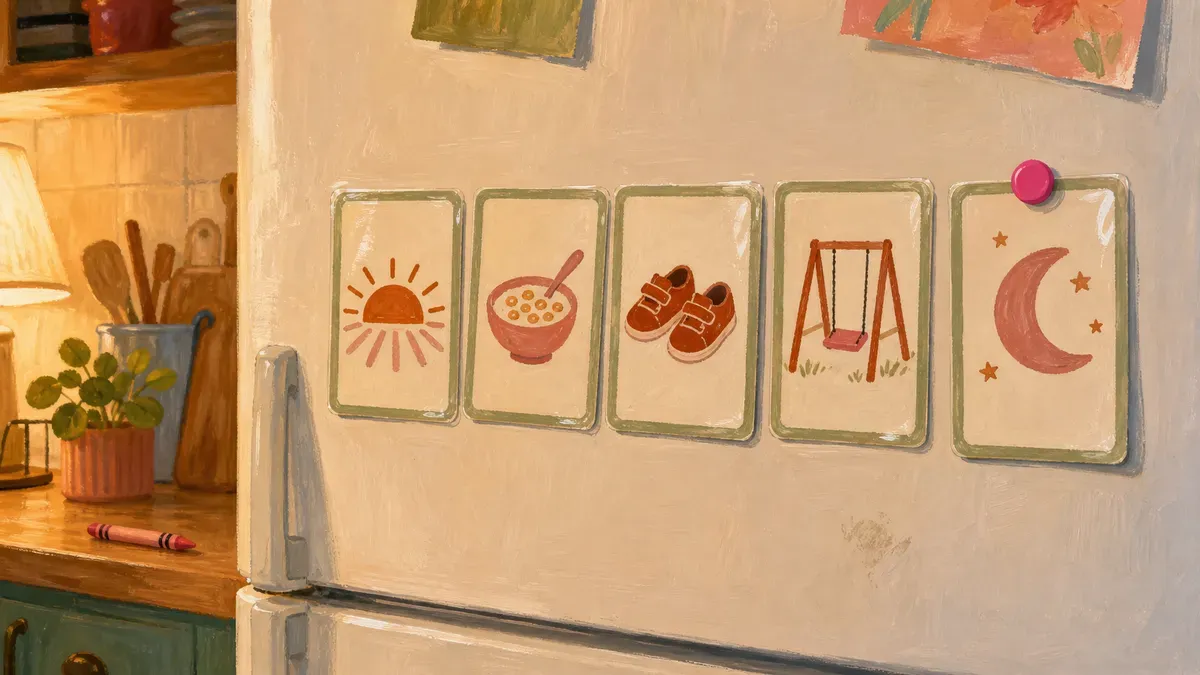
For the toddler bedtime routine chart itself, picture cards work better than words. For preschoolers starting to recognize letters, a word underneath the icon makes it a reading moment without slowing things down. Stick to icons or photos your child recognizes. Laminate it. Put it at their eye level, not yours.
What Time Should a Toddler Go to Bed?
The AASM, endorsed by the AAP, recommends 10-13 hours of sleep per 24 hours for 3-5 year olds and 11-14 hours for 1-2 year olds. For a child waking at 7 AM, that puts most 3 year olds needing to be asleep by 7-9 PM.
Bedtimes by age vary, but the mistake is starting too late. Stanford Children’s Health notes that toddlers’ natural sleep drive peaks between 7 and 8 PM, and delaying past 8:30 PM can trigger cortisol that makes it harder to fall asleep. That’s the second-wind problem: bedtime for 2 year old and 3 year old alike needs to start when the window opens, not after it’s closed.
Quick bedtime window guide by age:
- 1-2 year olds: 7:00-7:30 PM lights out
- 3-4 year olds: 7:30-8:00 PM lights out
- Start the wind-down 45 minutes before target sleep time
What time should a toddler go to bed? Earlier than feels right, with a firm wind-down start time you actually hold.
The Toddler’s Role: Why They Need to Run It
June doesn’t follow the routine because I tell her to. She follows it because she flips each card herself after each step is done.
That’s not a trick. Ages 2-3 are the developmental peak of autonomy-seeking, and giving toddlers agency over predictable tasks reduces defiance, as research on toddler autonomy documents. When the routine is something done TO a child, resistance is the logical response. When they run it themselves, they’re not being told what to do next. They’re checking off what they already decided.
Best sleep schedules for toddlers aren’t about calming environment and parental presence alone. The child’s sense of ownership over the sequence is the difference between a chart they ignore and a chart that becomes self-soothing habit. Sleep association builds when the toddler independently walks through a known sequence, not when a parent directs each step.
If you want the same approach applied to mornings, the children’s morning routine chart uses the same card-flip method to get kids out the door without the daily negotiation.
Bedtime by Age: Adjusting the Chart as Your Toddler Grows
The same five-step chart doesn’t need to change as your toddler gets older. The bedtime window does. Here’s how to adjust the timing based on your child’s age and whether they’re still napping.
The AASM (endorsed by the AAP) sets the sleep duration targets that anchor this chart. For 1-2 year olds, that’s 11-14 hours per 24 hours including naps. For 3-5 year olds, it’s 10-13 hours.
| Age | Total sleep needed | Nap status | Target bedtime (7 AM wake) |
|---|---|---|---|
| 13-17 months | 11-14 hours | Still napping | 6:30-7:30 PM |
| 18 month old | 11-14 hours | Napping 1x | 6:30-7:30 PM |
| 2 year old | 11-14 hours | Napping (some) | 7:00-8:00 PM |
| 2.5 years | 11-14 hours | Nap transitioning | 7:00-8:00 PM |
| 3 year old | 10-13 hours | Nap optional | 7:00-8:30 PM |
| 3.5-4 years | 10-13 hours | No nap | 7:00-8:30 PM |
The bedtime by age chart above is a starting point. Watch for these overtired signs rather than the clock:
- Meltdowns at dinner when they were fine at 5
- Rubbing eyes by 6:30 PM
- Wired, climbing-the-walls energy around 7 PM
Any of those means the wake window has run too long.
Nap transition is the trickiest phase. A 16 month old dropping from two naps, an 18-month-old settling into one, and a 2-year-old phasing out the midday nap each need earlier bedtimes as the shift happens. As the nap disappears, the overnight sleep need increases and the bedtime window shifts earlier by 30-60 minutes. Earlier is almost always better during a nap transition period, even if it feels too early.

For a more complete toddler daily schedule that works around the sleep schedule, the toddler schedule resource covers morning to evening structure for 2 year olds.
On the bedtime routine chart itself, the steps stay the same at any age. The difference is that a 13 month old needs a parent present through more of the steps, while a 3 year old can flip cards and call out the next step themselves. The chart’s job is to hold the sequence. Your job is to follow the child’s developmental readiness for how much independence they take in running it.
When the Routine Breaks Down: How to Reset Without Starting Over
Every toddler bedtime falls apart at some point. Travel, illness, a grandparent visit, daylight saving time. You don’t need a new system. You need a three-night reset.
The three-night reset: Run the same steps in the same order for three consecutive nights without variation. That’s it. Most toddlers reconnect to the sequence within three nights because the sleep association is still there.
Here’s what to do when specific problems show up:
-
Bedtime resistance and stalling. Your toddler asks for water, another book, one more hug. Don’t add steps to address it. Tell them what comes after lights out: sleep. One return trip is allowed. After that, you don’t come back until morning unless something is wrong.
-
Night waking restarts. A sleep regression can break the routine without changing it. If your toddler is suddenly waking at 2 AM after weeks of solid nights, the routine itself probably isn’t the issue. Check for developmental leaps, illness, or a nap that shifted. The chart doesn’t need to change.
-
Consistency fell apart over a week or more. Start the routine 15 minutes earlier than usual for three nights. Earlier start, shorter total time, same steps. Tired kids reset faster than kids who go in already past the bedtime window.
-
New resistance to the chart itself. If your toddler has decided they hate the chart, take it down for two days and run the routine verbally. Then re-introduce the chart as something they get to help you put back up. Giving them a role in re-establishing it usually fixes the resistance.
For toddlers with a documented pattern of bedtime power struggles, the introduce visual schedule power struggle resource covers strategies specifically for children who resist being told what’s coming next.
The goal with any reset isn’t to enforce compliance. It’s to rebuild the predictability your toddler’s nervous system learned to rely on. Consistency for bedtime routines for 2 year olds and 3 year olds works the same way: three nights without deviation, then the routine runs itself again.
Making the Bedtime Routine Chart Stick Long-Term
A routine chart that lasted three weeks and then got ignored isn’t a failure of the chart.
The most common long-term killer is the parent running the routine instead of the child. Before, I called out every step. Then one night she just moved to the next without me. That moment when kids start running the bedtime routine themselves, without direction, is what makes the chart feel permanent instead of temporary.
A few things that hold it together month after month:
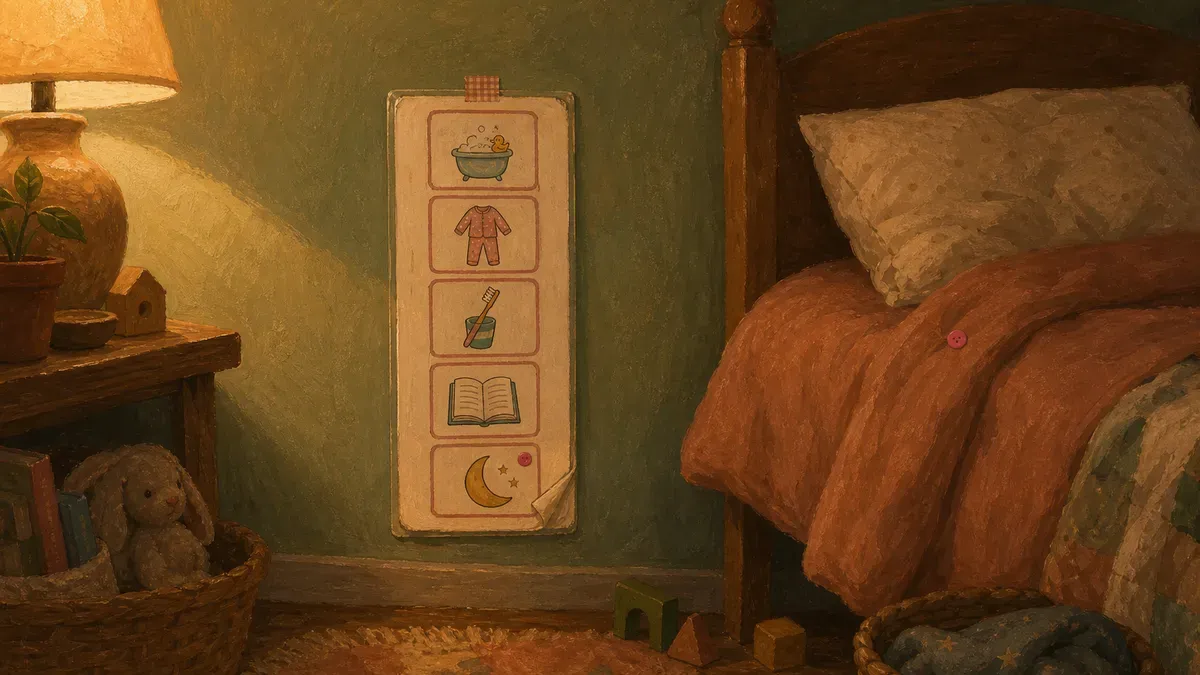
- Keep the chart at their height. If they can’t reach it, they’ll wait for you to run it.
- Don’t upgrade it when it works. Parents add steps when things are going well, and that’s exactly when it breaks. Five steps is enough.
- Replace it before it’s worn out. A faded chart loses authority. Print a fresh one every few months.
- Involve them in any change. Tell them the night before if a step shifts. Surprise changes are how bedtime battles restart.
A review in BMC Pediatrics found that the best predictor of long-term sleep outcomes for children was regularity of sequence, not any specific activity. The bath can move, the book can change. What cannot change is the order and the timing.
The visual schedule template walks through designing and printing picture cards for any routine, not just bedtime. For the full daily and weekly structure framework, the visual schedules routines hub covers it all.
The toddler bedtime routine chart that sticks isn’t the prettiest one. It’s the one your child runs themselves, at the same time, in the same order, every night.
Found this useful? Save it for the next rough afternoon.
Questions parents ask me about this
What bedtime routines actually work for 3 year olds?
The routines that hold are short (five steps or fewer), start at the same time every night, and let the child run the sequence themselves using a picture card chart. The steps matter less than the consistency of order and timing. Bath, pajamas, teeth, one book, lights out is a reliable sequence because each step is physical and clear.
How long should a toddler's bedtime routine take?
Around 20-45 minutes from first step to lights out is the range that works. Shorter routines tend to outperform longer ones when the sequence stays the same every night. If your routine is running past 45 minutes, cut a step rather than rushing through all of them.
What time should a 2 year old go to bed?
Most 2 year olds who wake between 6:30 and 7:30 AM need to be asleep by 7:00-8:00 PM. If they're still napping, bedtime can shift slightly later. If the nap is being dropped, bedtime usually needs to move earlier by 30-60 minutes during the transition.
What do I do when my toddler keeps stalling at bedtime?
Don't add steps to address the stalling. Run the routine to completion, tell your child that sleep comes next, and allow one return trip if they call out. After that, you don't go back unless something is wrong. Stalling almost always decreases within three to five consistent nights.
Does an 18 month old need a different bedtime routine than a 3 year old?
The steps can be identical. What changes is how much the parent runs it versus how much the child does. An 18 month old needs more parental involvement at each step. A 3 year old can flip the cards and call out each step themselves. The chart is the same. The ownership level shifts.
Should I include screen time in my toddler's bedtime routine?
No. Screen time in the hour before bed delays sleep onset because the light and stimulation work against the body's natural sleep drive. Remove screens from the routine entirely and replace them with a physical wind-down step like bath or books.
How many steps should a toddler bedtime routine chart have?
Four or five. That's the range most toddlers can track without the sequence falling apart. More than five steps and you'll typically see resistance or confusion at step four. Keep it to five, keep them in the same order every night, and let the child flip or check each card.
Written by
Nora Hayes
Mom of two and a former preschool aide. I share the screen-free sensory play and calm-down ideas I test at my own kitchen table, plus what the moms in my little meet-up swear by. A parent passing on what works, not a doctor or a therapist.
More about NoraKeep going
All Visual Schedules-
 Visual Schedules
Visual Schedule Printable: 20 Picture Cards + Free PDF
Visual schedule printable with the 20 picture cards every toddler home needs. Free PDF to download, print, and start using tonight.
-
 Visual Schedules
Visual Schedules: A Beginner's Guide for Parents
Most visual schedules fail before day three. Learn how they work and build your first board in 5 steps your child will actually follow. Start today.
-
 Visual Schedules
Toddler Schedule: Build One With Picture Cards
Your 2-year-old can't read a clock yet. Build a toddler schedule with picture cards in 5 steps that stop nap fights and meltdowns. Start today.
-
 Visual Schedules
Free Printable Daily Routine Chart Kids Will Follow
Grab a free printable daily routine chart your child will actually follow, plus picture cards and tips to make any routine stick. Download now.