AAC Devices vs PECS vs Communication Cards

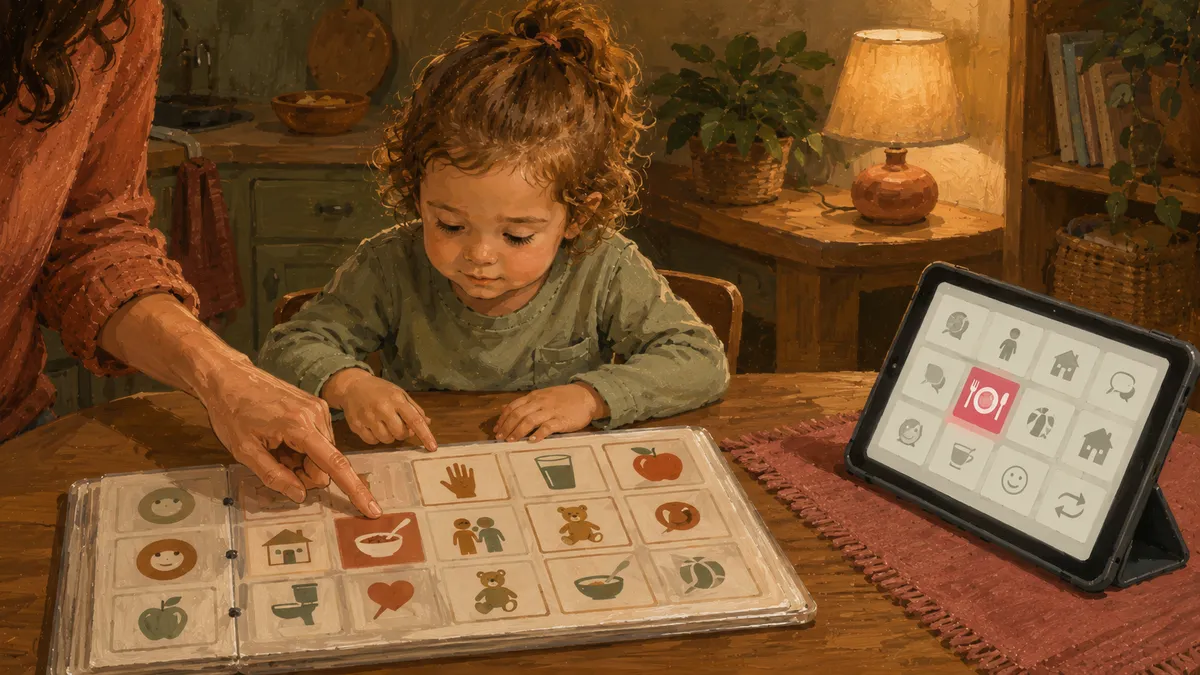
I am a parent sharing what worked at my house, not medical advice. For anything to do with your child's development or sensory needs, talk to your OT or doctor.
Some links here are affiliate links. If you buy through one, I may earn a small commission at no extra cost to you. As an Amazon Associate I earn from qualifying purchases. I only point to things I'd actually use with my own two.
Start with the option your child will actually pick up, not the one with the biggest price tag: low-tech communication cards for a kid just learning that pictures mean something, the structured PECS exchange for a child who needs the back-and-forth taught step by step, and a high-tech AAC device for one ready for a bigger vocabulary at their fingertips.
I’m Nora Hayes, a former preschool aide and mom of an autistic kid, and I’ve watched families burn money on a talker before their child was anywhere near ready.
We’ll lay PECS, picture cards, and speech-generating apps side by side, talk through which one fits which kid, and cover how to move up and what it costs, so the roughly 5 million Americans who may benefit from AAC get matched to the right tool instead of the loudest one.
What AAC Actually Means (and What It Doesn’t)
Before you can pick between cards, a PECS binder, or an app, it helps to know they’re all the same family. Here’s the plain definition, where each option sits on the spectrum, and who it’s actually for.
The Plain-English Definition
AAC stands for augmentative and alternative communication. That’s the long answer to what does AAC stand for, and honestly, the term sounds way more clinical than the thing itself.
Here’s the AAC meaning in real life: it’s any method that supplements or replaces talking.
- A laminated card your kid points to
- A board on the fridge
- A speech-generating device that talks for them
All of it counts.
The split is right there in the name. It’s augmentative when it adds to the speech a kid already has, and alternative when speech isn’t there or isn’t working yet. That distinction comes straight from professional guidance on augmentative and alternative communication, and it’s the cleanest way to understand what is AAC without a degree.
So if you’ve been wondering what does AAC stand for and assumed it meant some expensive piece of assistive technology, relax. A drawing of a snack works. The point is giving a kid a way to be understood.
Low-Tech vs High-Tech on One Spectrum
Think of AAC as a line, not a list of competitors.
On one end sits low-tech AAC: communication cards, a paper communication board, a PECS binder. No battery, no charging, nothing to crash. On the other end is high-tech AAC, the apps and dedicated devices with voiced output and a dynamic display that changes as your kid taps through it. The Indiana Resource Center for Autism describes exactly this continuum, and notes that most users mix tools from both ends.
That’s the part that trips parents up. Using AAC for communication doesn’t mean choosing one communication device and never looking back.
- Low-tech for the car, the bath, the spot where a tablet won’t survive
- High-tech for the bigger vocabulary your kid grows into
- Both at once, most days, because real life is messy
Which means the three communication devices in this article aren’t rivals fighting for one slot. They’re points on the same line, and plenty of kids land somewhere in the middle.
Who Benefits Beyond Autism
The assumption I bump into most, even from folks in our living-room group, is that an AAC device is an autism thing and nothing else.
It’s a big group, no question. A UK survey cited in ASHA’s AAC practice portal found autism made up 19% of AAC users, alongside Alzheimer’s or dementia at 23% and Parkinson’s at 22%. So an AAC for kids absolutely helps autistic kids, but the tools reach far past one diagnosis.
- Kids with apraxia who know the words but can’t get them out
- Children with cerebral palsy
- A grandparent with aphasia after a stroke
- Developmental delays where speech is just running late

That range is the whole point of alternative augmentative communication devices for autism and everyone else: meeting a person where their voice is, whatever the reason it’s quiet. For more on building those skills, see our complete communication and social skills hub.
PECS, Communication Cards, and AAC Apps Side by Side
Three tools, three completely different feels. Here’s what each one actually looks like in a living room, what it asks of your kid, and where each one tends to shine.
How PECS Works
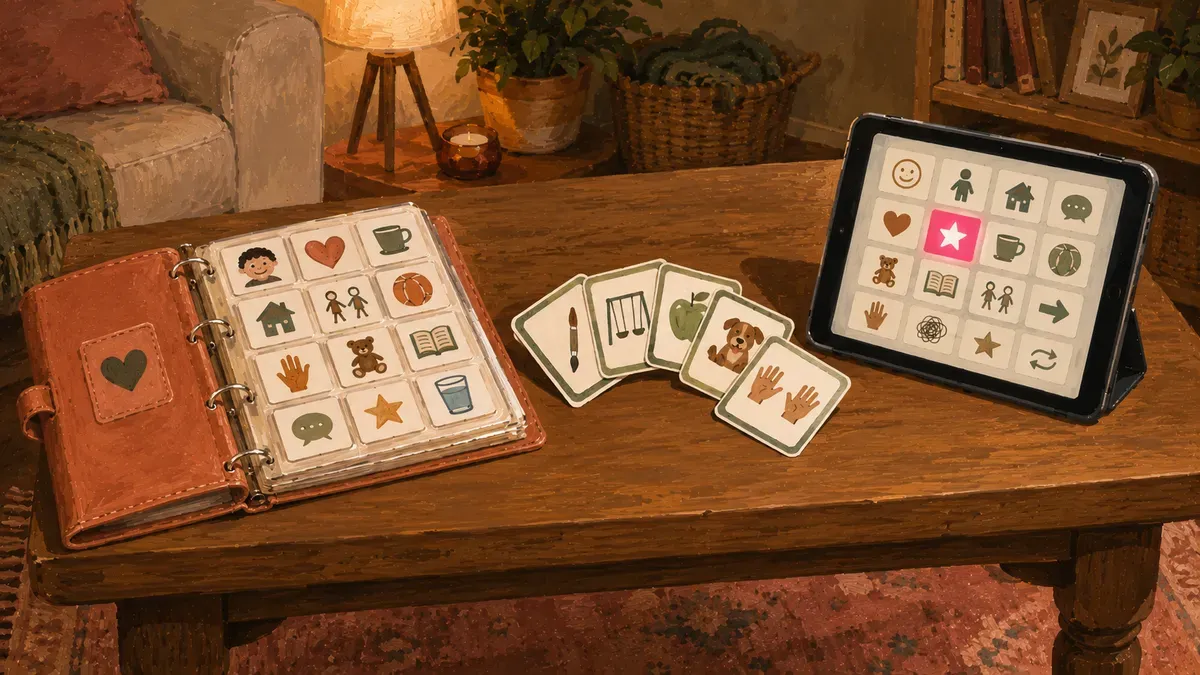
PECS is the one with rules, and the rules are the point. The picture exchange communication system is a structured, six-phase protocol where your child physically hands you a picture to ask for something. In that very first phase, the kid picks up a single card, places it in your hand, and you hand over the thing right away. No “say cracker first.” No verbal prompt at all. The exchange itself is the message.
- Coming to you first, not waiting to be prompted.
- Handing the card over and completing the exchange.
- Getting the real thing right away, so the connection between card and request is immediate.
PECS isn’t a worksheet. It’s a back-and-forth you run all day, trading cards for real things until the asking becomes automatic.
That’s the pecs meaning in practice: a real track record as symbol-based communication. Pyramid Educational Consultants, who developed the system back in 1985, points to research on the picture exchange communication system with more than 240 articles worldwide behind it. It sits at the low-tech AAC end, but it’s the most coached, most step-by-step option of the three.
How Communication Cards Work
Communication cards are the gentlest place to start. Same idea, less pressure: printed symbols your child points to instead of formally handing over. No six phases, no script. You print a set, you put it where the action is, and your kid taps the picture for what they want.
That lower bar is exactly why I steer most late talkers here first.
- A snack board on the fridge
- A couple of choices by the bath
- A feelings set near the couch
If you want the step-by-step, our guide to starting communication cards with a late talker walks the whole setup.
You can print and laminate your own, but you don’t have to. If DIY feels like one more project this week, a ready-made picture communication card set does the prep for you: 196 cloth cards that press onto a felt board, an Amazon’s Choice pick sitting at 4.3 stars across 160-plus reviews.
A communication board can grow with your kid. Start with a handful of words, then build toward core vocabulary, the small set of high-frequency words that carries most of what any of us says all day. As a low-tech communication device it costs almost nothing and bends to whatever your child cares about today. The trade-off: a board doesn’t talk, so the listener has to be watching.
How AAC Apps and Devices Work
Now the loud option. A high-tech AAC tool, whether it’s an app on a tablet or a dedicated device, actually speaks out loud. Your child taps a symbol or a word, text-to-speech reads it aloud, and the message lands without anyone having to lean in and watch.
This is where speech generating devices earn their keep. A dynamic display means the screen changes as your kid navigates, so one tablet can hold thousands of words instead of a binder’s worth of cards. Tap “I want,” the screen flips to snacks, tap again, the device says the sentence.
Two options stand out on the high-tech side.
- Proloquo2Go (AssistiveWare): more than 27,000 symbols and over 100 voices, a one-time purchase rather than a monthly subscription (per AssistiveWare’s product page, accessed June 2026; check the current price).
- A dedicated device costs more but does nothing but communicate, so it never pings with a game notification mid-sentence.
The app has to live on something, and that something doesn’t have to be a thousand-dollar machine. There are capable AAC apps built for Android, and they run fine on a plain Android tablet: a 10-inch screen, 64GB of storage, a battery that lasts the day. It’s an Amazon’s Choice pick holding 4.2 stars across 600-plus reviews, which makes it a low-stakes way to test the app route before you spend on a dedicated device.
Here is how all three tools compare at a glance:
Cards, PECS, and an AAC app each have a free or cheap entry point. You don’t need a referral to try the first one tonight.
None of these requires a specialist referral to try this week. The cards cost almost nothing, and that’s usually the right place to start.
Which One Should You Actually Start With
So how do you actually pick? It comes down to three questions: who your kid is, how little you can risk, and when to call in help.
Match the Tool to the Child, Not the Budget
The priciest option is not the “best” one. The best one is whatever fits how your child already moves and pays attention right now.
Watch three things before you spend a dime:
- Can they isolate a finger to point, or do they swipe with a whole hand?
- How long do they stay with one task before they’re gone?
- How do they ask for things today, by pulling your arm, by sound, by leading you to the fridge?
A kid who points but can’t yet sit for a back-and-forth might do beautifully with cards. A kid who taps a screen better than they grip paper might take to an app faster. When parents ask me what is an aac device good for, I tell them the right one is whatever fits this particular kid right now. Augmentative and alternative communication works when it starts with what the child can already do, then builds a real core vocabulary from there toward more independence.
Pick for the kid in front of you, not the device with the longest feature list.

Why Low-Tech Is Often the Smart First Step
Here’s the part that surprises a lot of parents. A mega-review of 84 systematic reviews on AAC for kids with developmental disabilities found that comparison studies did not show high-tech tools beating low-tech ones for communication outcomes. The expensive box isn’t automatically the better teacher.
That’s why cards or a PECS routine make such a sensible first move. Low-tech cards are cheap enough to test first (more on the cost reality in the next section).
Low-tech AAC is a cheap way to learn what your kid will actually use, and it builds the same early core vocabulary an app will lean on later. Pricier communication devices can wait until you know the symbols are landing.
Many of these kids are late talkers still figuring out when do babies start talking, so symbols and speech can grow side by side.
When to Bring in an SLP
There comes a point where you want a professional in the room. A speech-language pathologist can run a proper AAC evaluation, look at the whole picture, and recommend the vocabulary that fits your child instead of a generic starter set.
That evaluation is thorough on purpose. ASHA’s framework weighs eleven distinct areas, from motor skills and cognition to symbol representation and sensory needs, before anyone recommends a system. It’s the formal version of matching the tool to the child.
An SLP is also your gatekeeper for funding the high-tech aac devices.
Getting a dedicated device covered takes a few steps:
- A certified SLP completes the AAC evaluation
- Your doctor writes a Letter of Medical Necessity
- Medicare classifies speech-generating devices as durable medical equipment, and most private insurers follow the same path
This is where the assistive technology gets real, and where a free printable like a feelings chart for kids without words can hold you over while you wait on that speech therapy appointment.
Moving From Cards to a High-Tech Device
So the speech therapy appointment finally lands, and the real question becomes whether your kid is actually ready for a talking device or you’re just tired of laminating.
Two things matter: whether they’ve outgrown the cards, and whether you can switch without making them start over.
Signs Your Child Is Ready to Upgrade
The board starts to feel small before your kid ever says so. You’ll see it first.
Watch for these:
- They keep pointing past the pictures, asking for things that aren’t on the board at all.
- They’ve worked through the higher PECS phases and string symbols into little sentences.
- They use the same symbol the same way at home, at grandma’s, in the car, everywhere.
That last one matters most. A 2023 PECS outcomes study found kids who used symbols consistently across different settings reached significantly higher PECS phases, which tells you a fixed card set has been outgrown rather than abandoned.
A device with a dynamic display opens up vocabulary a fixed card set can never match.
Core vocabulary sits a tap away, no pec card lookup needed, no binder to flip through.
Signs the card set has hit its ceiling:
- The binder flip takes longer than the conversation.
- New vocabulary keeps getting taped over old symbols.
- Your kid waits, frustrated, while you search.
Keeping the Same Vocabulary as You Switch
This is the part people skip, and it costs them weeks. Don’t reinvent the symbols.
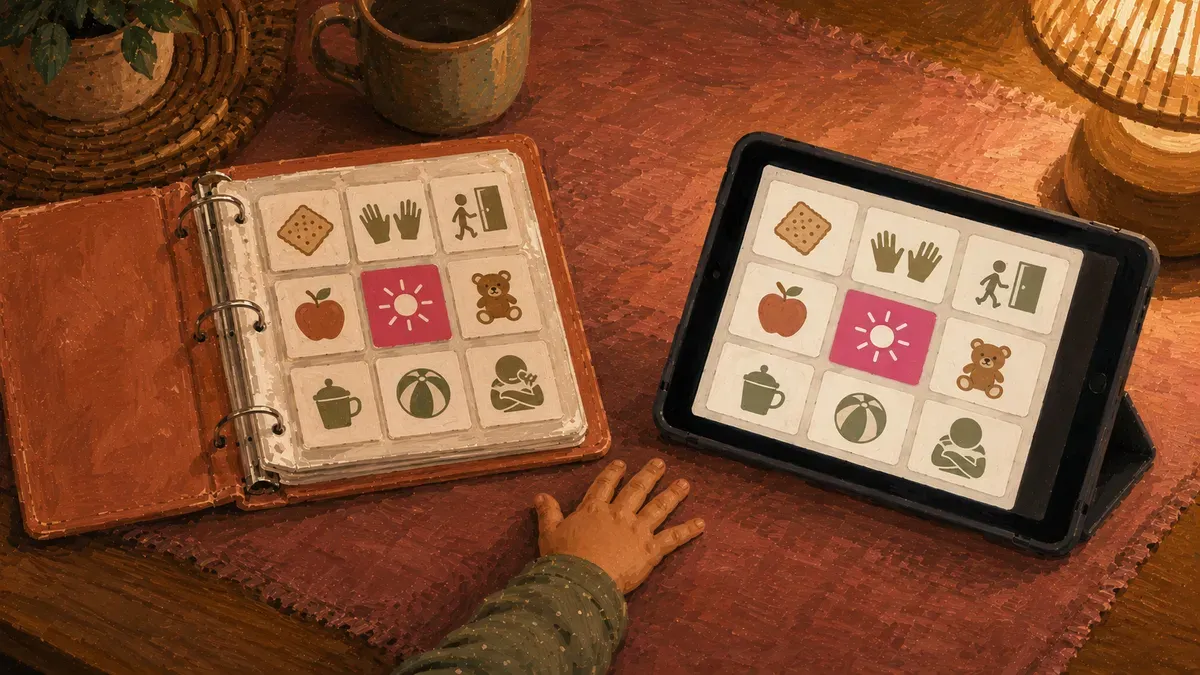
If the apple meant “snack” in the pecs book, the apple means “snack” on the tablet too. Same picture, same word, same spot if you can swing it. The picture exchange communication system already taught your kid that symbols stand for real things, so that foundation doesn’t disappear when the binder does.
What carries over from PECS to a device:
- Core vocabulary your kid already knows by symbol shape.
- The habit of pointing to a picture to mean something.
- Motor memory for where repeated words live on a screen.
Think of it as moving houses, not starting over. If you’re still firming up your starter set, the all done PECS card and other first symbols are a good anchor to keep on both. Once you grasp what is picture communication at its core, one image standing in for one meaning, you can see why pecs communication transfers so cleanly to a device.
Cost, Funding, and Free Starting Points
The price gap between these three tools is wide enough to give anyone sticker shock, so here is the honest range and how families actually pay for the expensive end.
What Each Option Really Costs
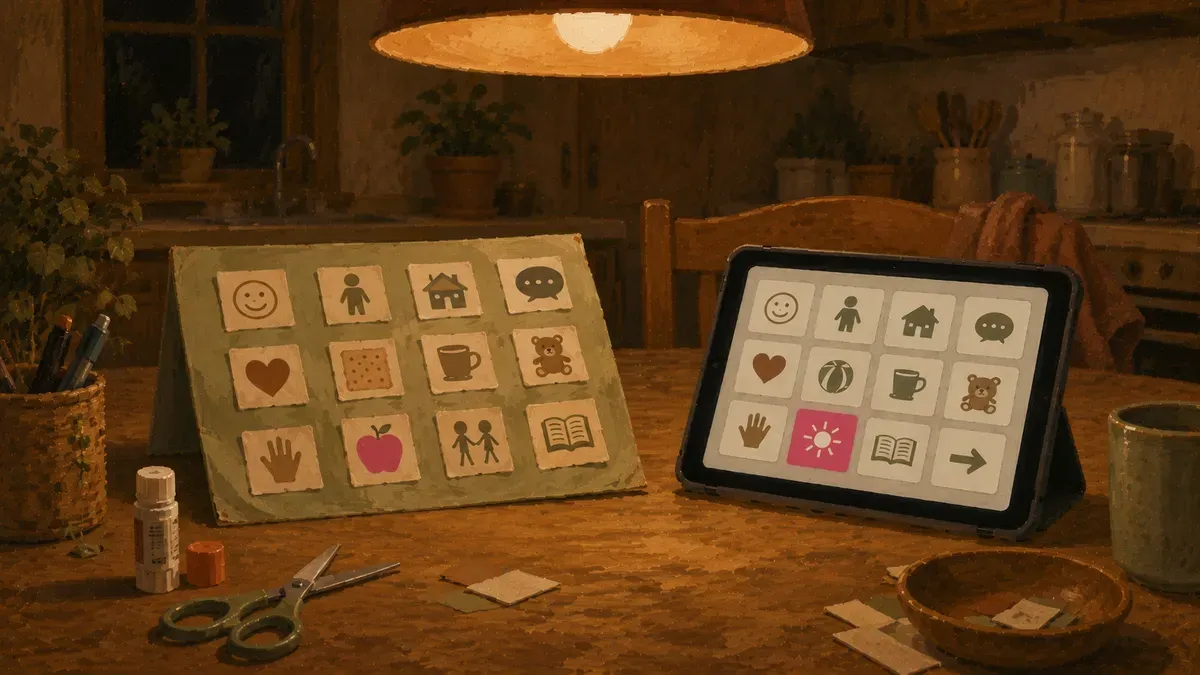
You can start communicating for the price of paper and a thermal laminator. Print a set of symbols, run them through, cut them out, and you have working communication cards before dinner. The laminator most parents reach for is an Amazon’s Choice machine with north of 12,000 reviews, and it earns its keep the first time a card survives a juice-sticky toddler. Plenty of free symbol libraries live online, and that low entry point is the whole reason to test the waters this way first.
Structured kits cost more. The official PECS Starter Kit from Pyramid Educational Consultants packs a 3-ring binder, 151 laminated cards, and a communication book strap. If you’d rather grab a ready-to-go binder without ordering direct, there’s a PECS starter kit on Amazon too; it’s a newer listing with only a handful of reviews so far, so read those and check the current price before you buy.
Then you hit the dedicated end. A dedicated speech-generating device, built for communication only, with no games or browser, can cost well into the thousands.
- Free to a few dollars — DIY printed cards, your own symbols
- A boxed kit — a structured PECS binder, cards, and strap
- One-time or subscription — an app on a tablet
- Hundreds to thousands — a dedicated speech-generating device, sometimes called a med talker
That is the full spread of speech devices, and the aac device meaning shifts as you climb it. The higher you go, the more the thing does on its own.
Insurance and Funding Pathways
Here is the relief: you rarely pay full price for the dedicated device out of pocket. The high-tech ones count as a medical need, and coverage is built around exactly that.
Those speech generating devices are classified as Durable Medical Equipment, eligible under Medicare Part B and state Medicaid. Medicaid tends to cover more for children, though it is the payer of last resort, so private insurance has to be tapped first.
The key that unlocks any of it is a speech-language pathologist. Their evaluation documents the need and recommends the right assistive technology, which is what funders want to see before approving a dedicated device for aac for communication.
If you are not there yet, start free. DIY cards cost almost nothing and tell you whether your kid responds to symbols at all. Our guide to building communication social skills walks through where to go from there.
Found this useful? Save it for the next rough afternoon.
Questions parents ask me about this
What are the best AAC devices for nonverbal kids?
There is no single best option because the right fit depends on your child's motor skills, attention span, and where they are in their communication journey. A dedicated speech-generating device works well for kids who are ready for dynamic displays and consistent cross-context symbol use. For children just starting out, low-tech communication cards are often the better first step since they let you test whether your child responds to symbols before committing to a device.
Is PECS the same as an AAC device?
No. PECS is a specific six-phase teaching protocol where the child physically hands over a picture card to make a request. An AAC device is a speech-generating tool, either a dedicated piece of hardware or an app, that speaks out loud when a symbol is selected. PECS is low-tech AAC; a speech-generating device is high-tech AAC. They are two points on the same spectrum, not the same thing.
At what age can a child start using AAC?
There is no minimum age. Many children begin with low-tech picture exchange or simple communication boards in toddlerhood, and research consistently shows that starting early does not cause harm. If your child is not yet talking and seems frustrated by the gap between what they want to say and what comes out, that is reason enough to talk to a speech-language pathologist about starting.
Does using AAC stop a child from learning to talk?
No, and this is one of the most common fears parents carry into that first SLP appointment. The research does not support it. AAC gives children a reliable way to communicate while their speech develops, and for many kids that reduced frustration actually supports more vocalization, not less. It does not replace speech therapy; it works alongside it.
Can I make my own communication cards at home?
Yes, and it is a practical way to start. Printed symbols, photos of real objects, or simple hand-drawn pictures all work. The most important things are consistent symbols across contexts, a durable laminated card the child can actually handle, and placing the cards somewhere accessible so the child can initiate. A homemade set costs almost nothing and gives you real information about whether your child will use symbol-based communication before you invest in anything else.
Do I need a speech therapist to start AAC?
For a low-tech set of cards or a simple communication board, you can start on your own. For a dedicated speech-generating device or a formal system like PECS, an SLP evaluation is genuinely worth it. An SLP assessment weighs your child's motor skills, attention, and current communication stage, which affects which system will actually work. Insurance and Medicaid funding for a dedicated device almost always requires an SLP evaluation and a letter of medical necessity anyway.
What is the cheapest way to start AAC?
DIY communication cards cost almost nothing: printed symbols, photos, lamination pouches from a dollar store. That is the lowest-barrier entry point and also the most useful first test, because it tells you how your child responds to symbols before you spend anything significant. Free symbol libraries exist online. If your child engages, you can build from there toward a more structured system or eventually a device.
Written by
Nora Hayes
Mom of two and a former preschool aide. I share the screen-free sensory play and calm-down ideas I test at my own kitchen table, plus what the moms in my little meet-up swear by. A parent passing on what works, not a doctor or a therapist.
More about NoraKeep going
All Communication & AAC-
 Communication & AAC
All Done PECS: 6 First-Word Cards to Cut Meltdowns
The all done PECS card is often a toddler's first word, and one of 6 first-word cards that halved our meltdowns. Print your own set free.
-
 Communication & AAC
Games for Speech Therapy: Picks for Late Talkers
Most speech games target school-age kids. These games for speech therapy pull words out of late-talking toddlers. Start playing tonight.
-
 Communication & AAC
Second Step at Home: Teach Kids Big Feelings Daily
Second Step skills don't need a classroom. Turn 15 everyday moments at home into social-emotional learning that sticks. Start tonight at dinner.
-
 Communication & AAC
Nonverbal and Verbal: 12 Toddler Communication Cards
Your nonverbal and verbal toddler can point before they speak. See the 12 communication cards every fridge needs to cut meltdowns. Start today.