ADHD Speech Delay and Why Big Emotions Erupt

I am a parent sharing what worked at my house, not medical advice. For anything to do with your child's development or sensory needs, talk to your OT or doctor.
Yes, the same wiring that slows down talking can also turn a small frustration into a full meltdown, and the two are more tangled than most parents realize. I’m Nora Hayes, a former preschool aide raising an autistic, sensory-seeking 7-year-old, and the thing I keep coming back to is this: a kid who can’t find the words for “I’m mad” will show you instead, on the floor, with their whole body.
With an estimated 7 million (11.4%) U.S. children aged 3-17 diagnosed with ADHD per the CDC’s 2022 survey, this overlap is common enough to walk through together, so here we’ll cover what an ADHD speech delay actually looks like, why feelings erupt alongside it, and the calm-down tools that help before the storm hits.
What ADHD Speech Delay Actually Looks Like
If your kid bounces off the walls and still isn’t stringing words together the way the milestone chart promised, those two things might be talking to each other. Here’s the overlap, then the early signs that usually tip parents off first.
Defining the overlap between attention and language
ADHD is a neurodevelopmental condition, which is a long way of saying the brain is wired a little differently from the get-go. It shows up as attention deficit, trouble sitting still, and acting before thinking. None of that sounds like it has anything to do with talking. But it does.
The same brain systems that run focus also run language development. Learning a word takes three things a distracted brain tends to short-circuit:
- Hear it: stop long enough to register the sound
- Link it: connect the word to something real in the room
- File it: hold it in memory to pull up next time
So speech delay rides along more often than you’d guess.
It’s common enough to have numbers behind it. In a community group of kids identified with ADHD, research on ADHD and language development found 45% also had co-occurring language problems. So an ADHD with speech delay combo isn’t a fluke, and it isn’t something you caused. The wiring just bundles them together.

What that means at diagnosis: a doctor may flag the attention piece first and the words second, or the other way around. Either way, it helps to know they travel together.
Early signs parents notice first
Most parents don’t spot “ADHD” first. They spot a kid who isn’t talking like the others at the playground.
The missed talking milestones are usually the loudest signal. If you’re fuzzy on what’s on time and what’s late, our guide on when do babies start talking lays out the rough ages without the panic. Past that, here’s what tends to stand out in toddlers:
- Short utterances. One or two words where you’d expect a little sentence, well past the age peers are chaining words together.
- Hard-to-catch articulation. Sounds come out fuzzy, and you’re the official translator everyone else relies on.
- Tuning out mid-conversation. You’re three words into a question and they’re already gone, which is where inattention and impulsivity show their hand.
The hyperactivity muddies the picture too. A kid in constant motion gets fewer of those slow, face-to-face moments where language actually clicks. So the talking lags, and the moving covers for it.
None of these alone means much, but a cluster is worth writing down. If you want to go deeper on the talking-and-connecting side, our full communication and social skills guide on communication and social skills walks through it. Trust the gut that brought you here, and bring your list to someone who can sort it.
Why ADHD Affects Both Speech and Emotions
The speech lag and the big feelings are not two separate problems. They grow from the same wiring, and once you see the link, the meltdowns start making a lot more sense.
The executive-function and dopamine link
Think of the front of the brain as the manager on shift. The frontal lobe pulls the right word off the shelf, holds it long enough to say it, and tells the body to wait a beat before reacting. In ADHD, that manager is short-staffed.
The same dip in executive function that makes a word hard to find also makes it hard to pause before a reaction. A child reaches for a word, the shelf comes up empty, and the moment to respond passes anyway.
- Dopamine helps the frontal lobe stay on task, tying word retrieval to the ability to pause before reacting.
- When dopamine signaling runs low, both slip at once: word access slows and impulse control weakens.
A 2024 Frontiers in Psychiatry review on inhibitory control found that weak impulse control is robustly seen in ADHD, tied to dopamine dysfunction in the prefrontal cortex that stretches all the way into social functioning.
So the slow word retrieval and the impulsivity are not bad luck stacked on bad luck. They run on the same low battery.
When missing words become big emotions
Here is what that battery looks like at 5pm. A kid is furious, or scared, or just done, and the word for it will not come. The feeling does not wait politely for expressive language to catch up. It comes out as a scream, a thrown shoe, a body on the floor.
- The body takes over when words fail, and that behavior is the child’s emotional signal, not defiance.
- Toddlers with language delays show bigger struggles with dysregulation than their talking peers, which tracks: missing words and big feelings travel together.
I have watched this with my own seven-year-old more times than I can count. The days his words come slow are the days the floor sees the most action. It is not defiance. It is a feeling with nowhere to go.
The quiet cost adds up over time.
- A kid who keeps getting it wrong, in their own head, braces for the next blowup, and connecting with other kids gets harder.
- That dent in how they see themselves emotionally is the part worth catching early.

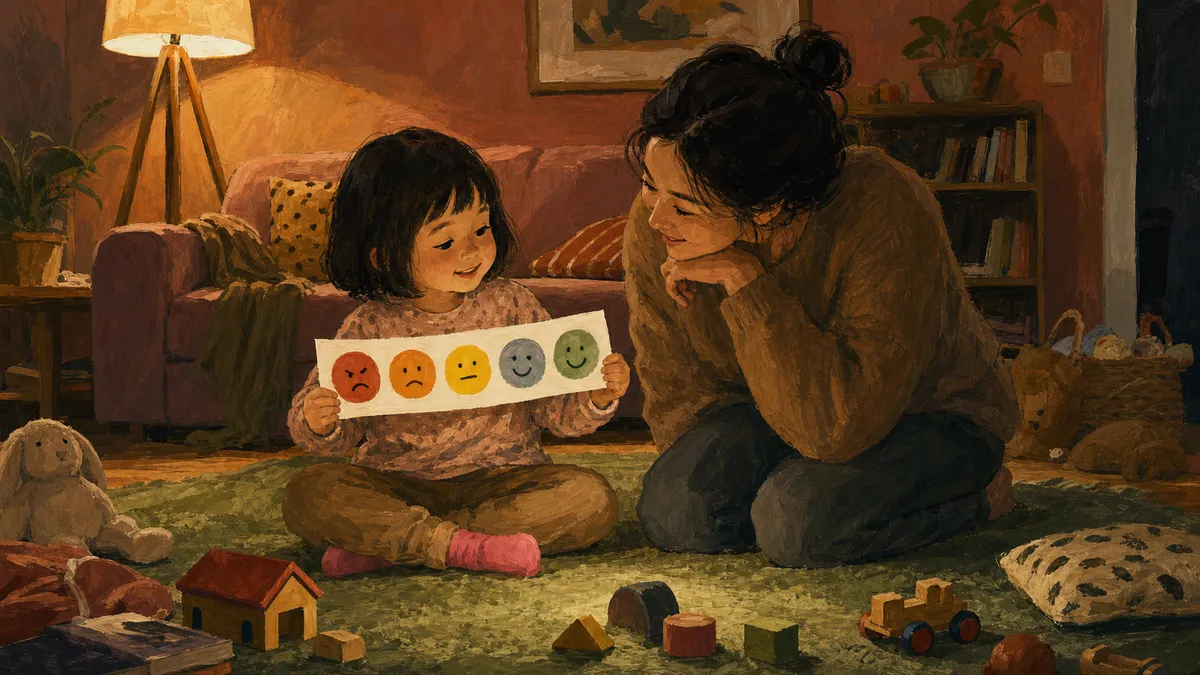
The good news is you do not have to wait for the words to arrive. You can hand your kid a shortcut. Even something as simple as a feelings chart gives them a way to point at “mad” before the mad takes over. That is where we head next.
Using a Feelings Scale Before the Meltdown Hits
A chart that names “mad” is step one. A scale that catches the mad while it’s still climbing is the part that actually saves your evening, and it works in three small moves: read the rising emotion, decode what each color is telling you, then track the pattern over time.
- Read the rising emotion before it peaks.
- Decode what each color is telling you about their state.
- Track the pattern over time so you stop getting blindsided.
Reading a feelings thermometer with your child
Think of it like the thermometer on the wall, except it measures the kid instead of the room. The bottom is calm, the top is boiling over, and your job is to catch them somewhere in the middle before they hit the top.
For a child whose words show up late or scatter under stress, this is huge. When the feeling outruns the sentence, pointing is faster than talking. A printable feelings thermometer for kindergarten or school gives them a PDF they can tap with one finger and say “I’m here” without finding a single word.

Here’s the move that makes it stick:
- Point to your own level first. “Mommy’s a little orange right now, I’m getting frustrated.”
- Ask, don’t quiz. “Where are you?” beats “Are you mad?”
- Catch the climb early, while they can still point.
Used a few times a day as a tiny routine, the thermometer becomes a piece of shared language. It builds the social communication and emotional development that words alone aren’t giving them yet. Visual aids do the talking when the mouth can’t.
What each mood color means
Most thermometers run on the same handful of mood colors, and the meaning is worth teaching out loud so the child can read their own state instead of just reacting to it.
- Blue: low, tired, sad, slow. Not bad, just running on empty.
- Green: calm, ready, good to go. This is the goal, not a constant.
- Yellow: wiggly, silly, antsy, starting to lose the thread.
- Orange: frustrated, overwhelmed, sensory load climbing fast.
- Red: done, boiling, the meltdown gate.
Green is where learning and listening happen, and the whole point of the scale is helping a kid notice when they’ve drifted off it. A sensory-seeker often lives in yellow, busy, needing to move before they can settle. That’s not misbehavior, that’s their sensory processing asking for input.
Naming the color hands a kid a grip on a feeling that used to just happen to them. That tiny bit of control builds real confidence, and it quietly teaches the emotional development and social communication skills that show up later in how they handle a hard moment with a friend.
Turning the scale into a daily emotion graph
The scale gains real power when you track it over time, and that’s where it connects to the mood-tracking work in the next section.
Discipline That Teaches Emotion Instead of Punishing It
Seeing the meltdown coming is half the work. The other half is what you do once your kid is on the floor, and that splits into two pieces: how you read the behavior in the moment, and whether you’ve got a steady framework to fall back on.
Coaching feelings rather than reacting to behavior
The throwing, the screaming, the slammed door. That’s the part you see, and it’s the part that begs for a consequence. But for a kid whose words run slow, the behavior is the only language they’ve got left when the feeling gets too big.
Emotional discipline means you answer the feeling first, not the act. You name it out loud. “You’re so mad your tower fell. That’s a hard one.” You’re not excusing the throw. You’re showing them the emotion has a word, and that words work better than fists.
- Punishment teaches a kid to hide the feeling so they don’t get caught.
- Coaching teaches them to handle it.
- Self-regulation is a skill you build, not a behavior you scare into place.
The long game is real. Gottman’s research on emotion coaching found that kids whose parents coached feelings had fewer anger and anxiety problems and got along better with peers.
You’re not just surviving tonight. Every named feeling is a small deposit in their confidence.
Does it land every time? No. Some nights you name the feeling and they still throw the cup. You build emotional development on the calm days, not by winning the worst moment.

Where conscientious discipline fits in
When “stay calm and name the feeling” feels like too much to wing in the heat of it, a framework helps. Conscientious Discipline is one many parents lean on: it puts connection before correction and treats every outburst as a chance to teach a skill, not a crime to sentence.
The core idea is that a regulated adult regulates the child. - Settle your own rising heat first.
- Co-regulate with your child.
- Problem-solve together once everyone’s back in their body.
It pairs naturally with the routines you’ve already built. Structured social-emotional curricula like the Second Step social-emotional program run on the same logic, handing you scripts and a predictable rhythm so connection isn’t something you have to invent at 6pm. For a kid who needs the world to be predictable, that steadiness does more for emotional development and social communication than any chart of rewards.
Creative and Lighthearted Ways to Express Big Feelings
Not every feeling needs a serious sit-down talk. Sometimes the fastest way to let a big emotion out is to make it something your kid can color, laugh at, or scribble onto a chart, and these three outlets do exactly that.

Anger coloring and other hands-on outlets
When a kid is furious and can’t find the words, handing them a crayon beats handing them a lecture. Anger coloring pages give that rage somewhere physical to go. Press hard, pick the angriest color, fill the whole page black if that’s the mood. The repetitive motion does the calming, no talking required.
There’s real backing for the hands-on part too. A 2025 study in the Canadian Journal of Occupational Therapy found color-based painting therapy improved self-regulation and reduced behavioral challenges in elementary kids with ADHD over ten weekly sessions. You don’t need a clinic to borrow the idea.
The same logic stretches past coloring:
- Play dough you can squeeze, pound, and tear
- A scribble pad that’s only for mad feelings
- Salt-tray or shaving-cream finger drawing
The sensory processing piece is the point. For a kid still building emotional development, these visual aids turn an invisible feeling into something they can see, touch, and finish. Keep one in the calm-down corner so it’s part of the routine, not a scramble mid-storm. Finishing the page is its own small hit of confidence.
Funny mood scales that lower the pressure
Naming a feeling is hard work for a word-limited kid. Make it silly and the pressure drops off a cliff. Funny mood scales swap the clinical face-chart for something that actually gets a laugh, a row of grumpy cats, dinosaurs from sleepy to stompy, weather from sunny to full thunderstorm.
The humor is the trick. A kid who freezes when you ask “how do you feel?” will happily point at the volcano dino. You’re not quizzing them, you’re playing, and that low-stakes framing builds social communication without it feeling like a lesson.
Pick a scale that makes your kid grin, then let them point instead of explain.
These work as visual aids the same way a feelings chart does, but the goofiness invites a reluctant talker in. Stick the scale on the fridge so checking in becomes a quick, normal part of the day’s routine. Every easy point-and-name builds a little more confidence and a little more emotional development, no big feelings required to get started.
Keeping a simple mood tracking template
A mood tracking template sounds fancy. It’s a sheet with the days of the week and a spot to mark the mood, and it does one quiet, useful job: it shows you the pattern you can’t hold in your head.
Keep it light. One color or one face per day, maybe a note on what happened right before. After a couple of weeks, patterns surface that you’d never hold in your head day to day.
- The mornings that crumble after a nap got skipped
- The noisy transition from preschool that tips things over every single time
- The after-lunch slump that precedes most of the week’s hard moments
That’s the executive function support working for you, not just your kid. The template carries the remembering so you can spot what soothes and what sets things off. Pair it with the routines and heavy work you already lean on, and you’re getting ahead of the storm instead of mopping up after it. It won’t catch every milestone or mood, and it doesn’t need to. Seeing the pattern is the whole win.
When to Bring in a Speech and Emotion Professional
Tracking the pattern at home is half the job. The other half is knowing when what you’re seeing is bigger than a long day, and who to call when it is. Below are the signs worth acting on, and how the right two pros split the work.
Red flags that warrant an evaluation
Most slow-to-talk, big-feelings kids catch up with time and patience. Some don’t, and when that happens it’s a signal worth paying attention to, not a reflection on you.
Watch for the combination, not one thing in isolation. A few that tend to add up:
- Words still cluster way behind the usual milestones, and the gap is widening, not closing
- Strangers can’t understand most of what your child says past age three or four
- Meltdowns are daily, intense, and don’t ease with the routines and heavy work you already lean on
- Frustration boils over the second words won’t come, every single time
- Your gut has been quietly worried for a while
The American Academy of Pediatrics clinical practice guideline says any child 4 to 18 showing behavior problems plus inattention or impulsivity should be evaluated, with language and learning checked in the same workup. So you’re not asking for too much by raising both at once. Start with your pediatrician and a speech-language pathologist. Earlier is easier; early intervention works best on a young, flexible brain, and a neurodevelopmental picture is clearer when nobody waited to see what happens.

How therapy supports speech and self-regulation together
Here’s what surprised me when Eli started: the speech and the meltdowns got worked on as one knot, not two.
A speech-language pathologist builds the words, the back-and-forth of conversation, the communication social skills that turn a frustrated point into a sentence. As the words land, the meltdowns often soften on their own, because the kid finally has another way out.
An occupational therapist comes at the same knot from the body. The SLP handles language; the OT builds the regulation and executive function that let a wound-up kid sit, wait, and try. A 2025 trial in the American Journal of Occupational Therapy found occupational therapy using sensory integration improved emotional regulation and attention at clinically significant levels (p < .001) versus a waitlist group. Speech feeds the words, OT feeds the calm to use them, and together they’re far stronger than either alone.
Found this useful? Save it for the next rough afternoon.
Questions parents ask me about this
Does ADHD cause speech delay and emotional outbursts in kids?
ADHD doesn't cause speech delay the way a structural issue might, but the two show up together far more often than chance would predict. Impulsivity and attention difficulties strain the same brain systems that support language development, so kids identified with ADHD are significantly more likely to also have language problems. When words are hard to find, feelings come out as behavior instead.
At what age should I worry about ADHD and a speech delay together?
If a child isn't speaking clearly enough for strangers to understand most of what they say by age four, or if vocabulary feels stuck well behind same-age peers, that's worth a conversation with your pediatrician now, not a wait-and-see. The American Academy of Pediatrics recommends that kids flagged for behavior or attention concerns get their language checked in the same workup, not separately. Earlier is easier on the brain.
Can a feelings thermometer really stop a meltdown before it starts?
It won't guarantee anything, but it gives you and your child a shared signal before the explosion hits. The whole point is catching the climb when a child is at yellow, not waiting until they're at red and regulation has already collapsed. Over time, even kids who can't reliably name emotions yet can learn to point to a color, which opens a window for a calm-down strategy while it can still work.
How do I explain mood colors to a child who can barely talk?
You don't explain it, you demonstrate it. Point to your own color out loud throughout the day: "I'm at yellow right now, a little rushed." Let them watch you use it before you ask them to. When they seem wound up, point to a color yourself and invite them to tap the one that feels right. Pointing lowers the language barrier, and the routine builds familiarity before the hard moments hit.
Is emotional discipline the same as being permissive?
No, and that confusion trips up a lot of parents. Coaching the emotion doesn't mean the behavior gets a pass. It means you name what the child feels before you address what they did. A child who hears "you were really angry" before the consequence learns to connect their internal experience with language; a child who only hears the consequence learns to hide the feeling instead. Structure and empathy work together, not against each other.
Will my child's speech delay catch up with early intervention?
Many kids close the gap significantly, especially when intervention starts early and targets both communication and the regulation skills that let a child use language under pressure. In practice, progress often shows up at home before it shows up on a chart: fewer meltdowns when the answer is "no," more words in a moment of frustration, a child who can finally point to what they need instead of dissolving. Most families see real progress, though the timeline varies by child.
Do anger coloring pages actually help calm big emotions?
For kids too wound up for words, giving their hands something to do is a genuine release. Pressing a crayon and filling a page engages the body and slows the nervous system in a way that talking often can't when emotions are running hot. It won't work every time, and it's not a fix on its own, but as one option in a calm-down toolkit alongside heavy work, a quiet corner, or sensory tools, it earns its place.
Written by
Nora Hayes
Mom of two and a former preschool aide. I share the screen-free sensory play and calm-down ideas I test at my own kitchen table, plus what the moms in my little meet-up swear by. A parent passing on what works, not a doctor or a therapist.
More about NoraKeep going
All Communication & AAC-
 Communication & AAC
AAC Devices vs. PECS vs. Cards: Which Comes First
AAC devices, PECS, or cards first? See what each does, what it costs, and how to pick the right starting point for your child.
-
 Communication & AAC
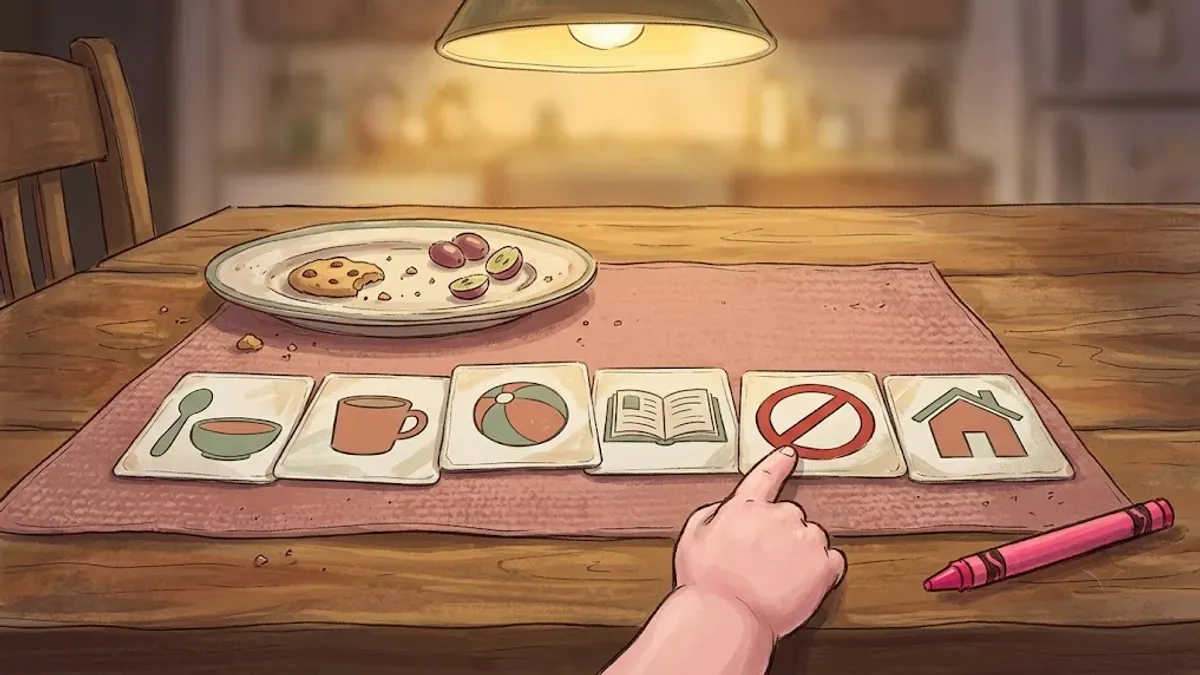
All Done PECS: 6 First-Word Cards to Cut Meltdowns
The all done PECS card is often a toddler's first word, and one of 6 first-word cards that halved our meltdowns. Print your own set free.
-
 Communication & AAC
Games for Speech Therapy: Picks for Late Talkers
Most speech games target school-age kids. These games for speech therapy pull words out of late-talking toddlers. Start playing tonight.
-
 Communication & AAC
Second Step at Home: Teach Kids Big Feelings Daily
Second Step skills don't need a classroom. Turn 15 everyday moments at home into social-emotional learning that sticks. Start tonight at dinner.