Conversation Cards for Teens Who Clam Up

I am a parent sharing what worked at my house, not medical advice. For anything to do with your child's development or sensory needs, talk to your OT or doctor.
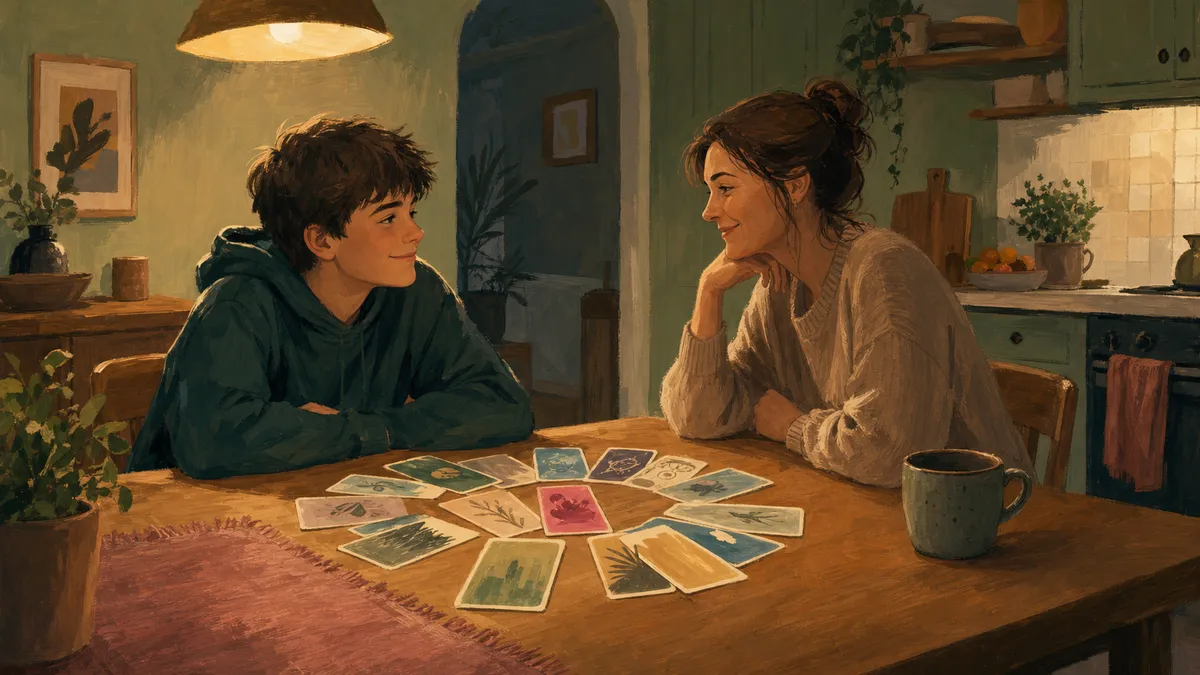
Ask a teen “how was your day?” and you get a shrug, because an open-ended question feels like being called on with nothing prepared. Conversation cards flip that: a small prompt on a card lowers the pressure and hands a reluctant kid an easy on-ramp into talking, which is also quiet practice at the social skills they’re still building.
I’m Nora Hayes, a former preschool aide raising two kids including a sensory-seeker, and below I’ll walk you through why teens freeze, how the cards work, 25 prompts to try tonight, and how to bring them to the dinner table without it feeling like a setup.
Why Kids Freeze Up When You Ask ‘How Was Your Day?’
The silence usually isn’t attitude. It’s a brain hitting a wall, and the two parts below untangle the everyday pressure first, then what to watch for when the freeze runs deeper.
The Pressure Behind a Broad, Open-Ended Question
“How was your day” sounds gentle. To a teen, it’s like being put on the spot to summarize six hours on demand, with no time to sort through any of it.
That’s a heavy lift for a developing brain. In one research on pragmatic language development in children (an NIH/PMC study), under high load adolescents made about 29% errors on working memory tasks versus 21% for adults. Open-ended questions pile on that load and the system stalls.
- Social skills meaning here: reading the moment and finding words to match it (another word for this is pragmatic language)
- Define social skills the simple way: it’s knowing what to say, when, and how
- What a vague question does: strips away the anchor a kid needs to start

When a Freeze Signals More Than Shyness
For a neurodivergent teen, or one carrying real anxiety, the quiet runs deeper than a long day.
Social communication challenges, the kind that make starting and holding a conversation hard, show up in a real slice of kids, and they’re often quieter at home than at school. That’s not a diagnosis you make at the table.
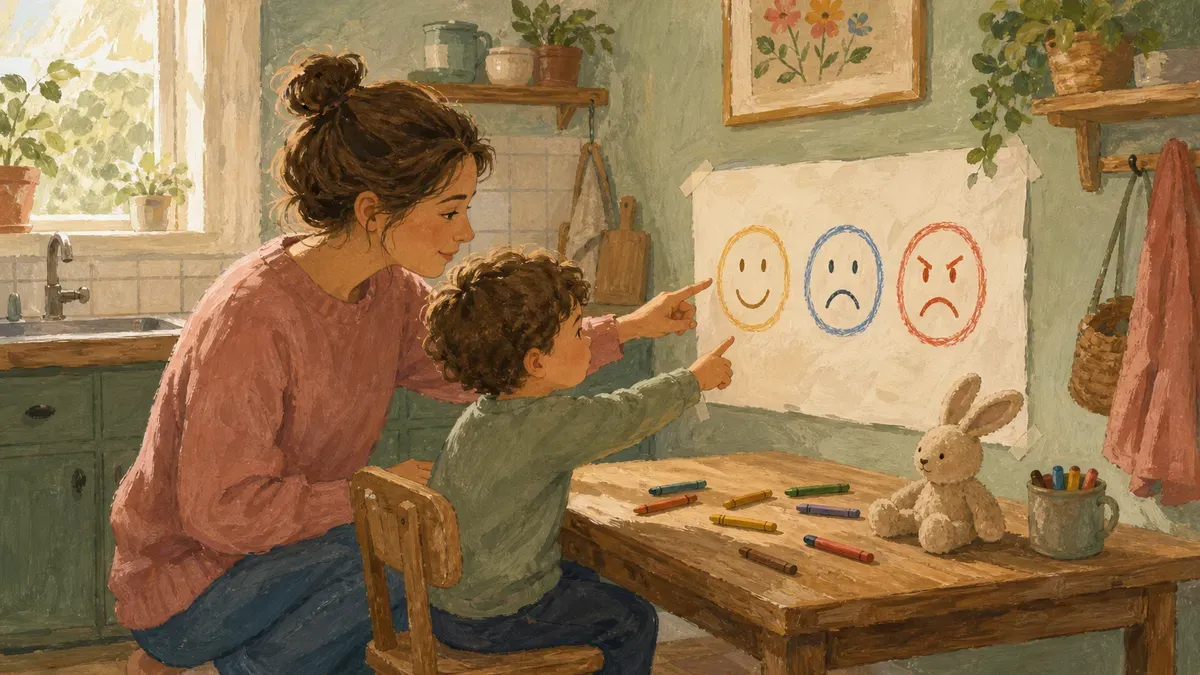
Hand them something to react to instead of a question to answer. A feelings chart that gives words to big emotions lets a teen point instead of perform, and for kids with adhd speech delay, naming the feeling first often unlocks the rest.
How Conversation Cards Get a Reluctant Teen Talking
Handing them a card to react to is what actually gets them through it, and it works for two reasons: where the spotlight lands, and how often you do it.

Why a Card Beats a Direct Question
Ask a teen a question face to face and they feel it as a spotlight, all eyes and pressure to say the right thing. Now you’re both looking at the prompt, not at each other, and the answer isn’t a performance, it’s just a reaction to a thing on the table.
A good conversation starter for teens reads as low-stakes because the card asked, not you.
Turning Cards Into a Family Habit
The magic isn’t one card, it’s pulling one every night.
We keep ours in a jar by the dinner plates and one more in the car. Anybody can pull, everybody answers.
Conversation cards in the family routine build a rhythm, and a longitudinal study of urban adolescents found more frequent family dinners tracked with stronger parent-child communication. Approaches like the Second Step social-emotional learning program use the same logic for families.
- A card moves the spotlight off your teen and onto the prompt, so their answer feels like a reaction, not a performance.
- Adding prompts about social awareness and topics they care about gives a quieter kid a way in without losing their confidence.
- Pulling one card every night turns talking into the default instead of a confrontation.
25 Conversation Starters for Teens Who Clam Up
A routine only works if you’ve got something good to pull from the jar, so here are 25 to start with, sorted from goofy to genuine.
Funny and Low-Stakes Openers to Break the Ice
The first card should never feel like a quiz. A fun conversation starter gives a teen something silly to react to, and a laugh drops the guard faster than any heart-to-heart. These convosation starters are the easy on-ramp.
My 13-year-old neighbor, who answers most things with a shrug, gave me a full paragraph on the zombie one.
- Would you rather fight one horse-sized duck or a hundred duck-sized horses?
- If our pets could talk for one day, who’d say the most embarrassing thing?
- What’s the dumbest way you’ve ever been hurt?
- You get to rename yourself today. What’s the new name?
- Pineapple on pizza: crime or genius?
- If zombies showed up, what’s our house’s weak spot?
- What’s a weirdly specific smell you secretly love?
- Pick a superpower that’s only useful at school.
These fun convo topics aren’t deep on purpose, and that’s exactly why they work.
Questions That Sidestep the Dreaded ‘How Was Your Day?’
Now swap the vague recap for a great, specific question your kid can actually answer. “How was your day?” asks them to summarize eight hours on the spot. Narrow it down and the words come easier.

- What was the best two minutes of today?
- What was the hardest part, and did anyone make it better?
- Tell me one weird thing that happened.
- Who made you laugh today?
- What’s something you wish hadn’t happened?
- If today had a title, what would it be?
- What’s one thing you’re glad is over?
- What surprised you?
These open-ended chatting ideas land because there’s always something worth talking about in a single moment.
Deeper Prompts That Build Confidence and Connection
Once they’re warmed up, the deeper cards do the quiet work. A reflective conversation starter for teens (girls and boys both) lets them name what they think out loud, which is how confidence gets built.
Go slow, and never push if they pass.
- What’s something you changed your mind about this year?
- When did you feel most proud of yourself?
- What’s a rule you think is unfair, and why?
- Who do you trust most, and what makes them trustworthy?
- What do you wish I understood about you?
- When do you feel most like yourself?
- What’s something you’re a little scared of trying?
- What kind of friend do you want to be?
- If you could fix one thing about your day-to-day, what is it?
Let the answers be short. A half-sentence is still your kid choosing to open the door, and that’s the whole point.
Practicing Social Skills Through Everyday Conversation
The prompts do more than fill a quiet car ride. Use them on purpose and they turn into low-key practice, folded into your day and stretched into games and groups.
Social Skills Activities That Fit Into Daily Routines
You don’t need a worksheet for any of this. The best social skills activities hide inside stuff you’re already doing.
Here are a few I rotate, and they work for teens and the kindergarten crowd both:
- Role-play a return. Before a doctor’s visit, we run the hello and the “thank you” once in the car. Two lines, that’s it.
- Eye contact, no pressure. I look up when June talks to me at dinner so she sees it modeled, never “look at me when I’m talking.”
- Take turns out loud. One card, your answer, then mine. Trading off is the whole skill.
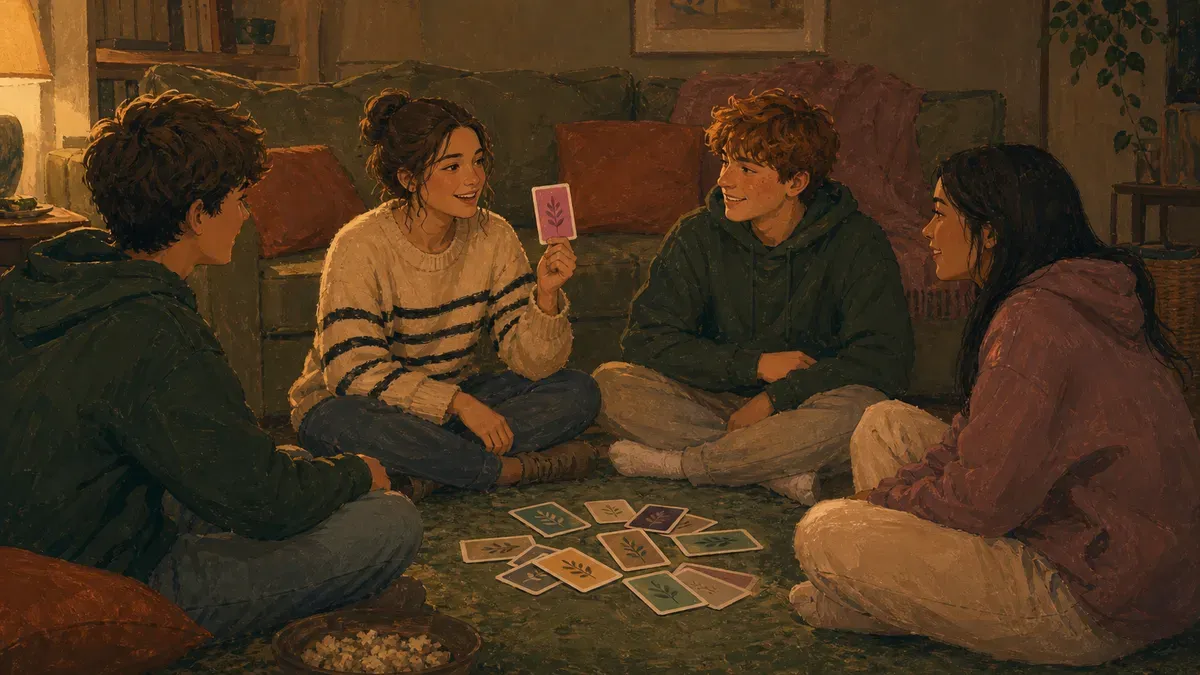
Those social skills examples sound small. They are. Social skills for kindergarteners and clammed-up teens grow the same way, in tiny reps nobody calls a lesson.
Using Cards in Groups, Games, and Scenarios
The same deck scales up. Hand it to more than one kid and it becomes a set of social games without anyone noticing it’s practice.
At our monthly meet-up I’ve watched a single card spark a real social skills group: kids pulling prompts, riffing off each other, building emotional intelligence one weird answer at a time. That MIT lab on conversational turns and children’s language scores found the back-and-forth turns matter more for a kid’s language scores than how much they hear, and a roomful of teens trading answers is back-and-forth on tap.
A couple of easy uses:
- Social skills games: deal the cards, fastest funny answer wins.
- Practice social scenarios for kids by acting out the prompt instead of just answering it.
Want therapy-style depth, like a 100 therapy questions for kids deck? Same idea, deeper end. For that, try more games for speech therapy, or browse our full library of communication and social skills guides when you’re ready for the next step up.
Bringing Conversation Cards to the Family Dinner Table
The car and the jar are great, but dinner is where a card really earns its keep. Below are questions the whole table answers, plus a few lines to save you when a prompt lands with a thud.
Dinner Table Questions the Whole Family Answers
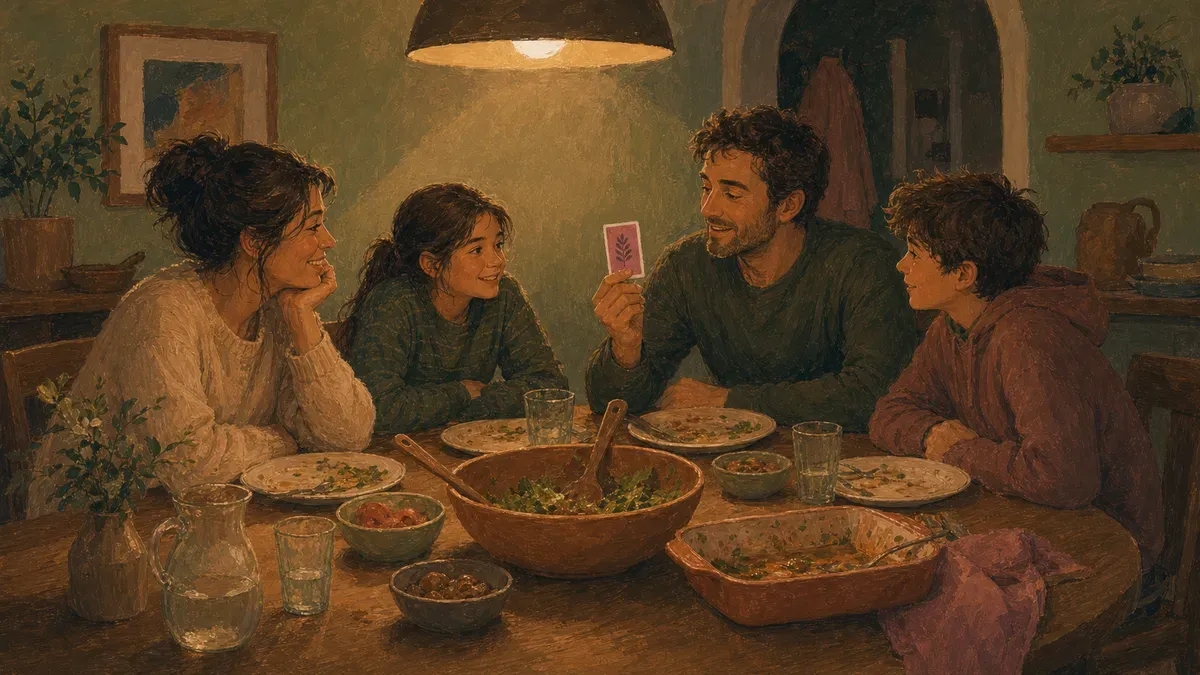
The trick that changed dinner at our house was simple: everybody answers, and a parent goes first. When the family dinner table topics go around the circle, your teen stops feeling singled out and starts feeling like one of the crew. Belonging beats interrogation every time.
We keep a short rotation of family dinner topics taped inside a cabinet, and one of us pulls a card before plates hit the table. Mixing goofy ones with genuine ones keeps it off-balance, in a good way, and folds it into the daily routine.
A few dinner questions for families that earn their keep at our table:
- High point and low point of your day, one sentence each
- Something that made you laugh today
- One thing you’re looking forward to this week
Dinner together is doing quiet work, too. A systematic review of family meal frequency links frequent family dinners to better emotional well-being and prosocial behavior in kids. The card just gives the connection something to chew on.
Scripts to Recover From an Awkward Silence
Some cards flop. A kid shrugs, the table goes quiet, and the urge to fill it with a lecture is strong. Don’t.
Keep two or three recovery lines in your back pocket so a stalled answer never shames the teen or kills the turn-taking. Try “Pass it, you can come back to it,” or “I’ll go first, you steal my idea.” My favorite is answering it myself, badly, on purpose. The laugh resets the room and hands their confidence back, which is the whole point of these communication social skills habits anyway.
Found this useful? Save it for the next rough afternoon.
Questions parents ask me about this
What conversation cards help teens build communication confidence?
Look for decks with a mix of low-stakes silly prompts and more reflective ones, so teens can ease in before the heavier questions come up. The best cards move the spotlight off the teen and onto a neutral topic, turning an answer into a reaction instead of a performance. One deck that covers goofy hypotheticals, single-moment recall questions, and values-based prompts will take you much further than a set that's all serious or all jokes.
What are some great conversation starters for a shy teenager?
Start with hypotheticals and would-you-rather questions, not anything about their actual day. "Would you rather have the ability to fly or be invisible?" costs nothing emotionally, gets them talking, and breaks the silence without pressure. Once they're warmed up, narrow-focus questions work well: "What was one thing that made you laugh today?" is far easier than "How was school?"
At what age do conversation cards work best for kids?
They work from preschool through high school, though the card style needs to match the kid. Little ones do best with single-choice or silly prompts that don't require much recall. School-age kids can handle more nuanced questions, and teens respond well when the prompts feel genuinely interesting rather than like a homework assignment. A good deck scales by how you deliver it, not just by what's printed on it.
How do conversation cards help a child with social anxiety?
They lower the stakes by shifting focus from the child to the card itself. When a question comes from an object everyone's looking at, the teen isn't put on the spot the way they are with a direct question. The structure also helps: knowing there's a prompt coming, and that everyone at the table answers it, removes the unpredictability that can trigger anxiety. Over time, the small daily reps build the habit of speaking up in a low-pressure context.
Can I make my own conversation cards instead of buying them?
Absolutely. Index cards and a marker are all you need. Mix in some goofy would-you-rather prompts, a handful of narrow single-moment questions, and a few reflective ones about something they're proud of or looking forward to. Keep 15 to 20 cards in a jar on the table so there's always one ready to pull. The format matters more than where it came from.
How often should families use conversation starters at the dinner table?
Nightly works well once it becomes a habit, but even three or four times a week makes a difference. The consistency is what builds the routine, not the frequency. Pull one card per meal, keep it short, and let the conversation go wherever it naturally goes after the prompt lands. If some nights you skip it entirely, that's fine too.
Do conversation cards work for neurodivergent or nonverbal kids?
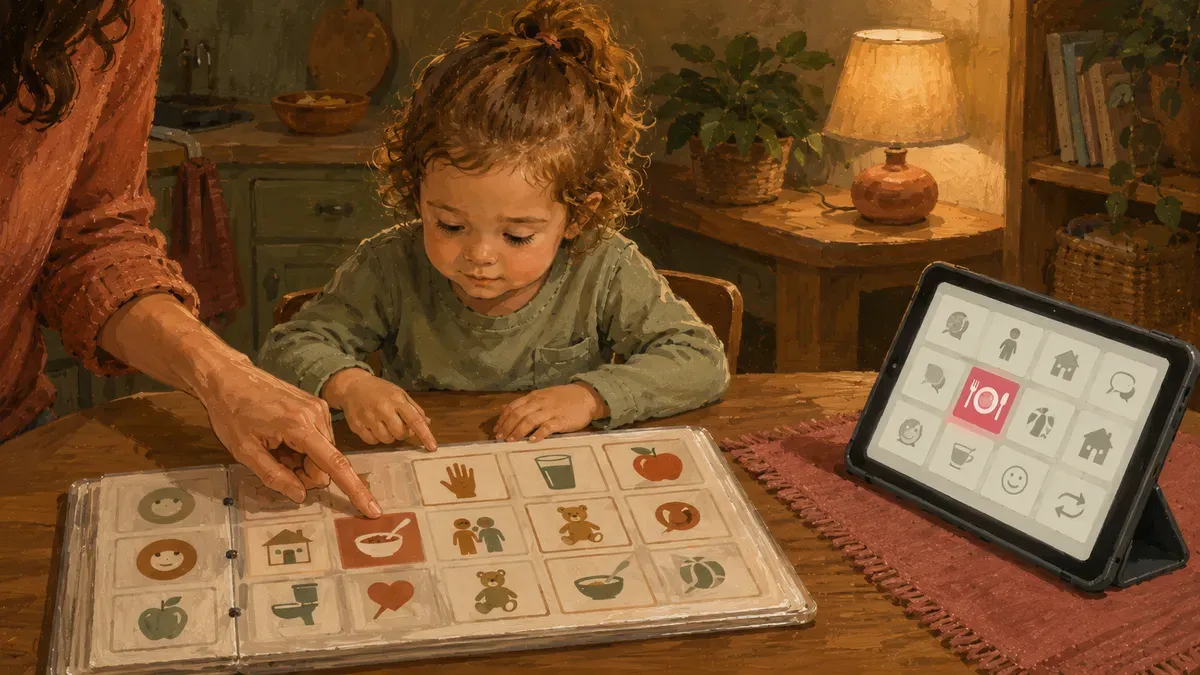
They can, with some adjustments. For kids who communicate through AAC devices, picture symbols, or pointing, the card still serves as a shared focus point while they respond in whatever way works for them. For autistic kids who love specific topics, look for or make prompts that open a door into those interests. The goal is a low-pressure turn-taking moment, not a specific verbal output, so the format is flexible enough to adapt.
Written by
Nora Hayes
Mom of two and a former preschool aide. I share the screen-free sensory play and calm-down ideas I test at my own kitchen table, plus what the moms in my little meet-up swear by. A parent passing on what works, not a doctor or a therapist.
More about NoraKeep going
All Communication & AAC-
 Communication & AAC
AAC Devices vs. PECS vs. Cards: Which Comes First
AAC devices, PECS, or cards first? See what each does, what it costs, and how to pick the right starting point for your child.
-
 Communication & AAC
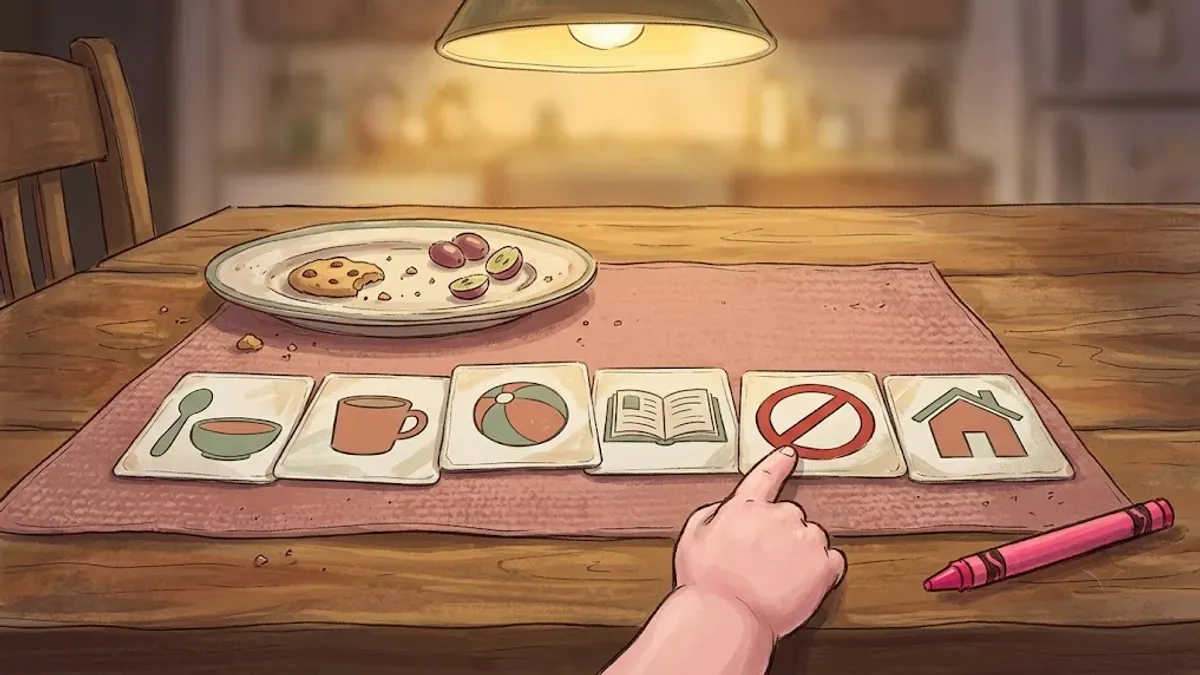
All Done PECS: 6 First-Word Cards to Cut Meltdowns
The all done PECS card is often a toddler's first word, and one of 6 first-word cards that halved our meltdowns. Print your own set free.
-
 Communication & AAC
Games for Speech Therapy: Picks for Late Talkers
Most speech games target school-age kids. These games for speech therapy pull words out of late-talking toddlers. Start playing tonight.
-
 Communication & AAC
Second Step at Home: Teach Kids Big Feelings Daily
Second Step skills don't need a classroom. Turn 15 everyday moments at home into social-emotional learning that sticks. Start tonight at dinner.