Free Printable Daily Routine Chart Kids Will Follow

Some links here are affiliate links. If you buy through one, I may earn a small commission at no extra cost to you. As an Amazon Associate I earn from qualifying purchases. I only point to things I'd actually use with my own two.
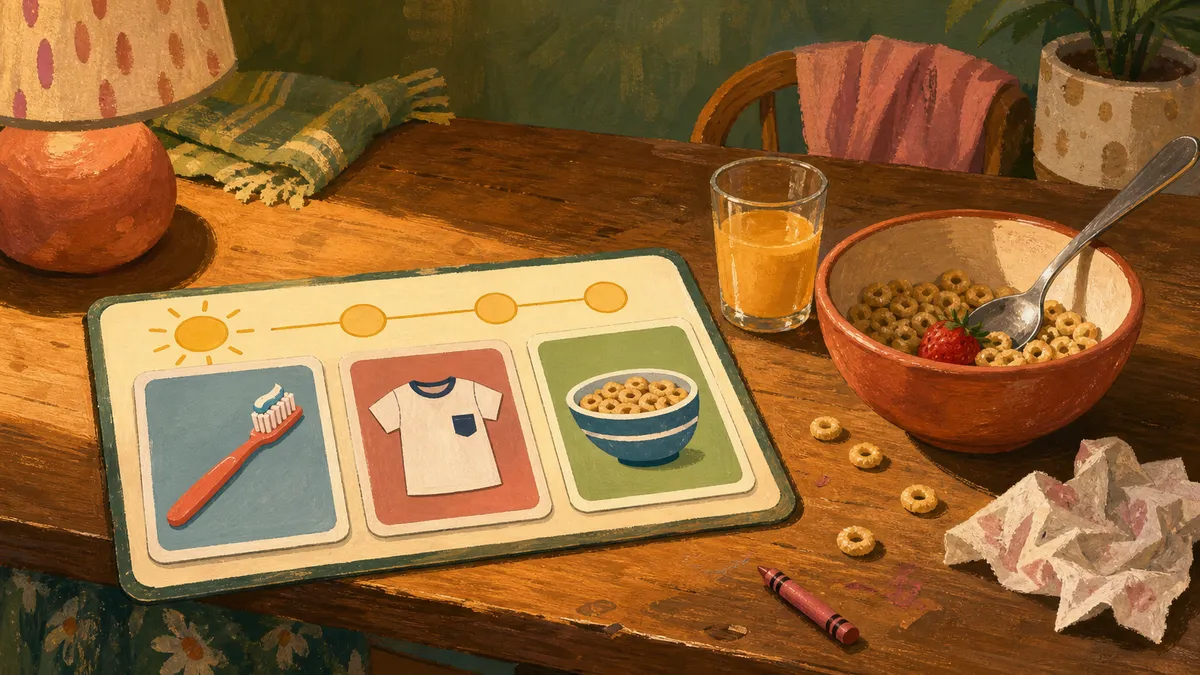
Grab a free printable daily routine chart, pick the version that matches your kid’s age, and tape it where the chaos happens, usually the bathroom door or the breakfast table. I’m Nora Hayes, a former preschool aide raising an autistic 7-year-old and a busy 3-year-old, and a picture-based daily schedule is the closest thing I’ve found to a morning that runs itself.
Below I’ll walk you through where to find a chart that’s actually free, how to choose the right one for a toddler versus a school-age kid, and how to set it up so it sticks past the first novelty week.
Why a Daily Routine Chart Works for Kids
- A child who moves through their morning without being told what comes next
- Fewer fights at the door when the schedule is on the wall, not in your head
- A steadier day for kids who need predictability to hold it together
Building Independence Without Constant Reminders
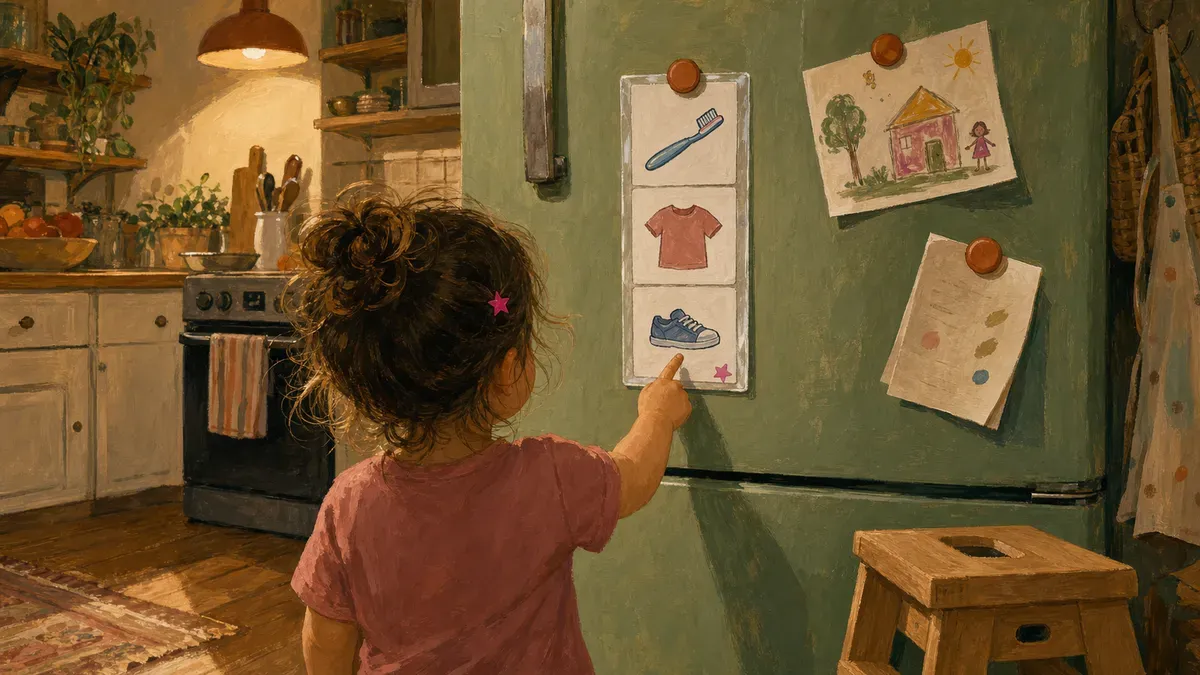
The nagging is the part that wears you down. “Brush your teeth. Did you brush your teeth? Go brush your teeth.” A daily routine chart for kids hands that job back to the child. They glance at the wall, see the picture cards in order, and figure out what comes next on their own.
The Virtual Lab School, a USDA-funded early childhood resource, describes it plainly: pictures or objects stand in for the times of day, and kids use them to move through a routine more independently.
With June, my 3-year-old, the shift was small but real. Instead of me hovering, she walks to the routine cards by the sink and points to the next one herself. She is not reading yet, and does not need to be. The pictures do the reminding so I don’t have to.
Smoother Transitions and Less Resistance
For children with ADHD or anxiety, a predictable daily schedule does the same work: the brain stops bracing for whatever comes next because it already knows what does. A chart will not solve the hard stuff. Most meltdowns don’t happen during an activity. They happen at the hand-off, and a blindsided kid digs in:
- Turning off the tablet
- Climbing into bed
A daily visual schedule fixes that by killing the surprise. When the sequence is right there on the wall, your child sees the transition coming before it lands. That little bit of warning lowers the anxiety that fuels the resistance.
For a toddler who falls apart at “two more steps,” a first-then board is the simplest version: first shoes, then park. The consistency is what does the work. Same order, same pictures, every single day, until the routine stops feeling like a fight and starts feeling like the way things go.
Support for Neurodivergent and Anxious Kids
This is where a chart stops being a nice-to-have. For a neurodivergent kid, a predictable day is regulation, not decoration. My son Eli is autistic, and a printable visual schedule is one of the few things that reliably takes the edge off a day with too many unknowns in it.
These visual supports are not just a parent hack. A children’s daily schedule is not a cure-all, but it removes the guesswork.
That is not a fix. It is just something solid to hold onto on an anxious day.
Where to Download Free Printable Routine Charts
So where do you actually find one without paying or handing over your email? Two flavors cover most homes: finished PDFs you grab and tape up tonight, and editable files you tweak first when the stock ones do not quite fit your kid.
Ready-Made PDF Charts You Just Print
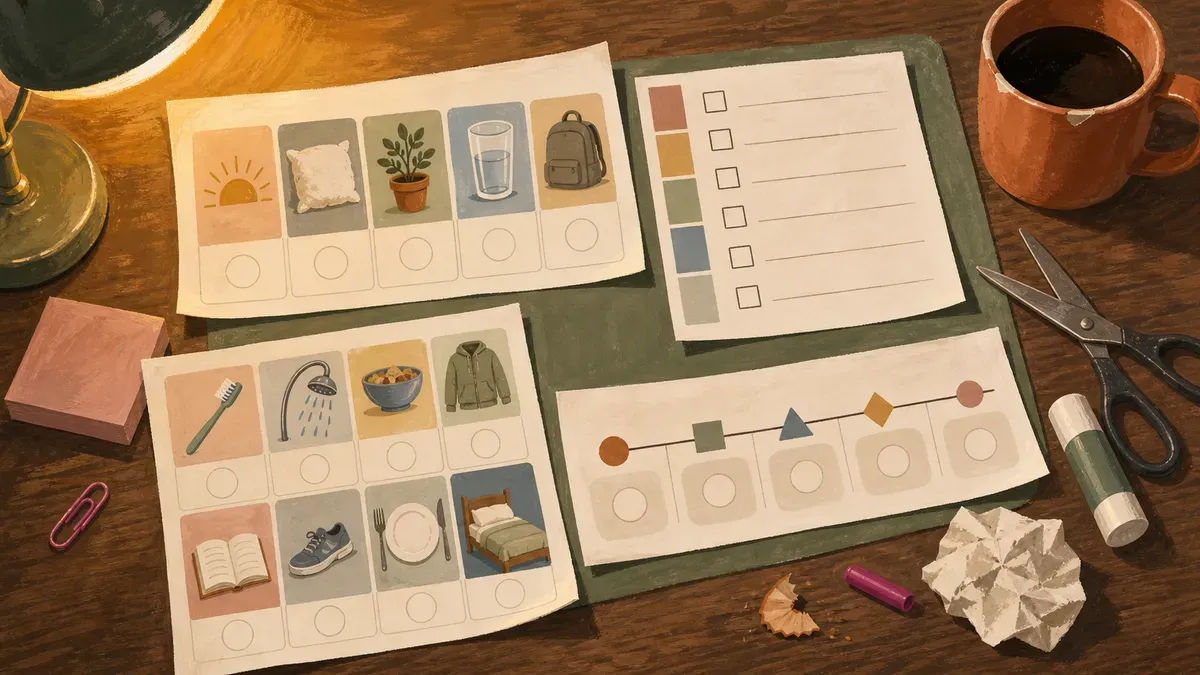
The fastest win is a done-for-you PDF. You click, it downloads, you print, you are finished. No account, no “check your inbox” dance while a toddler melts down behind you.
Look for a free printable daily schedule that already has the picture cards built in. Pre-drawn icons mean you skip the part where you hunt for clip art at 9pm. Age makes a difference in which layout actually works:
- Toddlers need pictures over words: a three-year-old reads the toothbrush icon, not the caption.
- School-age kids can handle check-off boxes and a longer afternoon block with a few written tasks alongside the icons.
Most of the genuinely good free children’s routine downloads and visual schedule charts live on parenting and teacher blogs, plus the round-ups in our visual schedules routines guide.
Editable Templates You Can Customize
Sometimes the ready-made one is close but wrong. Your kid has swim on Tuesdays, your mornings start at 6, or the chart says “homework” and yours is still in diapers. That is where an editable file earns its keep.
A free editable preschool schedule printable lets you swap the tasks, drop in your child’s name, and set your real times before anything hits paper. The same goes for a solid visual schedule template free of charge that opens in Canva or a basic PDF editor.
Look for a flexible kids schedule template you can treat like a task planner: type the activity, slide it into the timetable, print. No design skills required.
The payoff is a chart that matches your actual day instead of some stranger’s. A schedule template you control beats a perfect one you have to fight.
Matching the Chart to the Time of Day
One chart rarely carries the whole day. Mornings, the after-school slump, and the long crawl to bedtime each have their own kind of chaos, so it helps to split them into separate sets you swap in when they’re needed.
Morning and After-School Charts
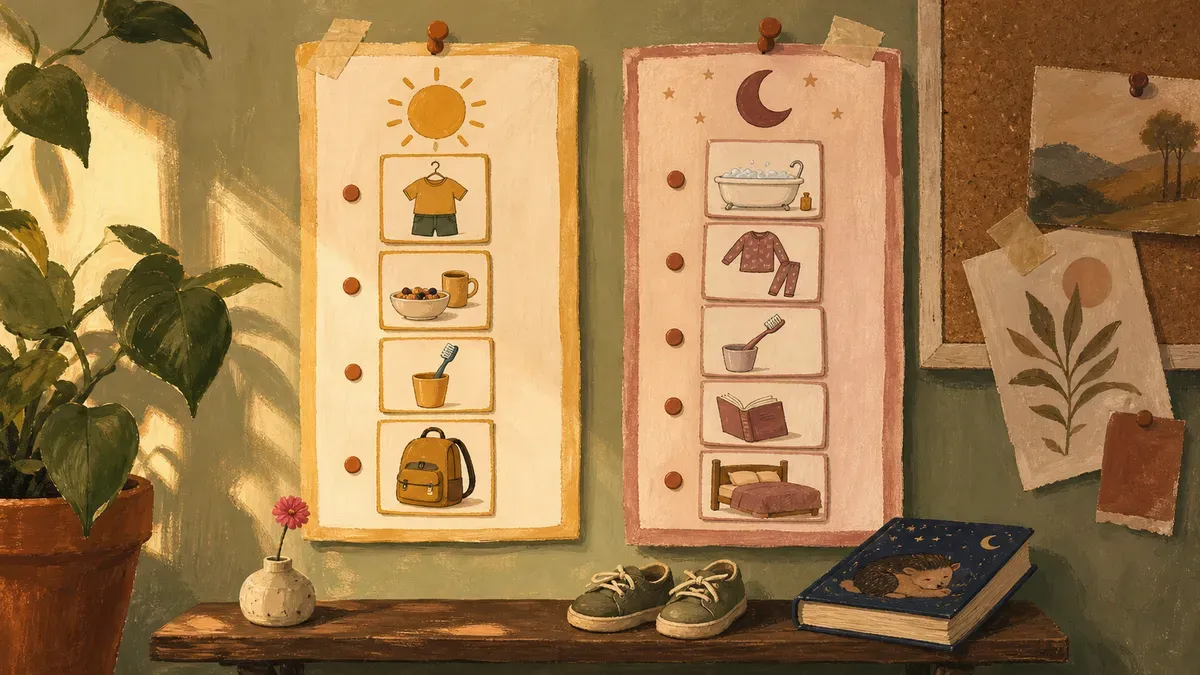
Mornings are a sprint, and a kid who has to be told every single step is a kid who makes you late. A kids daily routine chart puts the steps in front of them: get dressed, eat, teeth, shoes, backpack. They check off each one and you stop being the human alarm clock repeating yourself nine times.
The after-school block is the other busy window, and it’s a different animal. Backpack unpacked, snack, homework, then free time. Spelling out that order keeps the homework fight from starting fresh every afternoon.
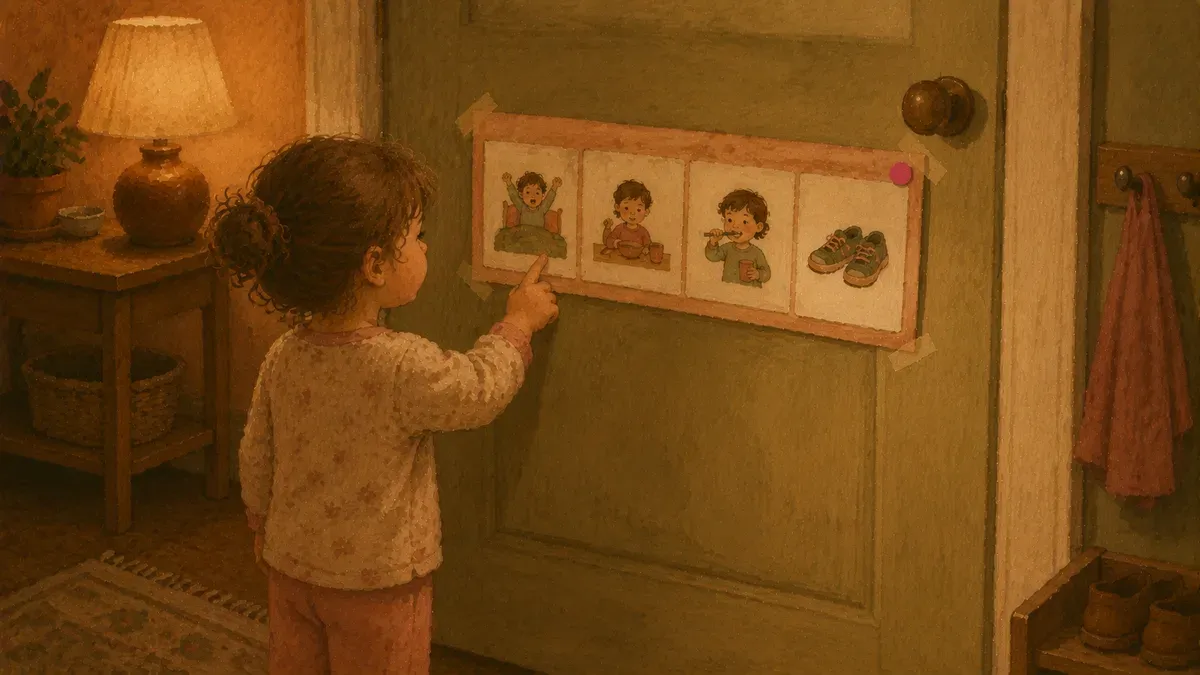
For younger kids, lean on a picture-card version where the image does the reading. We keep a children’s morning routine chart by the door for June, and the pictures alone get her most of the way out without a single nag from me.
Bedtime and Wind-Down Charts
Bedtime earns its own chart, because the steps that calm a kid down look nothing like the ones that get them out the door. A bedtime routine chart breaks the evening into the same small, repeatable steps every night: bath, pajamas, teeth, two books, lights out. That sameness is the signal. The body starts reading the routine cards and figuring out that sleep is next.
Consistency is the whole point. A predictable wind-down softens the transition from busy to still, which is usually where the nightly battle lives. There’s real weight behind it, too. A randomized trial of a 30-minute nightly routine found children fell asleep faster and woke less often once a steady bedtime sequence was in place.
Keep your children’s daily schedule for the evening short and in order. Three to five steps is plenty. A long list at bedtime is just one more thing to fight about.
Weekday Versus Weekend Sets
The school-day timetable does not belong on a Saturday, and forcing it there is how you turn a free morning into a standoff. Pair a tight weekday chart with a looser weekend one, and you keep the structure without the rigidity.
The weekday version stays detailed and time-bound, because school sets the clock. The weekend chart can drop the times and keep only the anchors: breakfast, get dressed, one chore, then go play. Same daily routine bones, way less pressure.
An activity schedule template makes this easy, since you build both off one file and just trim the weekend down. Kids still get the predictability they lean on, and you get a Saturday that doesn’t feel like a school day in disguise.
Match the chart to the day, not the other way around. A kid who knows what’s coming next argues a whole lot less about getting there.
Choosing the Right Chart for Your Child’s Age
Knowing what’s coming next only helps if your child can actually read the chart. Age shapes everything here, from whether it uses pictures or words to how many steps you include.
Toddlers and Preschoolers: Picture-Only Cards
Cox Campus, an early childhood educator resource, recommends sticking to picture-only visual schedules through preschool age. No words. Just images your kid recognizes as the thing they’re about to do.
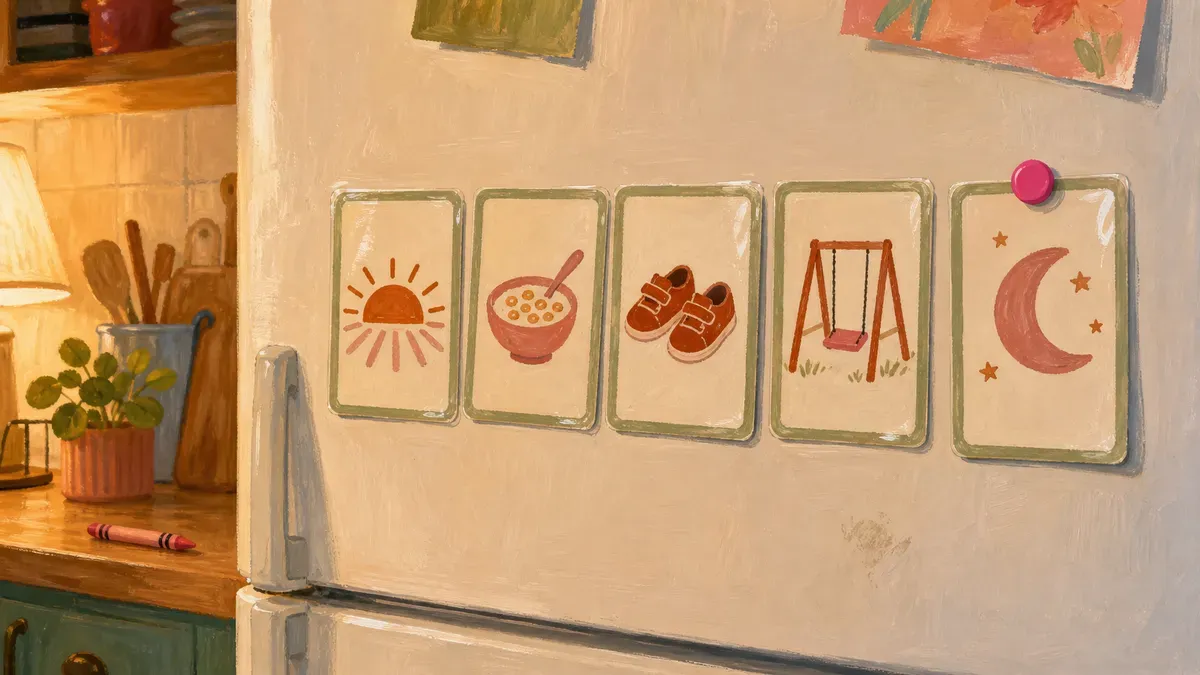
For toddlers, even a toddler schedule with three cards is plenty. Wash hands, eat breakfast, put on shoes. That’s a full kids routine chart for a two-year-old. Add a fourth step and the whole thing stops getting looked at.
Routine cards with clear pictures do the heavy lifting. Eli at three would point to his picture cards rather than answer me when I asked what came next. The card spoke for him before the words were there.
- Keep it to 2-3 steps per time of day
- Use real photos of your child doing the task if icons confuse them
- A first-then board works well if the full sequence is too much to take in at once
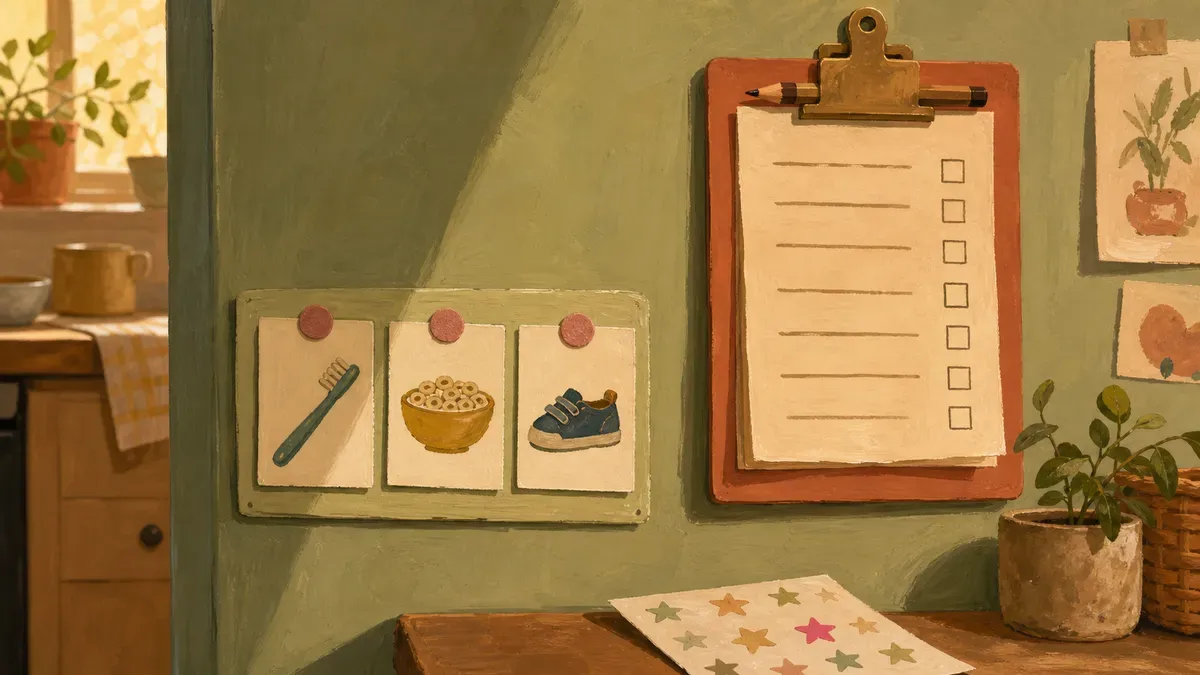
Visual supports don’t need to be fancy. A printed picture taped at eye level beats a laminated binder they can’t reach.
School-Age Kids: Checklists and Check-Off Boxes
Once they’re reading, a daily routine checklist with boxes to tick becomes the whole point. The check-off is the reward. Something about physically marking a task done clicks for school-age kids in a way verbal praise never quite matches.
A visual schedule template can bridge the gap for kids just starting to read, pairing pictures with printed words on the same card. By second grade, most are ready to drop the icons and work from a written list alone.
- Self-monitoring: kids who own their chart and check it themselves build the habit faster than kids who get a reminder from a parent
- Executive functioning: ticking a box is the practice run for planning and following through
NIH-published research found stronger executive function predicts better school readiness and academic performance, which is exactly what an independent daily checklist quietly builds.
Keep the task planner to one page, school-age or not. A two-page routine rarely gets finished.
Printing, Assembling, and Reusing Your Chart
One good print is worth a hundred reminders. Here’s how to make it last and make it actually work.
- Make it durable: laminate each card and back it with velcro so your child can handle it every day without it falling apart.
- Make it stick: run a short reward phase for the first few weeks, then fade it out once the routine is automatic.
Laminate and Add Velcro for Daily Reuse
Printing once and taping it to the wall is fine for a trial run. But if the routine is sticking, laminate it.
A laminated chart wipes clean with a damp cloth, survives sticky fingers, and holds up to the kind of attention a three-year-old gives anything she really loves. Take your printable routine cards to a local print shop, or buy a home laminator if you’ll reuse it. And you will: every chart, every school project, every recipe card from here on. The Scotch PRO TL906 is the one I’d hand a beginner. It’s an Amazon’s Choice pick with 12,000-plus reviews at 4.6 stars, it’s warm in about five minutes, and it swallows a full 9-inch sheet without chewing it up. Check the current price on Amazon, then run each card through and cut them apart.
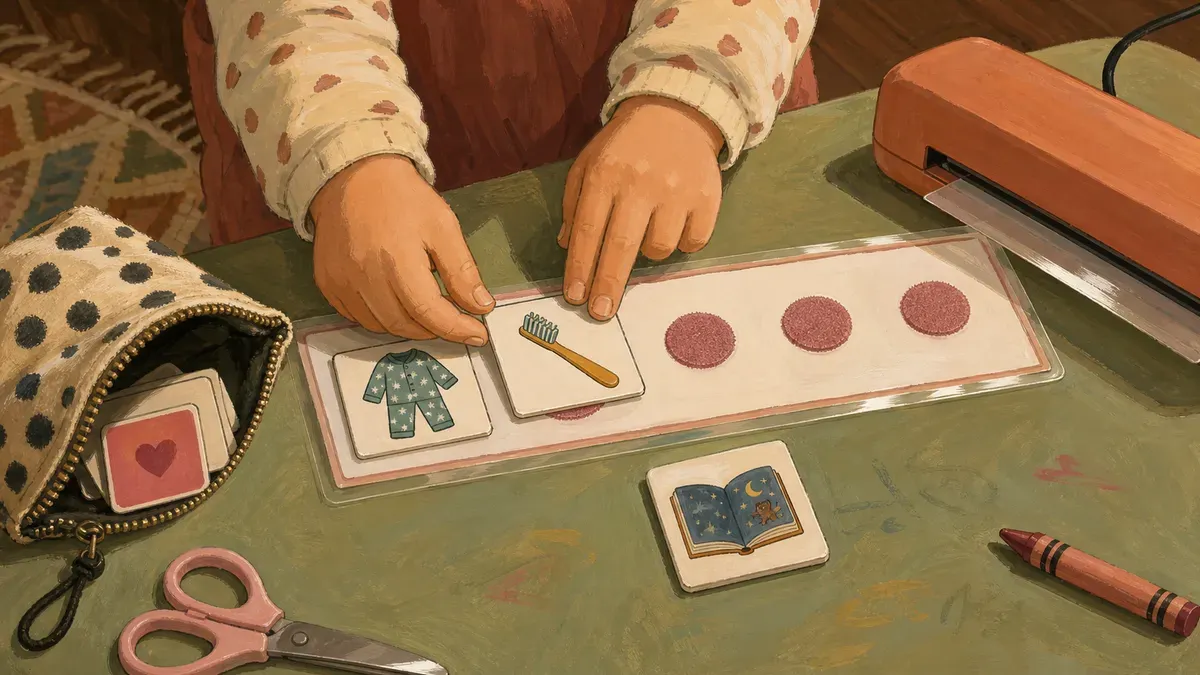
Next, press a small piece of velcro to the back of each card and a matching piece to the board. I keep a bag of self-adhesive velcro dots in the craft drawer for this exact job; one pack is 500 pairs, so it outlasts this chart and the next dozen. They’re the #1 best seller in adhesive dots, and 2,000-plus parents give them 4.7 stars. Now your child can pull off each card as they finish the step, move them into a “done” pocket, or rearrange them when the morning order shifts. That last part matters more than it sounds. Kids who can physically handle their own cards engage with them longer and argue about them less.
For visual schedules meant to travel, slip the laminated cards into a see-through mesh pouch and toss it in the car or the diaper bag. The set I reach for comes four to a pack (4.7 stars, 700-plus reviews), so morning cards go in one color and bedtime in another, and you can tell which is which without unzipping a thing.
Add a Simple Reward to Reinforce the Habit
A new routine needs a reason to exist until the habit takes over. A sticker or a token board gives that early motivation without turning it into a negotiation.
Pick one small reward your kid actually cares about. When they complete the routine without a prompt from you, they earn it. That’s the whole system. If you’d rather not draw one yourself, a reward chart pack with star stickers hands you 80 ready-made charts and 2,160 stickers, which outlasts even the stickeriest three-year-old; it’s an Amazon’s Choice with 600-plus reviews at 4.6 stars.
- Use the reward for the first two to four weeks
- Fade it gradually, not all at once
- Let independence become the motivator once consistency is there
Most kids stop needing the external push after a few weeks. The transition to doing it on their own is the goal, not the reward itself. When the sticker chart comes down and the routine keeps running, that’s when you know it worked.
Making the Routine Actually Stick
Getting the chart printed and laminated is the easy part. What comes next, actually persuading a three-year-old to follow it, takes a different kind of work.
Introducing the Chart to a Reluctant Child
Some kids walk up to a new chart and start pointing. Others shove it off the counter. If yours is the second type, the chart itself isn’t the problem. The problem is that it landed as another rule they had no say in.
Fix that by handing them the pen, literally. Let them pick which pictures go on the routine cards. Let them tape the card to the wall. Ask them where they want it to hang. That shift from “your mom made this” to “I made this” does more for consistency than any reward. Anxiety around transitions often comes from the feeling that things are happening to them. Giving a child real choices inside the routine removes that edge.
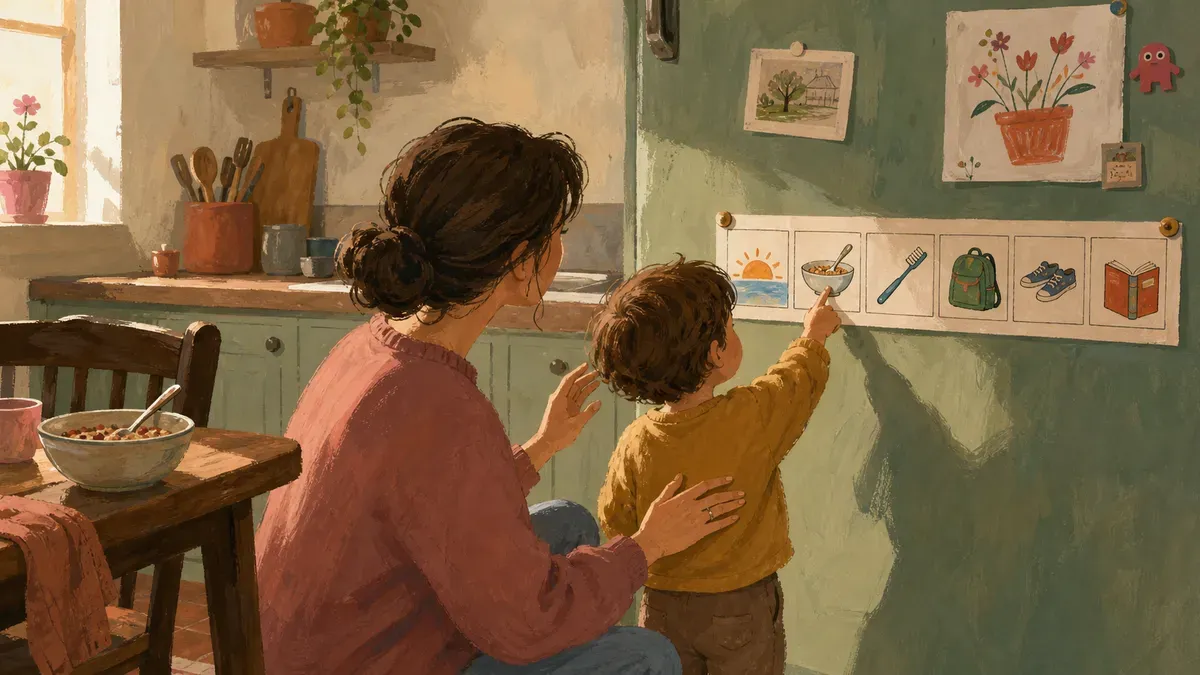
For bedtime routines for 3 year olds, letting a toddler arrange picture cards in order the night before the chart goes up can be enough buy-in to make the next morning run smoother.
Fading the Chart Into an Independent Habit
Once the daily routine runs without much prompting for a couple of weeks, it’s time to step back. Not abandon. Step back.
Research published in the NIH’s PMC archive finds that children who help plan a routine cooperate more willingly because they feel ownership rather than obligation. That kind of internally motivated consistency is what builds executive functioning over time. The chart is scaffolding. The independence is the building.
Start by removing one prompt: instead of pointing to the chart, ask “what’s next?” Then ask less often. Then stop asking. The chart stays on the wall, just doing less of the work each week.
When the daily routine holds on its own, browse our full library of visual schedules and routines to find what your child might need next. The routine is theirs now.
Found this useful? Save it for the next rough afternoon.
Questions parents ask me about this
Where can I get a free printable daily routine chart for kids?
Several parenting and education sites offer free downloads with no sign-up required. Look for PDF versions you can print immediately, or editable templates you can customize in a browser before printing. The body of this article links directly to reliable sources.
What age should a child start using a daily routine chart?
Most kids can start benefiting from a picture-based chart as young as two. Toddlers do best with two to three steps maximum, using photos or simple drawings rather than words. School-age kids can handle a written checklist with check-off boxes.
How do I make one routine chart work for multiple children with different schedules?
The cleanest approach is separate charts side by side rather than one shared chart. Younger kids need pictures; older kids can follow text. If you want a single chart, editable templates let you create two versions from the same file before you print.
Are there app or digital alternatives to a printed routine chart?
Yes, several apps offer visual schedule features, including timer countdowns and audio cues. That said, a printed chart has no screen glare, no notifications pulling a kid sideways, and nothing to charge overnight. For most families, paper at the right height in the right spot outperforms the app version.
What should a daily routine chart for kids include?
Start with the transition points that cause the most friction: morning (get up through out the door), after school, and bedtime. Each block should show tasks in order, with a picture or icon for younger kids. Keep the bedtime chart to three to five steps so it signals wind-down, not a long to-do list.
Do routine charts help children with autism or ADHD?
Visual supports are a well-documented tool for autistic children and appear in IEPs across age groups. For kids with ADHD, the chart offloads the sequencing work so they are not relying on working memory to figure out what comes next. The chart does not replace a therapist or a behavior plan, but it can reduce daily friction noticeably.
How long does it take for a routine chart to start working?
Most families see less resistance within a week or two of consistent use, though the first few days often feel like more work, not less. The key is placing the chart where the task actually happens and reviewing it with your child at the start of each routine until they start checking it on their own.
Written by
Nora Hayes
Mom of two and a former preschool aide. I share the screen-free sensory play and calm-down ideas I test at my own kitchen table, plus what the moms in my little meet-up swear by. A parent passing on what works, not a doctor or a therapist.
More about NoraKeep going
All Visual Schedules-
 Visual Schedules
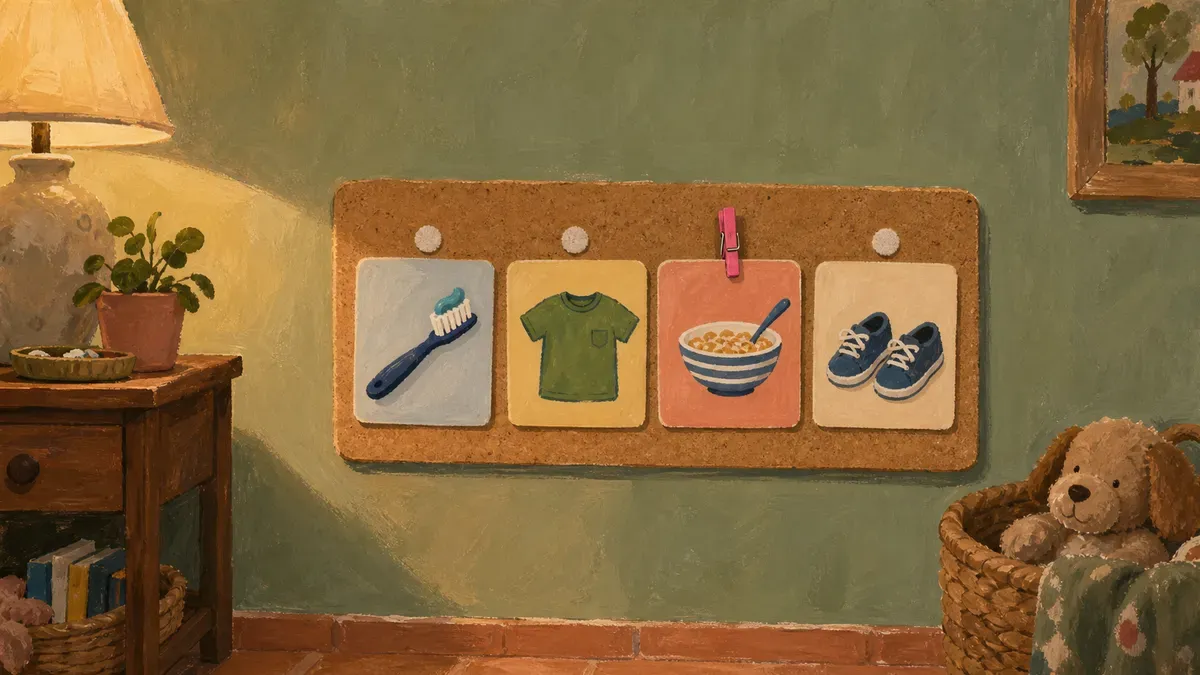
Visual Schedule Printable: 20 Picture Cards + Free PDF
Visual schedule printable with the 20 picture cards every toddler home needs. Free PDF to download, print, and start using tonight.
-
 Visual Schedules
Visual Schedules: A Beginner's Guide for Parents
Most visual schedules fail before day three. Learn how they work and build your first board in 5 steps your child will actually follow. Start today.
-
 Visual Schedules
Toddler Schedule: Build One With Picture Cards
Your 2-year-old can't read a clock yet. Build a toddler schedule with picture cards in 5 steps that stop nap fights and meltdowns. Start today.
-
 Visual Schedules
Morning Routine Printable: Make One Kids Follow
Stop the morning yelling. This morning routine printable gets kids out the door on their own in 15 minutes. Grab the free chart and build it today.