What Is Montessori? A Parent's Guide to Starting at Home

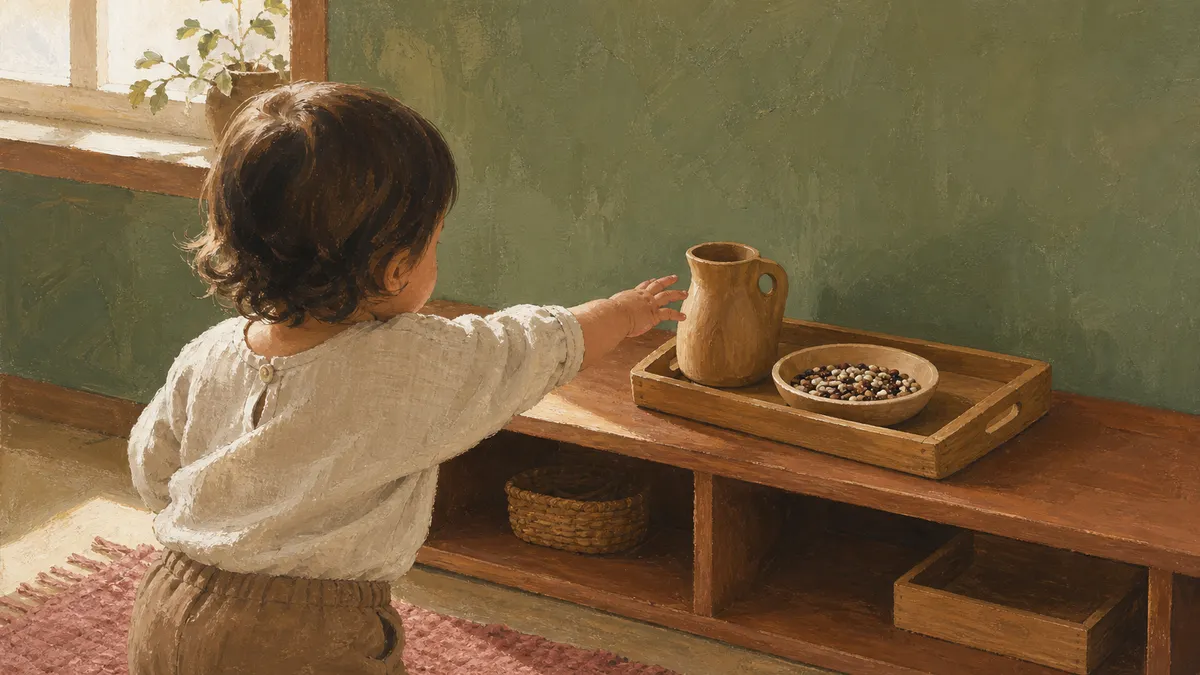
I’m Nora Hayes, a former preschool aide turned stay-at-home mom, and Montessori at home is how I set up our space so my toddler can work independently, at her own pace, on real tasks with her hands.
It works because kids this age are wired to do, not watch, and a prepared environment channels that energy into focused play instead of chaos. This guide walks you through the core principles, what a Montessori space actually looks like, and the first five trays you can set out at home this week.
What Montessori Actually Means
Two things define this approach: who drives the work, and what that work looks like. Start with the plain-language definition, then the story of where the method first took shape.
A Plain-Language Definition
Montessori is a child-led education approach built on hands-on learning and independence. The child chooses their work, does it with real objects, and repeats it until they’ve got it. No adult decides when it’s time to move on.
In Montessori schools, there’s no lesson at the front of the room. A three-year-old might spend the entire morning moving dried beans from one bowl to another with a spoon. Another child traces sandpaper letters while someone else practices pouring water. The work itself does the teaching (the concentration, the muscle control, the sorting logic) without anyone directing it.
The definition of Montessori that actually matters: the child leads, the materials teach, and the adult steps back.
That’s what student-directed work means in practice. It’s also why hands-on learning and independence aren’t just buzzwords in this method. They’re the whole structure. Deciding is Montessori good for your child really comes down to one question: can they handle choosing their own work?
Maria Montessori and the First Children’s House
The Montessori method was built on observation, not theory. Dr. Maria Montessori developed it by watching what children actually did when given the space to direct their own learning.
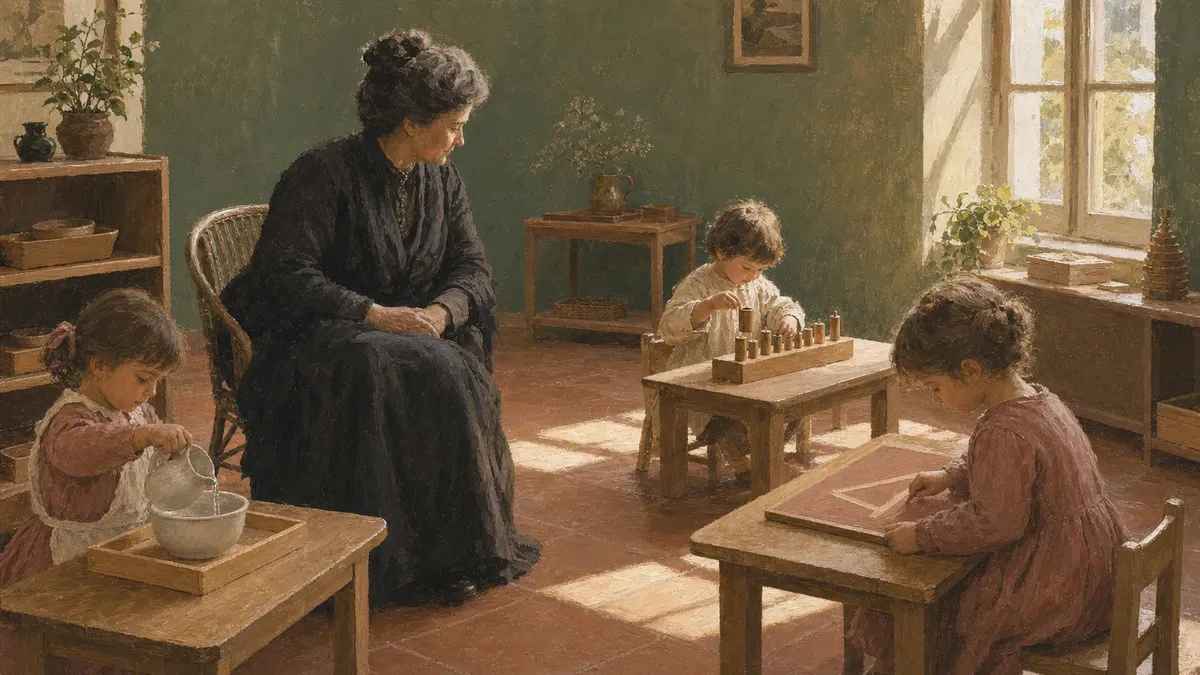
According to the origins of the Montessori method, the first Casa dei Bambini opened on January 6, 1907, in the San Lorenzo district of Rome, serving roughly 50 children ages 2 to 6 from families where parents worked long hours and kids were largely unsupervised. What she observed in that prepared environment changed everything: when children were given freedom and appropriate materials, they showed an “astonishing, almost effortless ability to learn.” That observation became the foundation the Montessori method stands on today.
How Montessori Works: The Core Principles
Three principles drive the Montessori method, and once you see how they connect, the rest of the approach clicks.
Follow the Child: Letting Kids Lead
“Follow the child” is not passive. It means watching for the windows when a child is pulled toward something (pouring, sorting, arranging) and stepping aside so concentration can deepen.
The American Montessori Society identifies six sensitive periods in the first six years: order, language, movement, social behavior. These are windows when a child is “biologically ready and receptive to acquiring a specific skill or ability,” and their research on how young children learn through hands-on play shows why. More on maria montessori theory.
The Prepared Environment
A prepared environment is a room at the child’s scale:
Freedom within limits: the child chooses the work; the shelf defines the options.
- Low shelves so materials are reachable without asking
- Real objects rather than simplified toy versions
- Clear order so everything has a place to return to
Uninterrupted work periods hold what the environment sets up. Uninterrupted work periods protect what the environment sets in motion. A child who can act without waiting gains independence from the adult.
The Adult’s Role: Guide, Not Instructor
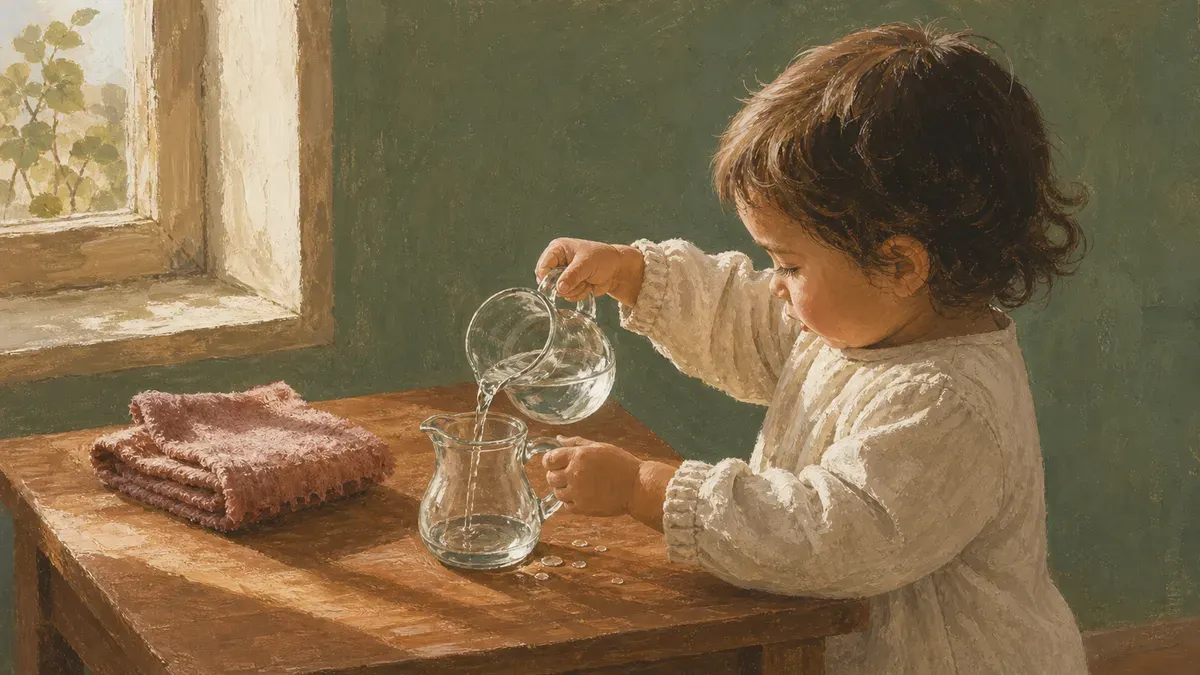
The guide demonstrates an activity once, slowly, then steps back. Observation replaces instruction. A child who works through a problem without being rescued builds normalization: calmer, more focused, and more likely to return to the work.
When a child works through a problem without rescue, normalization builds: a calmer, more focused child who returns to the work on their own. The guide’s job is to keep from breaking that.
Inside a Montessori Classroom and Curriculum
What happens in the room tells you more than any brochure. The structure, the age mix, the shelves: these are the things worth understanding before you visit a school or try anything at home.
Mixed-Age Groupings
A Montessori class groups children across a three-year span rather than a single grade. Three-to-six-year-olds share the same room; six-to-nine and nine-to-twelve do the same. Younger children absorb skills by watching older peers work, well before any formal lesson. Older children reinforce what they know by teaching it, which turns out to be genuinely better review than a worksheet.
These multi-age classrooms ease the pressure of age-based benchmarking. A child working two levels ahead or behind isn’t out of place. Long, uninterrupted work periods, usually two to three hours in the morning, hold the whole thing together. That same normalization described above is what makes those long work periods possible.
The Five Areas of the Curriculum
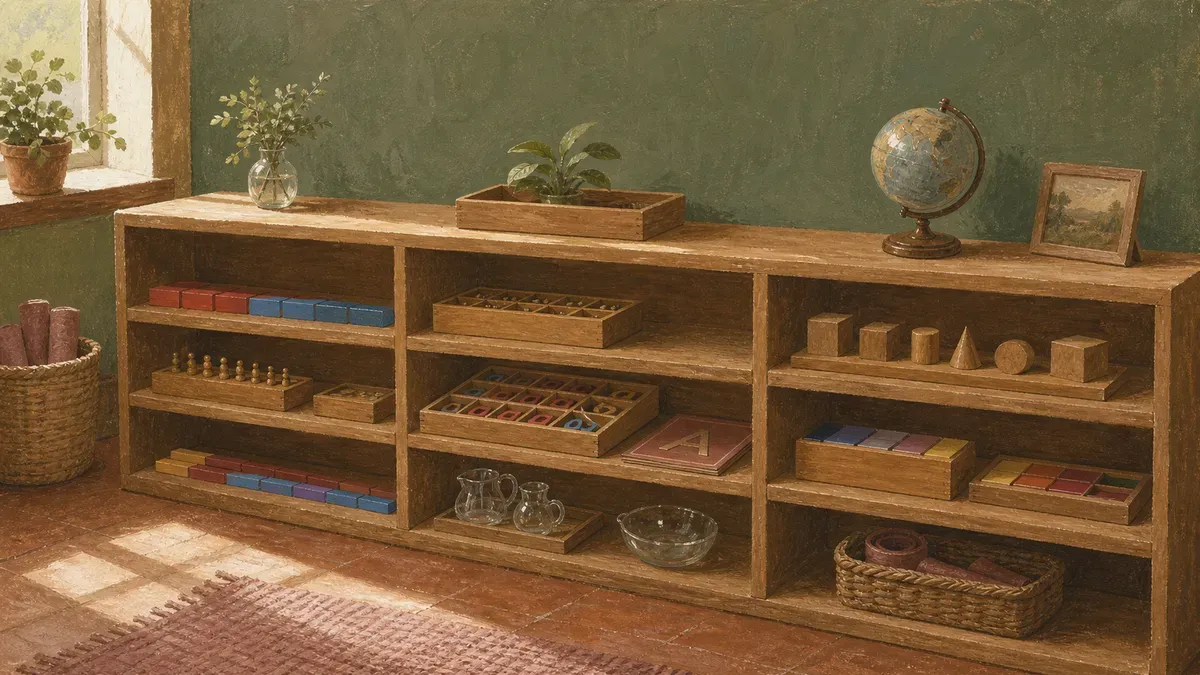
The full Montessori preschool curriculum and syllabus divides into five areas, each on its own shelf:
- Practical life: pouring, buttoning, sweeping. Builds concentration and fine motor control before academics start. Montessori practical life activities are mostly things you already own.
- Sensorial: sorting by color, texture, size, and weight to sharpen perception
- Language: letter sounds, moveable alphabets, early writing
- Mathematical materials: number rods, spindle boxes, golden beads; abstract ideas made concrete
- Cultural / cosmic education: geography, biology, art, and history woven together
A 2025 study published in PNAS on the nationwide Montessori cost-and-outcomes findings in randomized classrooms found these teaching activities ran $13,127 less per child over three years than conventional preschool, because mixed-age peer learning reduced the need for direct adult instruction.
Programs by Age, From Infancy Up
Montessori early childhood education runs from birth. The infant-toddler program, sometimes called Nido or the Montessori baby track, starts as young as six weeks. Early childhood covers ages three to six; elementary runs six through twelve.
The catch: “Montessori” is not a protected name. Chains like Learn and Play Montessori and smaller programs such as Project Montessori, Montessori for All, and Montessori and Me all vary in what they actually do. Accreditation is the credential that distinguishes an authentic program from one that borrows the name without meeting established standards. When you tour a school, ask about teacher training and accreditation. The label alone tells you nothing.
Setting Up Montessori at Home
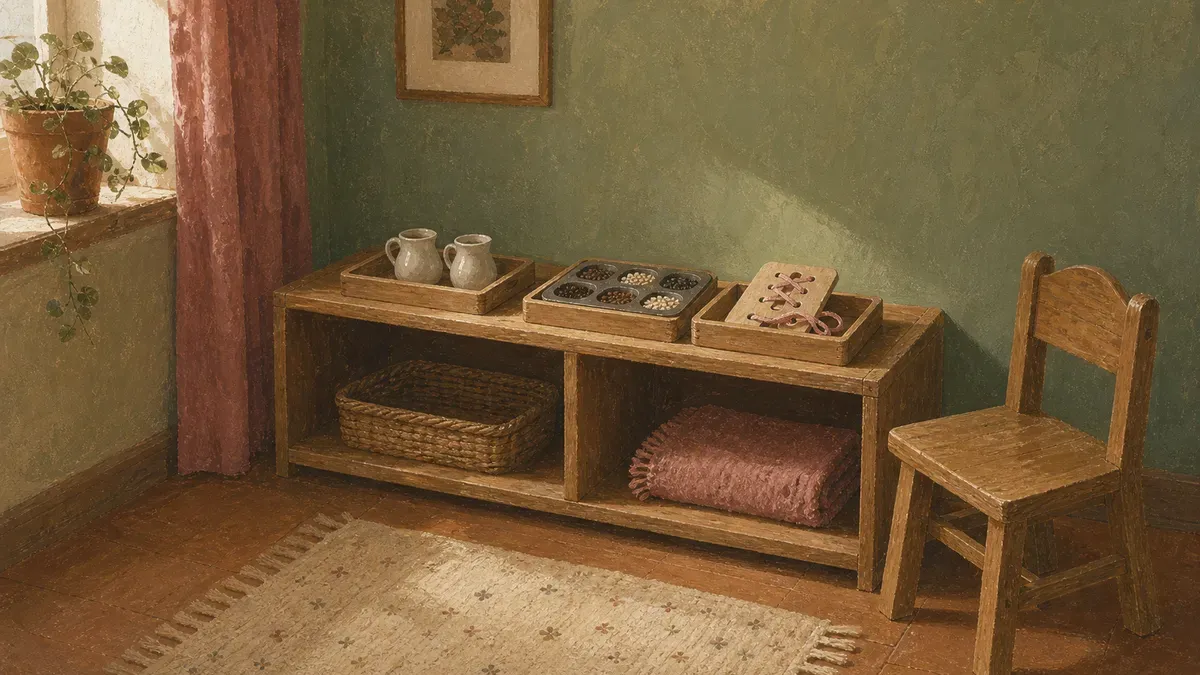
You don’t need a dedicated room or a catalog order to get started. The three things that matter most are a low shelf, an uncluttered space, and materials your kid can reach without asking.
Start With a Single Shelf
One low shelf, three to five trays, and you have a prepared environment. That’s the whole setup. Pick items your child can use independently without your help: a small pouring activity, a simple puzzle, a lacing card. They choose what to work on, and everything on the shelf is something they can actually finish. Resist the urge to fill every spot. Empty shelf space isn’t failure; it’s room to focus. For more on setting up a Montessori environment, that’s the place to dig deeper.
Making It Work in a Small Space
Apartments and small homes handle this better than you’d expect. The key is rotation. Keep four or five learning materials out at a time, swap one in when your toddler loses interest, and store the rest out of sight. A small corner with a low shelf becomes a prepared environment that stays inviting precisely because it’s not overwhelming.
Doing Montessori on a Budget
The expensive branded materials are nice. They’re also optional. Practical life activities like pouring water, spooning beans, and washing a small dish need a small pitcher, a bowl, and a sponge. That’s it. A muffin tin and some dried pasta is a sorting tray. A wooden spoon and a pot of rice is a sensory bin. For tips for creating a child-friendly home space on the cheap, the pantry is your starting point. Hands-on learning doesn’t require a specialty store.
The First 5 Trays to Try This Week
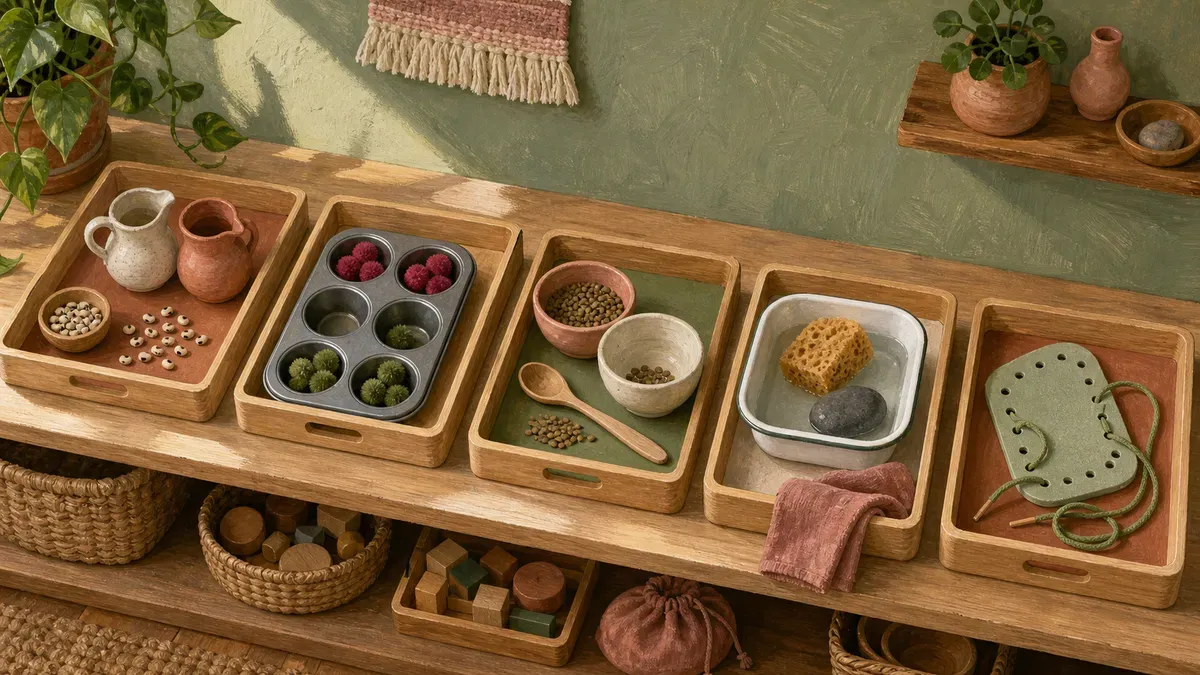
Start with practical life. These are the activities that don’t need any explanation and don’t require anything special from your kid. Pouring, sorting, transferring. Kids do this stuff anyway. You’re just giving it a tray and a purpose.
Here are five that work for most toddlers and preschoolers right out of the gate:
- Pouring tray. Two small pitchers, some dried beans or water. Scoop from one pitcher to the other. Concentration lock-in happens fast. Cleanup is one swipe.
- Sorting tray. A muffin tin and two types of objects (buttons, pompoms, pasta shapes). One object per cup. The independence is real: they figure it out without you hovering.
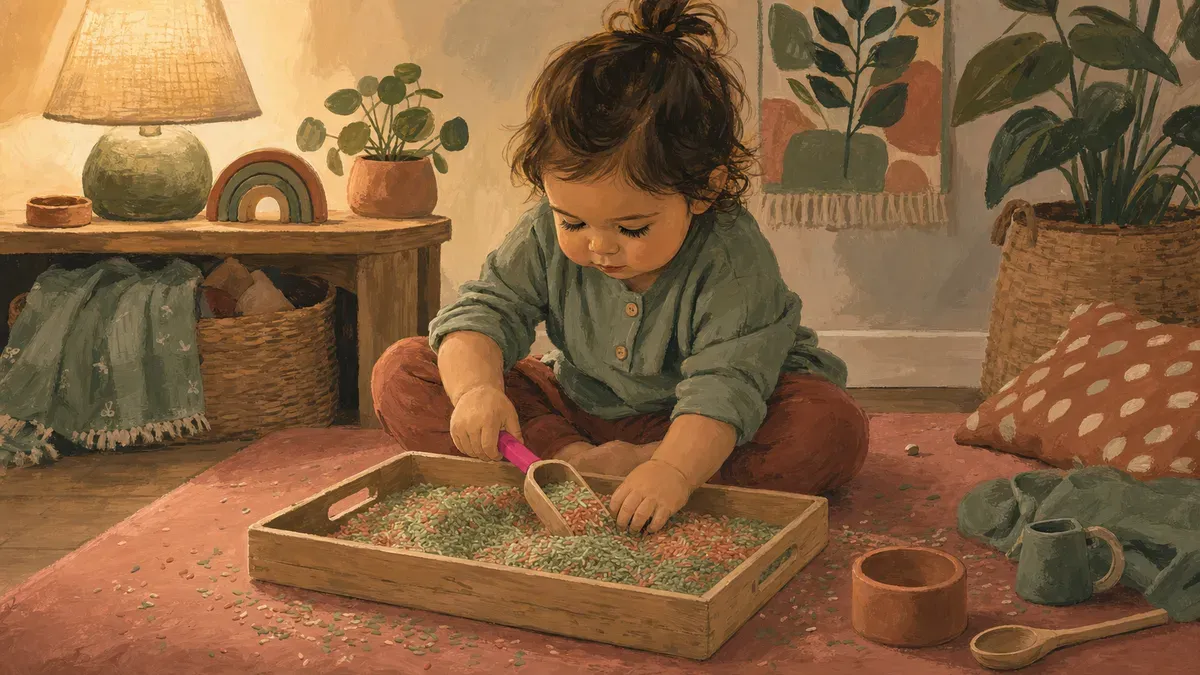
- Spooning tray. Two bowls, a spoon, some rice or dried lentils. Same idea as pouring, different grip. Fine motor work without the word “fine motor.”
- Washing tray. A small basin, a sponge, a bar of soap, a few plastic fruits or small smooth rocks to wash. Practical life at its most literal. My daughter June did this for 25 minutes the first week we set it up.
- Lacing card. A piece of foam or cardboard with punched holes, a shoelace. Quiet, focused, completely self-directed. Great follow-up when they need to wind down after the messier sensorial materials.
None of these need anything beyond what you likely have at home. Rotate one or two trays each week so the center of the shelf stays fresh without adding more stuff.
Pick one tray this week, not five. Watch how your kid uses it before you add another activity. That’s how you learn what actually holds their attention.
If you want ready-to-use montessori activities printables that match these trays, those are a quick way to add a visual component without making anything from scratch. Otherwise, a handwritten label on a piece of tape does the same job.
Common Beginner Mistakes to Avoid
The trays are ready. Then nothing goes as planned.
Three mistakes show up over and over:
- Too much, too soon. Swapping trays before your child has settled into any of them. Rotation is good; churn before concentration sets in isn’t.
- Confusing freedom with “anything goes.” The prepared environment has real structure. A tray goes back to the shelf when a child is done. That order is how independence actually develops.
- Helping too fast. Wait a beat. Watch. Most kids figure it out before you think they will, and observation is how you find what they’re actually ready for.
The “freedom within limits” piece is the one that trips people up most. The limits aren’t punitive; they’re the container that makes self-direction feel safe.
Browse our growing library of Montessori activities and printables when you’re ready for more trays.
Found this useful? Save it for the next rough afternoon.
Questions parents ask me about this
What does a typical Montessori day look like at home?
At home, a Montessori day is less about a schedule and more about rhythm. You set up one or two trays on a low shelf, let your child choose what to do, and step back while they work. Short focused stretches, some outdoor time, and practical life mixed into the real day (cooking, folding, pouring) is what it looks like in most homes.
What age should children start Montessori?
Montessori works from infancy through elementary, so there is no wrong starting age. For toddlers at home, anywhere from 18 months up is a natural entry point, since practical life trays like pouring and sorting are well within reach at that stage. If you are just beginning, start with one tray at whatever age your child is now.
Do you need special training to teach Montessori at home?
No formal training is required to bring Montessori home. The core moves are simple enough to learn from books, blogs, and observation: follow the child, prepare the environment, and stay out of the way when they are focused. Training helps if you want to run a school or go deep, but a low shelf and a few trays are all you need to start.
How does Montessori handle discipline and boundaries?
Montessori uses what it calls "freedom within limits." Children choose their work and direct their own time, but the structure of the environment sets the boundaries without a parent having to enforce rules constantly. Limits in Montessori are about protecting the activity and the space, not punishing the child.
Does Montessori allow screen time?
Traditional Montessori de-emphasizes screens, particularly for young children, favoring hands-on, real-world materials instead. At home, most families find a middle ground: screens happen, and that is fine. The Montessori piece is just making sure there is also time each day for uninterrupted hands-on work.
Can you combine Montessori with regular school?
Yes, and many families do exactly that. You do not have to choose one or the other. Practical life, sensorial trays, and the general posture of following the child's lead all translate into any home, regardless of what happens at school during the day. Even one Montessori-style shelf at home adds something real.
Written by
Nora Hayes
Mom of two and a former preschool aide. I share the screen-free sensory play and calm-down ideas I test at my own kitchen table, plus what the moms in my little meet-up swear by. A parent passing on what works, not a doctor or a therapist.
More about NoraKeep going
All Montessori-
 Montessori
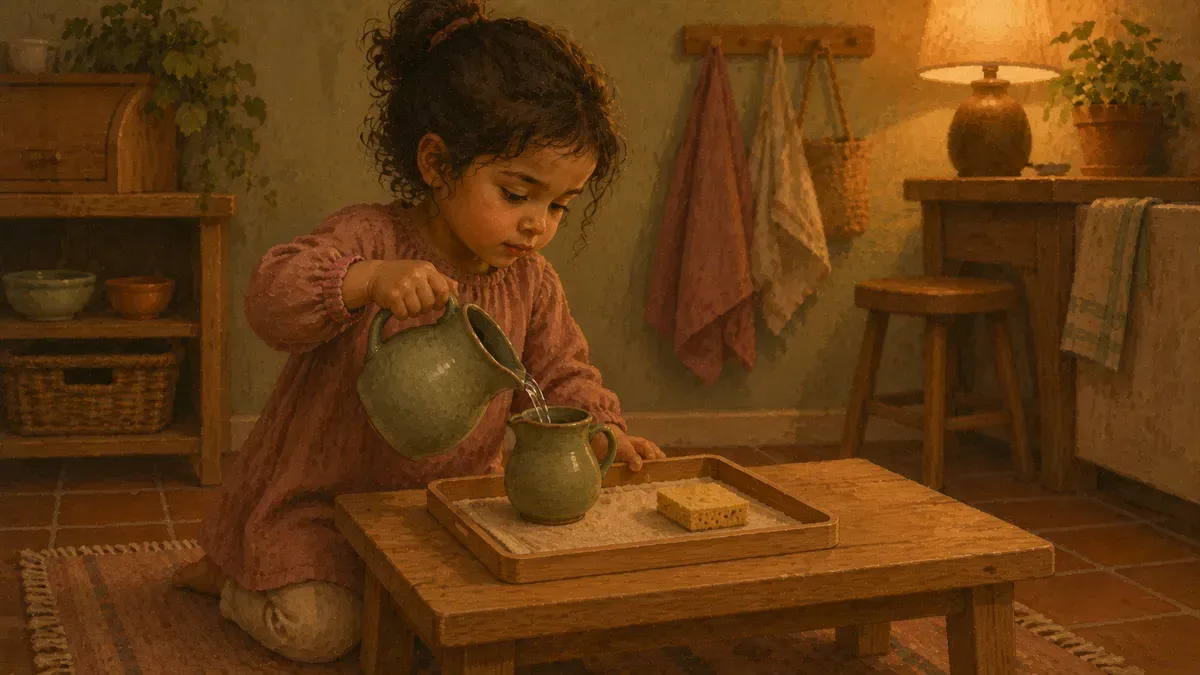
Montessori Activities for 3 Year Olds That Build Skills
At 3, kids crave real work, not toys. These Montessori activities for 3 year olds build focus, coordination, and independence. Start one today.
-
 Montessori
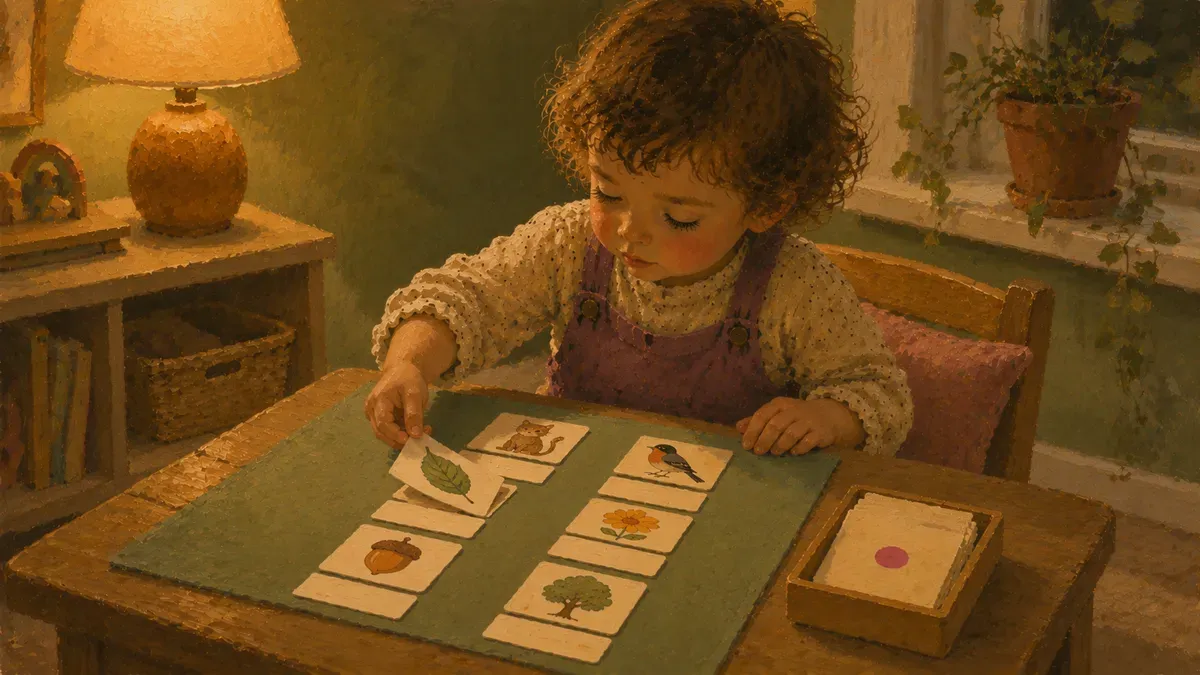
Step by Step Montessori 3-Part Cards Walkthrough
Confused by 3-part cards? This step by step Montessori walkthrough shows the exact order to present them so your child matches and self-corrects.
-
 Montessori
Sensorial Montessori Activities That Calm Toddlers
Sensory-seeking toddler heading for a meltdown? These 10 sensorial Montessori activities calm and refocus little hands fast.
-
 Montessori
Practical Life Montessori: 20 Kitchen Activities
Practical life Montessori starts in your kitchen. Get 20 no-buy activities using spoons, jars, and bowls you own. Set up a tray today.