Practical Life Montessori: 20 Kitchen Activities


Practical life Montessori is the simple idea that real chores, pouring, scooping, spooning, are the work little kids actually crave, and you can run most of it straight from your own kitchen drawers. I’m Nora Hayes, a former preschool aide and mom of two, and I’ve watched a wound-up 3-year-old settle the moment she gets a jug of water and a job that’s hers alone.
Below you’ll find what these hands-on Montessori tasks actually are, how to set up your first tray, and 20 activities built from stuff you already own.
The plan in brief:
- Pick three kitchen items: a small jug, two bowls, and a spoon.
- Set one task per tray at child height so they can reach it alone.
- Demonstrate the activity slowly once, then step back and let them repeat it.
What Practical Life Means in Montessori
These are the real, everyday tasks: washing hands, setting a table, pouring a drink, sweeping up crumbs. Self-care, home care, courtesy, and purposeful movement. That’s the whole category. If you want the full background on what is montessori and how this approach works at home, that page lays the foundation.
The Four Areas Every Activity Falls Into
The Montessori method’s principles of practical life organize every task into four buckets: care of self, care for the environment, grace and courtesy, and movement of objects (sometimes called motor control exercises). That’s it. Washing hands is care of self. Wiping a table is care for the environment. Saying thank you and passing food politely is grace and courtesy. Pouring rice from one bowl to another is movement of objects.
Food prep sits across all four at once, which is why it shows up constantly in Montessori kitchens. Once you see the four areas, you can slot almost any household task your kid might do into one of them, and suddenly the curriculum is just your morning routine.
Why Process Matters More Than the Result
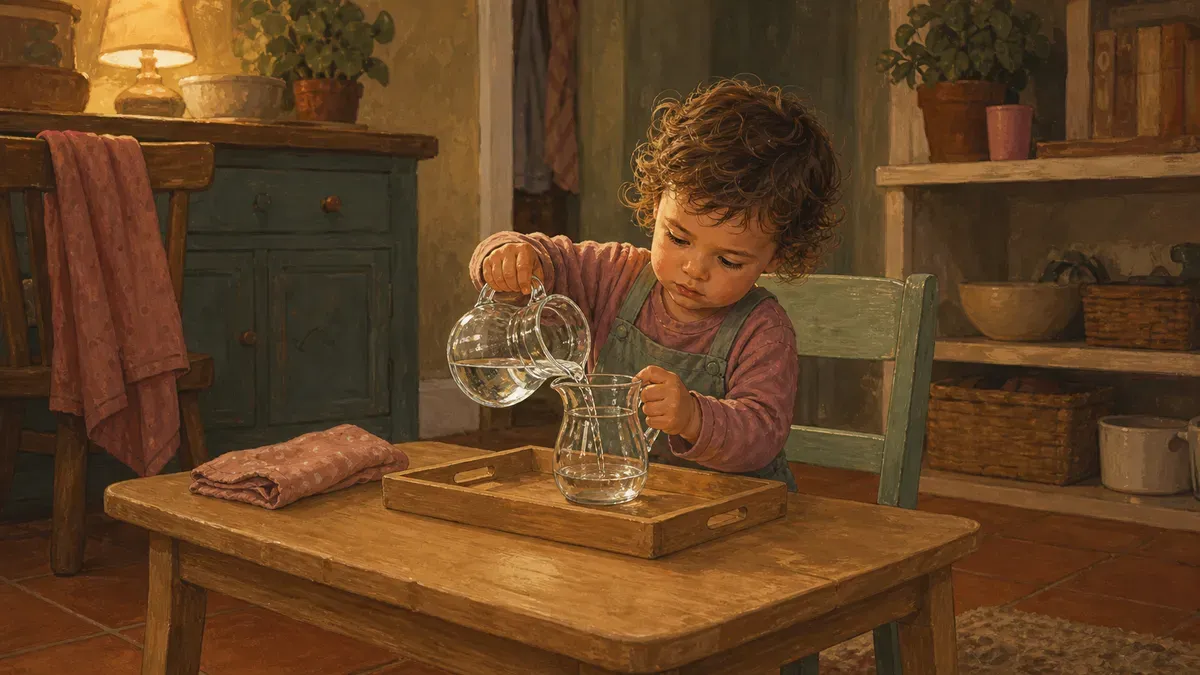
The spilled water is not a failure. That’s the single hardest mental shift in Montessori practical life, and it’s also the most freeing one.
Maria Montessori observed that children who finished a piece of concentrated work “appeared rested and deeply pleased,” satisfied by the doing, not by the outcome. The cup that doesn’t pour perfectly, the crumbs that don’t all make it into the dustpan: those are just the price of real purposeful activity. Your child is building independence and concentration through repetition, not practice-running toward a spotless floor.
Skip the correction mid-task. Let them finish. That ten-minute window of uninterrupted focus is what practical life is actually buying you. You can find montessori activities printables that lay out each step visually so kids can self-correct without needing you to step in.
How to Set Up Your First Practical Life Tray
That uninterrupted focus window doesn’t show up on its own. The tray in front of your child either invites concentration or hands them three reasons to walk away in the first minute.
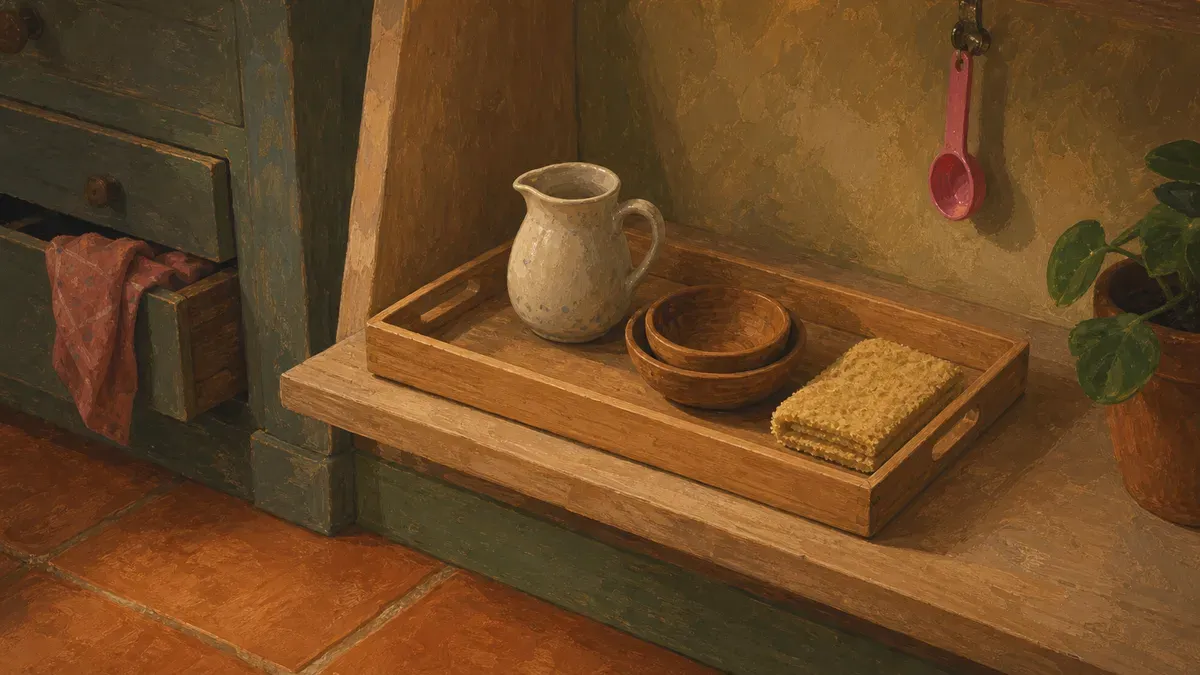
- One task only (pouring or scooping, not both).
- Low shelf, child-height access, no asking for help to get started.
- Silent slow demo first, each movement isolated so they can copy it.
- Then leave them to it. A spill they fix themselves is the whole exercise.
Choose One Task and the Right-Sized Tools
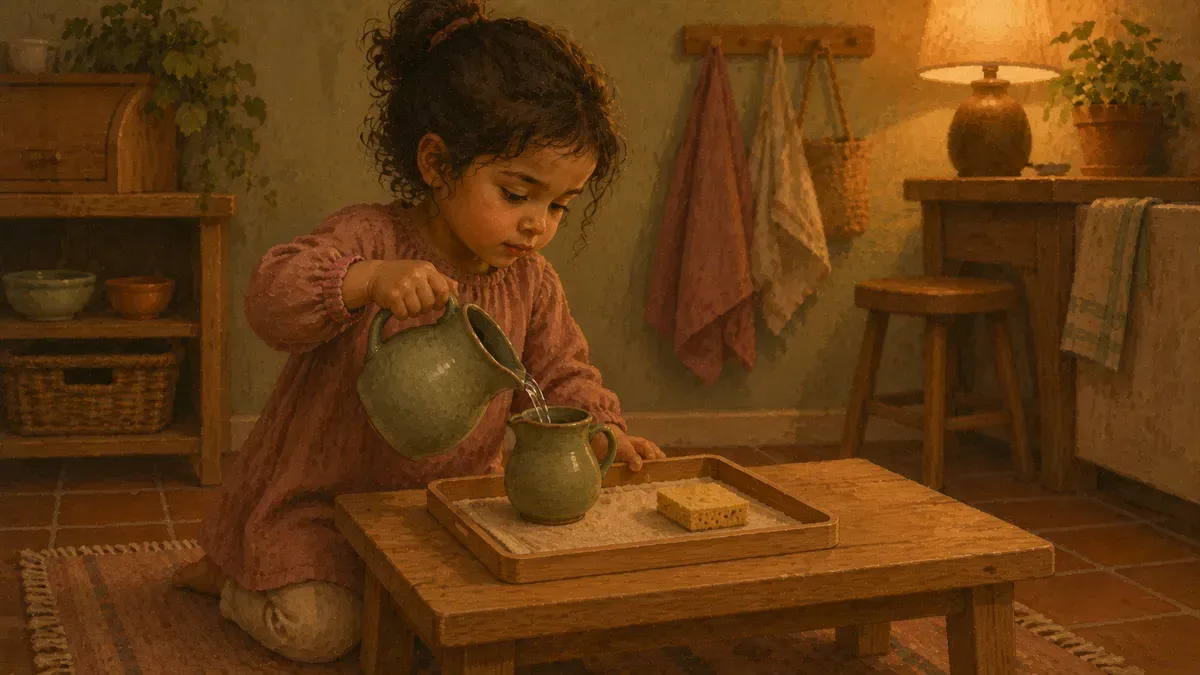
Pick one job, not a sequence. Pouring water from a small pitcher into a bowl is a complete purposeful activity on its own. Add scooping afterward and you’ve made two tasks, not one deeper one, and most toddlers will abandon halfway and feel it as failure.
Match the tools to small hands. A pitcher sized for a 3-year-old is roughly the size of a large mug. Child-sized tools aren’t precious. They’re functional: a spoon too big to control defeats the fine motor challenge the tray was built around.
Keep the tray simple. One pitcher, one bowl, one sponge for spills. Fewer decisions means longer focus.
Place It at Child Height and Demonstrate Slowly
Montessori Academy describes how Montessori redesigned the environment after observing children’s frustration in an adult-sized world, positioning sinks, shelves, and mirrors at child height so children could work without asking for help. The same logic applies to your shelf at home. A tray your child can reach independently means they can start without asking.
Before they touch it, demonstrate slowly and without words. Pick up the pitcher, pour, set it down. Hands-on Montessori shelf activities work because the child sees each movement isolated, not blurred into adult speed. Then step back.
Don’t correct mid-pour. If water misses the bowl, they’ll notice. That small moment of self-correction is the concentration you’re building. To arrange your space around this kind of work, see how to build a montessori environment at home.
20 Practical Life Activities Using Kitchen Items
Your cupboard is already stocked for most of this. The three buckets below run from the easiest setups (moving stuff from one container to another) up to the ones that genuinely help you, like washing dishes and setting the table, so start wherever your kid is today.
Pouring, Spooning, and Transferring Exercises
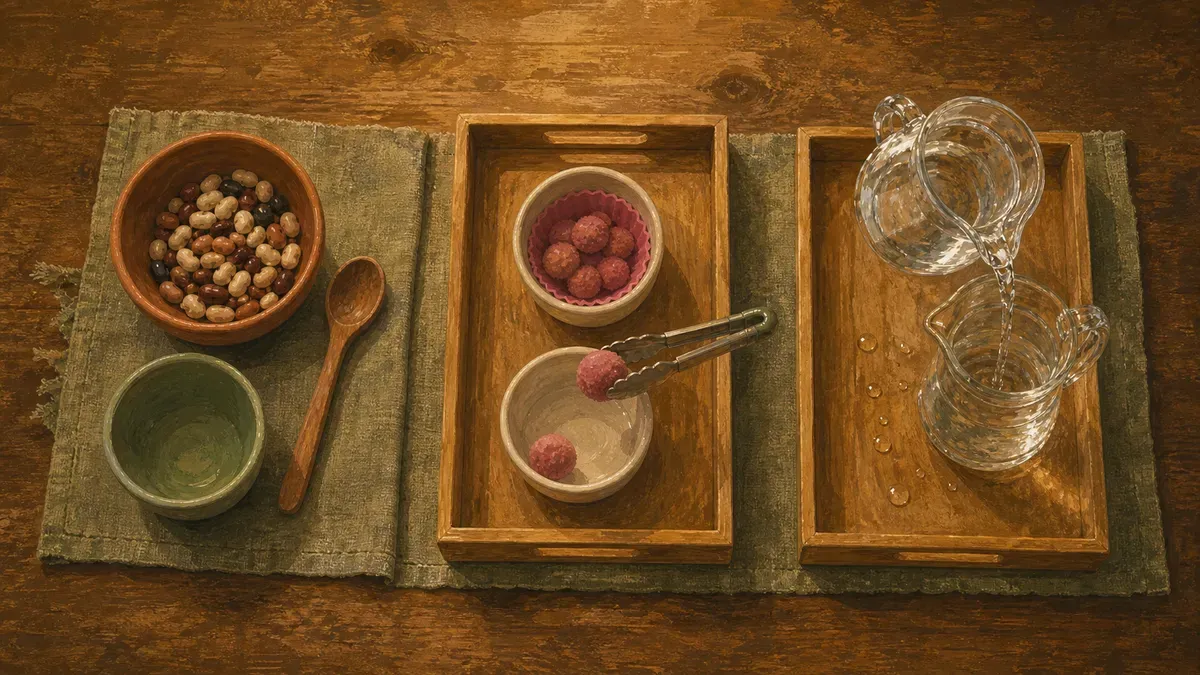
This is where everybody starts, because the prep is basically nothing. You give your child two containers and something to move between them, and the whole activity is the moving. Set a small jug of dried lentils beside an empty bowl and let them practice pouring. Hand them a spoon and a cup of beans for spooning into an egg carton. Pull out the kitchen tongs and a bowl of dry pasta for tonging one piece at a time.
The smaller the item, the more it asks of small fingers, so tweezing chickpeas with the tongs is a real step up from scooping with a spoon.
Few of these need anything you’d have to buy:
- Pouring lentils or water between two small jugs
- Spooning pom-poms or beans into an ice tray
- Tonging pasta, corks, or cotton balls into cups
- Tweezing pom-poms into a muffin tin for the next step up
Keep one task per tray and let them repeat it twenty times if they want. That repetition is the fine motor work doing its quiet thing. For ready-made sets that survive a toddler, here are some montessori practical life toys for toddlers worth a look.
Food Preparation Kids Can Actually Help With
Real food prep beats any pretend kitchen, and it hands your child purposeful work that actually feeds the family. Spreading is the gateway: a butter knife, a slice of bread, a bowl of soft cream cheese, and they’re set. From there, give them a banana to slice with a dull table knife, a mandarin to peel, a few cherry tomatoes to wash in a colander.
These small jobs lean on the same hand-skills as the transferring trays, just with a real result at the end.
Simple jobs that give a real result:
- Spreading cream cheese or jam on toast
- Slicing a banana or strawberry with a dull knife
- Peeling a mandarin or a hard-boiled egg
- Measuring and washing berries before they hit the bowl
A kid who peels their own mandarin stops asking you to do it.
Cleaning, Washing, and Table-Setting Tasks
Kids love cleaning until about age nine, so cash in now. These tasks care for the environment and double as the cleanup for the messy stuff above. Hand your toddler a small dustpan and brush for sweeping crumbs under the high chair. Fill a sudsy basin for dish washing, unbreakable cups only. A step stool at the sink turns plain hand washing into a job they ask to do.
The American Academy of Child & Adolescent Psychiatry notes that 2 to 3 year-olds can ‘put toys away and dress themselves with help,’ and 4 to 5 year-olds can ‘help clear the table after dinner,’ so table setting is squarely on the menu.
Household tasks worth handing over:
- Sweeping crumbs with a child-sized broom
- Washing unbreakable dishes in a low basin
- Wiping the table with a damp cloth
- Setting one placemat, fork, and cup at a time
Start a kid on placing their own placemat and napkin, and you’ve handed off a real chore while they think it’s a game. Give it a week before you decide it didn’t take.
Matching Activities to Your Child’s Age
Not every task works for every kid. What clicks for a five-year-old will frustrate a 20-month-old, and what feels easy for a toddler bores a preschooler fast. Here’s how to match the activity to where your child actually is right now.
Activities for Toddlers (Ages 1 to 3)
One step. That’s the rule at this age.
Carrying, pouring, and wiping are the sweet spots because they’re self-contained: your child does the whole thing without waiting on anyone. According to child development milestones by age from The OT Toolbox, scooping and pouring accuracy develops around 15 to 18 months, with most toddlers attempting water-to-container pouring by 18 months. That’s your window.
Toddler-ready tasks to try:
- Carry a napkin from the drawer to the table
- Scoop dried beans from one bowl to another
- Pour water from a small pitcher into a cup
- Wipe the table with a damp cloth after eating
- Drop peels into a small compost bin
Self-care counts here too. Wiping hands, rinsing a cup, pulling off shoes. The motor control is there earlier than most parents expect. You just have to offer the chance.
Activities for Preschoolers (Ages 3 to 6)
By three, the window opens up. Concentration stretches, hands are steadier, and a sequence of steps starts to feel satisfying rather than overwhelming.
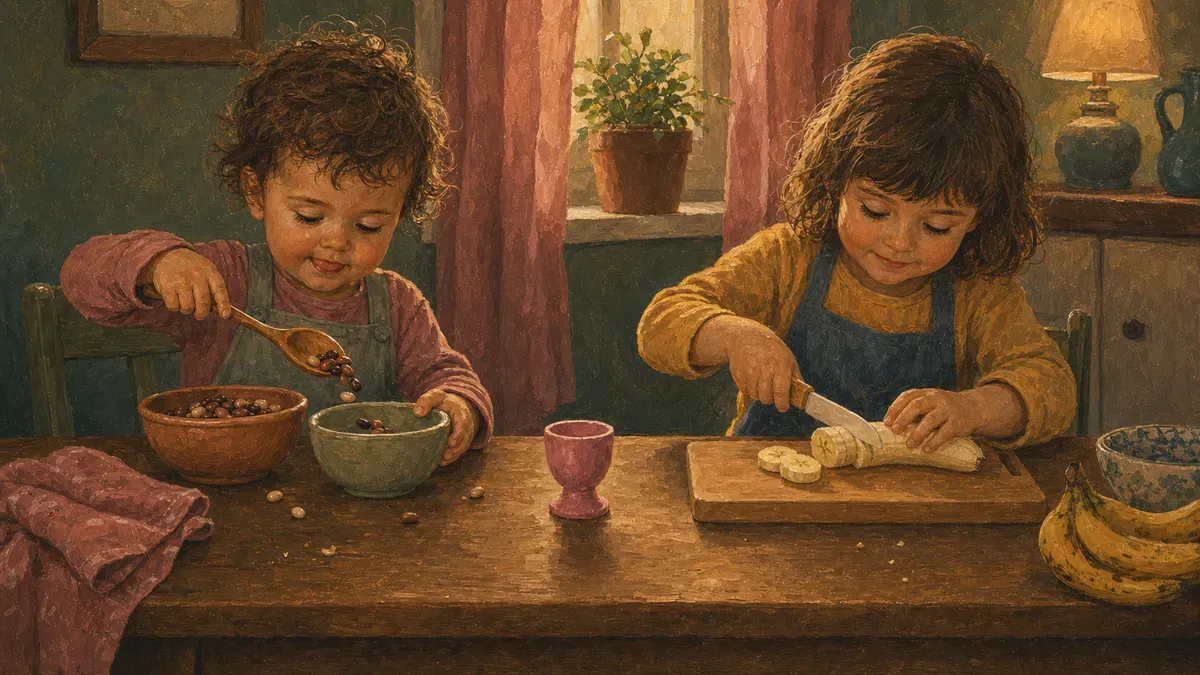
Food preparation is the richest territory for this age because it touches independence, concentration, and a visible payoff all at once. Peeling a mandarin, slicing a banana with a child-safe knife, measuring oats for breakfast, washing the cutting board. A preschooler can move through those as a real morning sequence.
The Rossmann longitudinal study from the University of Minnesota found that young adults who began chores at ages 3 to 4 were more likely to be self-sufficient than those who started as teenagers. Kitchen tasks at this age aren’t precious theory. They just work.
For a full breakdown of how these activities shift as your child grows, see our guide to montessori practical life by age.
Troubleshooting When Activities Don’t Stick
Some days a tray that worked brilliantly last week gets abandoned in thirty seconds. That’s normal, and it’s fixable.

When Your Child Loses Interest Fast
A short attention span isn’t defiance. ReadyKids notes that children aged 3-6 sustain focused attention roughly 2-3 minutes per year of age in adult-directed tasks, but interest-driven activities can stretch much longer. The key word is interest-driven.
When a child walks away quickly, the tray is usually too hard or too familiar. Both kill concentration. If the task has too many steps, strip it to one. If your child has mastered it already, raise the challenge just slightly: smaller pasta for transferring, a narrower-mouthed jar for pouring. Shelf activities stay purposeful only when they still ask something of small fingers.
Rotate trays every week or two rather than leaving the same setup out indefinitely. You don’t need new materials. Swap a spoon for tongs, swap dried beans for dried lentils. The novelty resets curiosity fast.
When the Activity Turns Into a Mess
A three-year-old who pours rice and misses the bowl half the time is still building independence and hand-eye coordination. What you’re after is the attempt, not the clean result.
Two things make mess manageable without stopping the activity. A rimmed tray keeps spills in one zone: rice stays on the tray, water stays in the tray, your floor stays sane. A small folded cloth placed beside the work lets your child clean up the spill themselves. That cleanup IS the activity extending. Child-sized tools (a tiny sponge, a dustpan that fits a small hand) mean they can fix it without needing you.
Check out our full library of Montessori activity printables for tray setup guides you can laminate and keep beside the shelf.
Found this useful? Save it for the next rough afternoon.
Questions parents ask me about this
What practical life Montessori activities can kids do at home?
Most of the best ones are already in your kitchen. Pouring water between cups, spooning beans into a muffin tin, spreading soft butter on toast, wiping a table, setting out one fork per plate. The rule is simple: if it's a real task that keeps the house running, a young child can learn a version of it.
Do I need to buy special Montessori materials for practical life?
No. A small pitcher from the dollar section, a regular spoon, and a rimmed tray are enough to start. Most activities work with what's already in your cupboards. Purpose-built Montessori materials exist, but they duplicate what you own. The transfer activity works the same with two mugs and dried pasta.
How long should a practical life activity last?
As long as the child stays with it. Attention spans in young children are short for directed tasks, but concentration can run surprisingly long when a child chooses the work and finds it genuinely challenging. Don't call time. Let them finish, reset, or walk away on their own terms.
At what age can a child start practical life activities?
Earlier than most parents expect. Simple carrying and one-step pouring show up around 15 to 18 months. By two, most children can handle scooping and basic wiping. Toddlers get one-step tasks; preschoolers can follow a short sequence once each step is familiar.
How often should I rotate practical life trays?
When you see the child working mechanically without real engagement. For some kids that's after a few days; others return to a favorite for weeks. Curiosity is your cue. Swap one tray at a time rather than refreshing everything at once, so there's always something familiar alongside something new.
How can I adapt practical life activities for a child with sensory needs?
Start with the texture and weight your child can tolerate right now, not the version that looks best. A sensory-avoider may need dry materials and a contained tray before anything wet. A sensory-seeker often does better with heavier work first (carrying a basket, scrubbing a surface), then settles into fine motor tasks. Follow their lead and adjust one variable at a time.
Written by
Nora Hayes
Mom of two and a former preschool aide. I share the screen-free sensory play and calm-down ideas I test at my own kitchen table, plus what the moms in my little meet-up swear by. A parent passing on what works, not a doctor or a therapist.
More about NoraKeep going
All Montessori-
 Montessori
Montessori Activities for 3 Year Olds That Build Skills
At 3, kids crave real work, not toys. These Montessori activities for 3 year olds build focus, coordination, and independence. Start one today.
-
 Montessori
Step by Step Montessori 3-Part Cards Walkthrough
Confused by 3-part cards? This step by step Montessori walkthrough shows the exact order to present them so your child matches and self-corrects.
-
 Montessori
Sensorial Montessori Activities That Calm Toddlers
Sensory-seeking toddler heading for a meltdown? These 10 sensorial Montessori activities calm and refocus little hands fast.
-
 Montessori
Montessori Activities for 2 Year Olds: 30 Ideas
30 Montessori activities for 2 year olds, sorted by mess level. Pick a no-mess tray or a sensory bin and set it up tonight.