Montessori Activities for 3 Year Olds Worth Doing

Some links here are affiliate links. If you buy through one, I may earn a small commission at no extra cost to you. As an Amazon Associate I earn from qualifying purchases. I only point to things I'd actually use with my own two.
The best Montessori activities for 3-year-olds are practical, real-life jobs they can finish on their own: pouring water, scrubbing a table, sorting buttons, because this age craves doing it themselves above everything else. I’m Nora Hayes, a former preschool aide who has run hundreds of these setups with my own two kids, and that drive to do it myself is exactly what Montessori work is built to feed.
Here you’ll find practical life, fine motor, language, and early math work that holds a three-year-old’s attention, how to set it up at home, and how it stacks up against a preschool or kindergarten classroom.
Why Three Is the Montessori Sweet Spot
Three is a peculiar age. The same child who melted down over a broken cracker yesterday will spend forty minutes pouring water from one cup to another today, completely absorbed, asking for nobody’s help.
That focus is not accidental. The American Montessori Society’s research on sensitive periods in early childhood development describes the 3-to-6 window as a time when several sensitive periods overlap at once. All at once. That overlap is rare in human development, and it explains why a three-year-old can be so intensely driven to sort, carry, pour, and repeat the same sequence until they nail it.
- Order
- Language
- Sensory refinement
- Movement coordination
- Concentration
- Independence
The Montessori approach is built around exactly this window. Maria montessori theory gives the idea its name: follow the child. Activities are sized and paced for a child who wants real tasks, not pretend ones. A wooden pouring activity is not a toy. It is the child-led learning version of “I need to figure out how this works.”
At three, the drive for independence runs ahead of the skill, and that gap is where good activities live.
The practical life, fine motor, and language work in this guide are chosen because they meet a three-year-old where that drive actually is. Not where a curriculum says it should be.
Practical Life Activities That Build Independence
This is where Montessori stops feeling like a philosophy and starts looking like your kitchen. The jobs below let a three-year-old pour, dress, and chop their way to real independence, and most of them use stuff already on your counter.
Pouring, Spooning, and Transferring
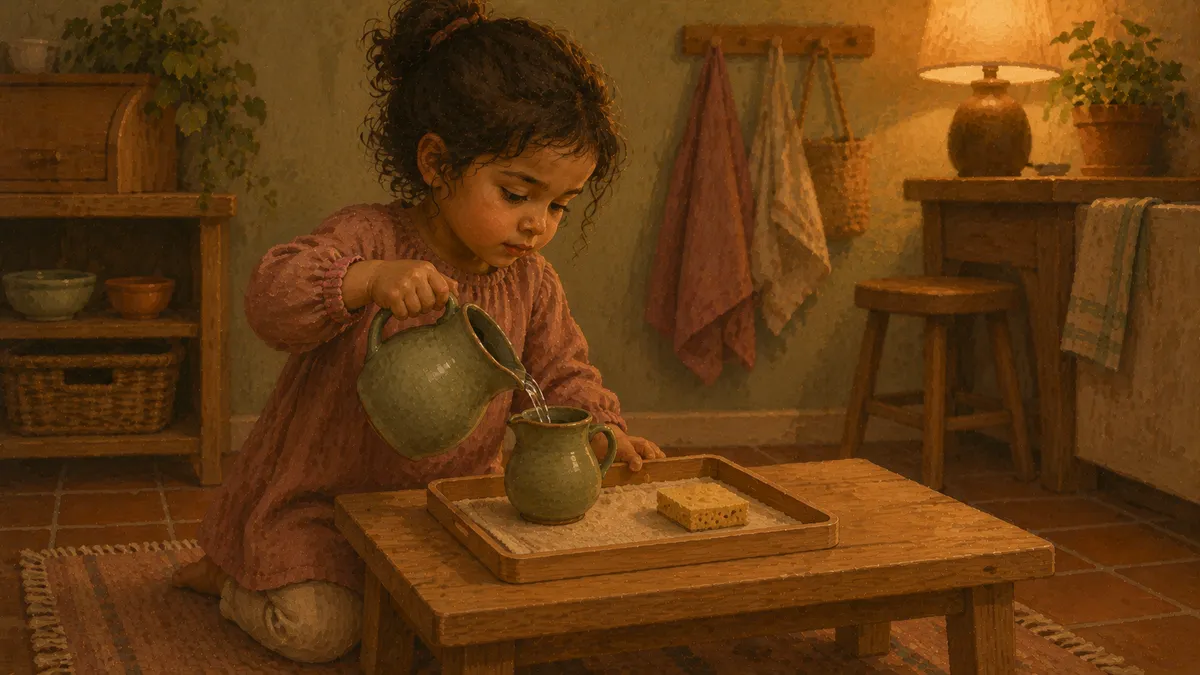
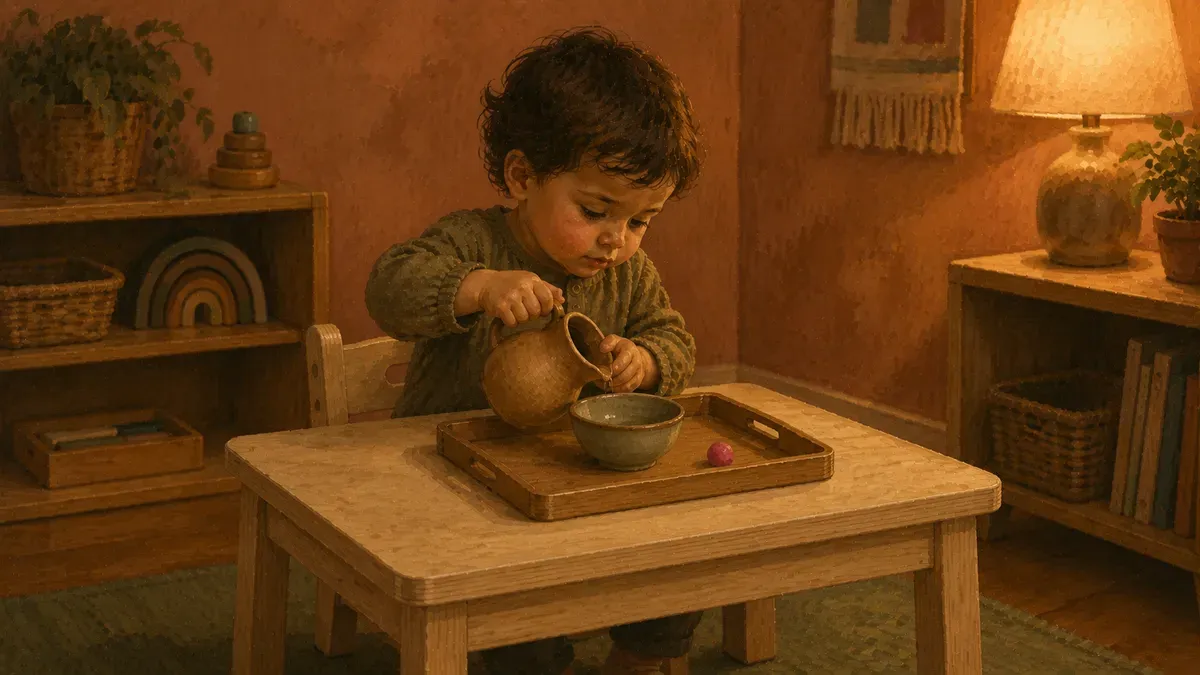
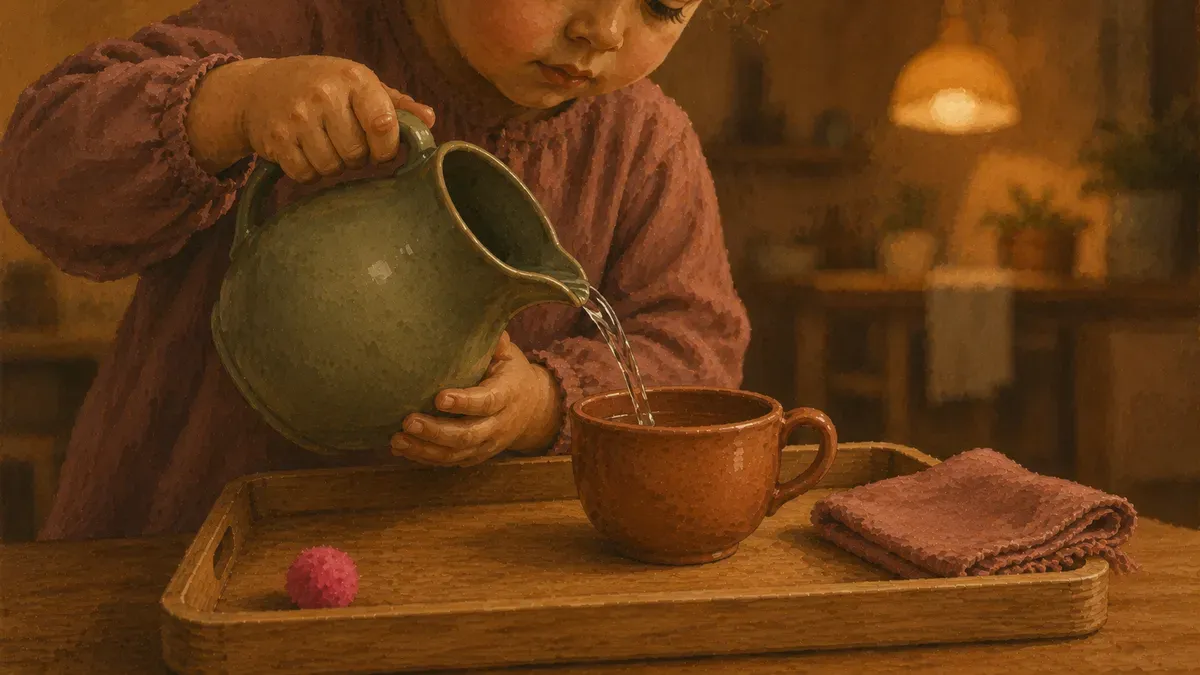
Start with two small pitchers and a little water. Your kid pours from one to the other, spills, pours again. That wobbly transfer is doing serious work on hand-eye coordination, the pincer grip, and the kind of concentration that makes a wound-up kid go quiet.
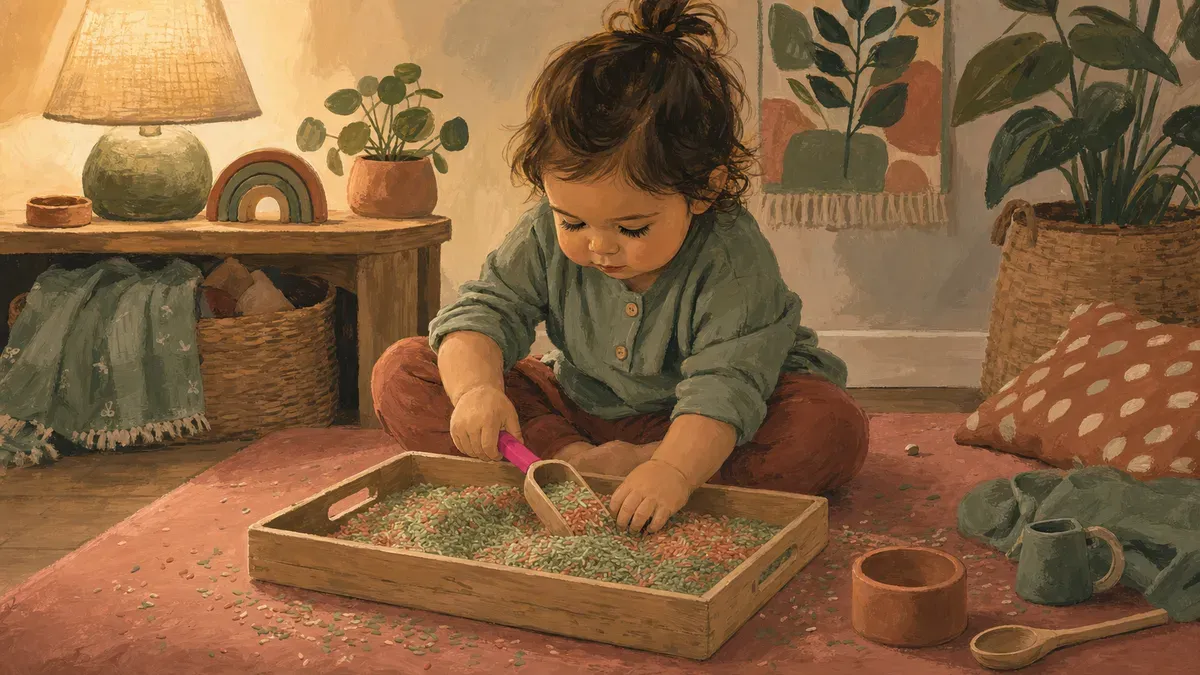
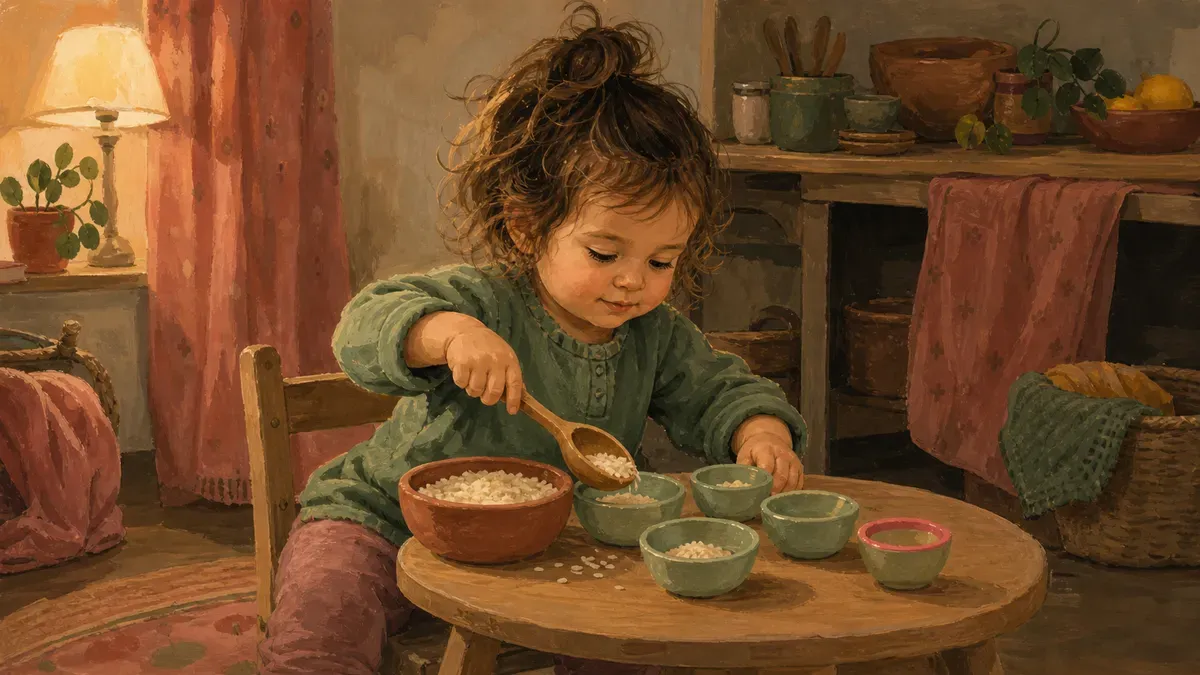
Dry first if water feels like too much. Dried beans or rice between two bowls with a spoon, then graduate to liquid once their dexterity catches up. A funnel and a turkey baster add a whole new layer for a kid who’s mastered the basics.
The magic isn’t the pouring. It’s the cleanup. Hand them a small sponge and let them wipe their own spill, and you’ve turned an accident into a self-completable job. Water play that ends with the child mopping up is the whole practical-life loop in one tidy circle.
Dressing Frames and Self-Care
Buttons and zippers are exactly where a three-year-old lives right now. Lurie Children’s Hospital developmental guidelines for self-care skills note that a 3-to-4-year-old can dress themselves but may still need help with fasteners, which makes buttons and zippers the precise frontier to practice now.
You don’t need a fancy wooden dressing frame. An old cardigan draped over a chair, a zippered jacket, a shoe with laces, any of it works. The point is to let them fumble through the fastener without you swooping in.
Then widen it past clothes. Pouring their own cereal, spreading their own toast, brushing their own hair. These small self-sufficiency wins build genuine responsibility and the fine motor skills behind it, and they sit at the heart of plenty of montessori preschool activities. A kid who buttons their own coat walks taller for the rest of the morning.
The win you’re after isn’t a dressed child. It’s a child who knows they dressed themselves.
Food Prep and Caring for the Home
Hand a three-year-old a real job in the kitchen and watch them rise to it. A child-safe crinkle cutter lets them chop a banana into coins without ever touching a real blade, and a peer-reviewed cooking-skills guideline backs kids aged 3 to 5 using child-safe or plastic knives on soft foods like bananas or herbs, with you right beside them. The stainless one I reach for has more than 8,200 reviews at 4.7 stars, so plenty of other kitchens run on it too.
From there, the whole home opens up as a workplace.
- Set the table with one fork and one napkin per seat.
- Water a windowsill plant with a tiny pitcher.
- Arrange a few cut flowers in a short vase, or do a bit of gardening on the patio.
My deeper guide to montessori practical life work lays them out step by step. Start with one task this week. A swept floor or a watered plant is a small thing, and at three it lands like a victory.
Fine Motor and Sensorial Work to Set Out
Once the real-job activities are humming, the next shelf is the quiet work: small hands learning to grip, sort, and tell one thing from another. Here are three kinds of fine motor and sensorial work that hold a three-year-old’s attention longer than you’d expect.
- Beads, buttons, and color tablets (grip, focus, and visual discrimination) on one shelf
- The Pink Tower and cylinder blocks (grading by a single quality, self-correcting, no adult input needed)
- Safe scissors, knobbed puzzles, and hand strength work, the foundation that has to come before pencil work
Threading, Sorting, and Color Matching
Threading wooden beads onto a shoelace looks like nothing and does everything. The pincer grip that picks up a bead is the same one that will hold a pencil in a year or two, and the focus it takes to aim a string through a tiny hole is real concentration, not busywork.
Sorting buttons into a muffin tin works those muscles with less frustration. Give your child a bowl of mixed buttons and a few egg cups, and they’ll separate the red from the blue while building dexterity they have no idea they’re building. There’s good reason to set this out: a peer-reviewed study on fine motor skills and early academics found that preschoolers who did threading-type activities had higher reading scores in their first school year and stronger math in preschool.
Color matching tablets zero in on one quality only:
- Two tiles of each color, nothing else to sort by
- The child’s only job is pairing them up
- Sorting by a single attribute, color and nothing else, is precisely the mental skill matching quietly builds
Sensorial Materials Like the Pink Tower
The Pink Tower is the one piece of “real” Montessori gear I’d actually spend money on, and at 4.6 stars across more than 3,300 reviews, plenty of parents landed in the same place. It’s ten wooden cubes, the same shade of pink, graded from a tiny one to a chunky one, and the child stacks them largest to smallest. Everything but size is held constant on purpose, so a three-year-old’s eyes do nothing but grade dimension.
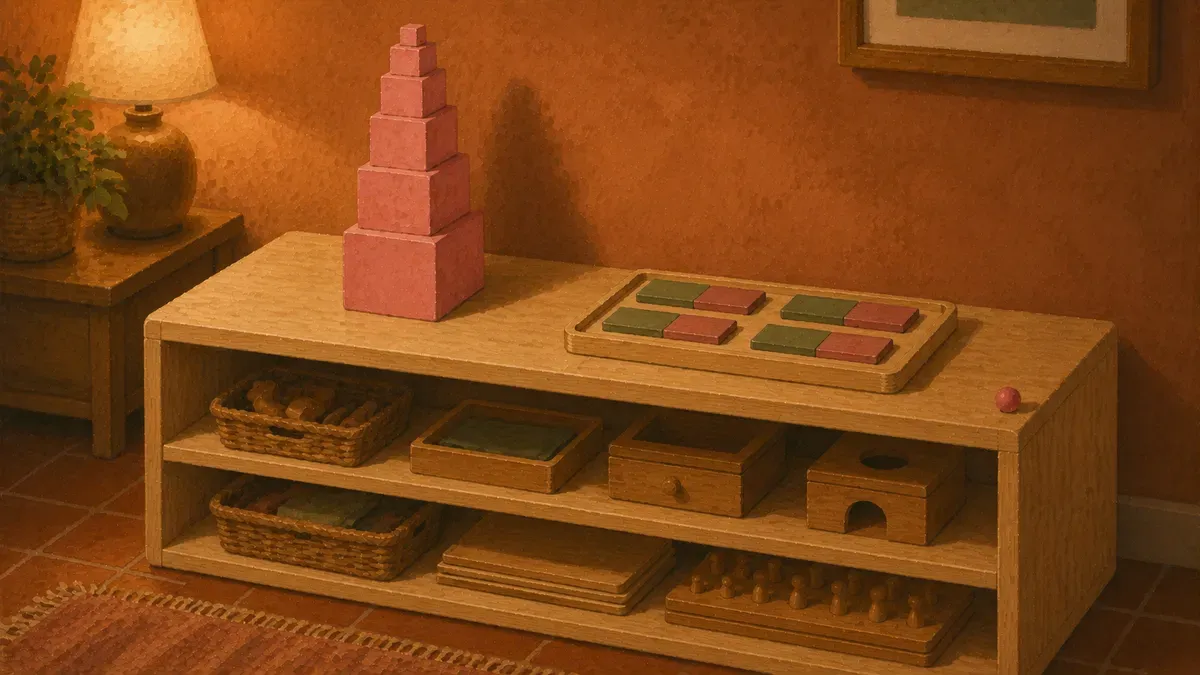
That isolation is the whole design. The American Montessori Society names visual and tactile discrimination as an active sensitive period for ages three to six, which is why sensorial materials land so hard right now. The tower is also self-correcting: build it out of order and it leans or topples, and the kid sees the mistake without you saying a word.
Cylinder blocks do the same thing through hands-on exploration, each cylinder fitting one hole only. If you’re raising a kid who needs to move while they learn, my roundup of calming sensorial montessori work pairs this concentration with movement.
Cutting, Puzzles, and Hand Strength
Safe scissors feel terrifying to hand over, and then they become the activity my three-year-old asks for by name. A pair of toddler safety scissors that snip paper but not hair or fingers is the whole starter kit, and the plastic pair I point people to is an Amazon Overall Pick with over 5,700 reviews behind it. Start with snipping a strip of paper into confetti, then graduate to cutting along a thick line.
Don’t rush the line work; the snipping is doing the real job of strengthening the hand.
There’s a benchmark worth knowing. An occupational therapy scissor skills checklist notes that by around three to three-and-a-half, a child can cut a six-inch line within half an inch of straight, and that the hold itself builds the finger isolation and wrist stability handwriting later needs.
Wooden knobbed puzzles round it out. The little knobs force that same pincer grip, and the puzzle won’t sit right until each piece finds its spot, so the child keeps trying. Both of these build the hand strength and concentration that come before pencil work, never after. Set out the scissors before you ever worry about letters.
Early Language and Math the Montessori Way
Letters and numbers come last, not first. Before a three-year-old reads a word or writes a numeral, they need a fat vocabulary and a body memory of what “three” actually feels like, and both come from naming and touching real things.
Vocabulary Baskets and Three-Part Cards
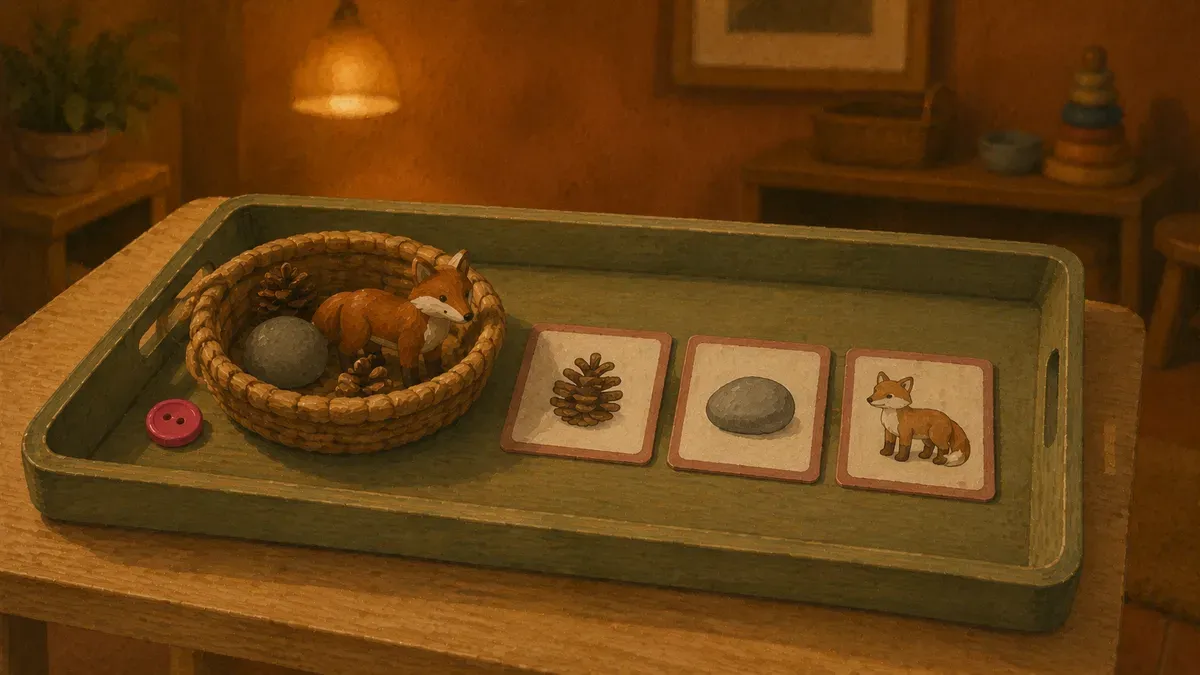
A vocabulary basket is the lowest-prep language work you can set out. Drop five or six real objects in a basket, a toy fox, a pinecone, a spoon, and name each one slowly as your child picks it up. That is the whole lesson. You’re stacking words before any letter shows up.
Once the naming gets easy, the sequence builds in stages:
- Start with object-to-image matching: lay a photo next to each object, no words yet
- Move to picture-only sets of four to six images once that clicks
- Add three-part cards: a picture, a label, and a control that lets your child check their own work
- At three, skip the labels entirely and match picture to picture
If cutting and laminating your own isn’t happening this month, a ready-made Montessori three-part card set does the prep for you. The themed pack I like covers 13 everyday categories and holds a 4.7-star average across 220-plus reviews.
If you want the full sequence, here’s how to use montessori 3 part cards without rushing the letters.
Counting and Number Recognition
Math at three is a hands-on thing, not a worksheet. Number rods, the red-and-blue graded bars, come out around two and a half to three so a child can feel that ten is genuinely longer than three. Quantity lives in the hands first.
Sandpaper numbers come later, usually around three and a half. Your child traces the rough numeral with two fingers, the same path they’ll use to write it, so the shape gets into muscle memory before the pencil does. The two materials stay separate on purpose: master the amount, then attach the symbol.
Then you ditch the materials entirely and count what’s already on the table:
- raisins onto a plate, one per finger
- spoons as you set each place
- stairs out loud, one number per step
- buttons dropped into a jar with a clink
The counting that sticks is the kind a kid does with their hands while their attention is somewhere else. For ready-to-print sets of both, our montessori activities printables cover cards and counting work in one download.
Setting Up Activities at Home
You don’t need a dedicated room or a Pinterest-perfect playroom. You need a low shelf, a handful of trays, and a way of showing the work that hands the job over to your kid instead of doing it for them.
Building a Low, Orderly Shelf
Start with one low, open shelf your three-year-old can reach without asking. The open Montessori shelf worth the money stands about two feet tall and stretches close to four feet wide, room for a full row of trays without towering over a small kid. It’s an Overall Pick on Amazon, 4.4 stars across 130-plus reviews. Skip the toy bin overflowing with a hundred things. Put out a few trays, each holding one complete activity, and leave space around them so each one reads as an invitation rather than a pile.
The American Montessori Society describes a prepared environment as child-sized, accessible furniture with materials on low shelves, arranged left to right from easiest to hardest by area. That order isn’t fussiness. An orderly arrangement is what lets a kid choose work on their own and, the part that matters more, put it back when they’re done.
That return is the whole game. A tray with a clear home gets returned. A toy from a jumbled bin gets abandoned on the floor.
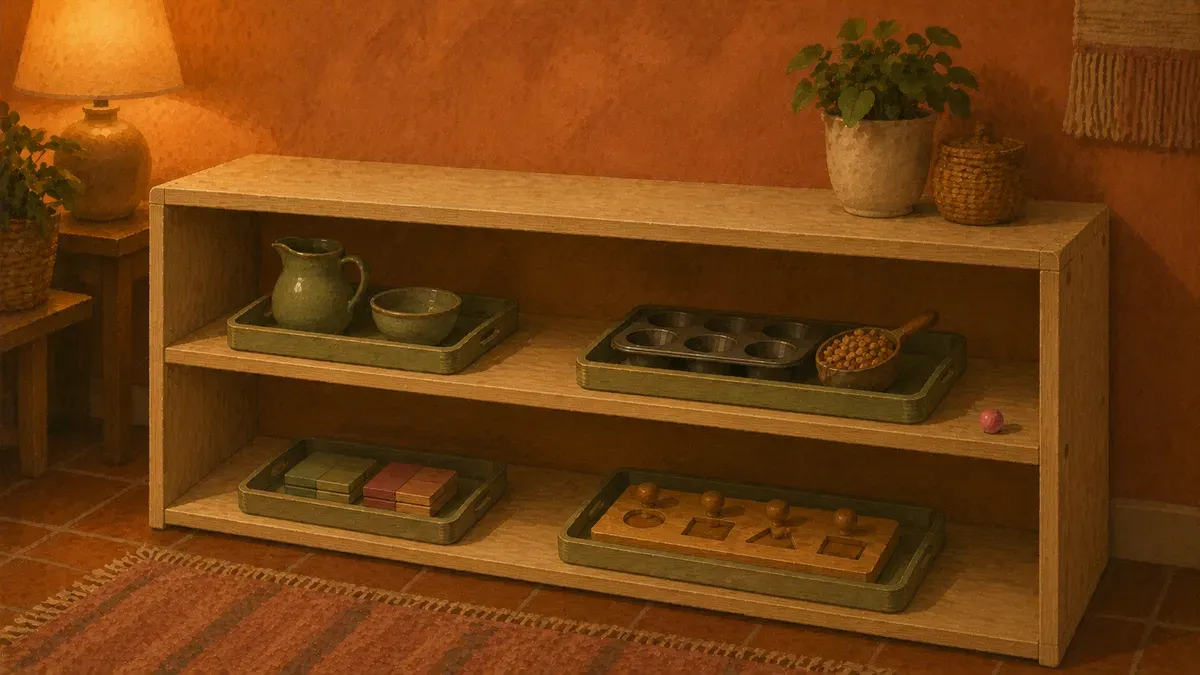
Rotate three or four trays at a time and stash the rest. Fewer choices, deeper play. If you want the full layout, this organization-first guide to the montessori environment walks through shelf height and tray count.
How to Present and Step Back
Here’s where most of us trip up: we narrate. Showing a new activity works best slow and nearly silent, your hands doing the talking. Name it once or twice, clearly, then let them watch you do it. Then hand it over.
That slow, low-word rhythm follows the classic three-period lesson. You name the work, your child interacts with it, and later they name it back to you, with few words between each part so the material teaches instead of your voice.
Then the hardest part. Sit on your hands and let them repeat it badly, again and again, with no correction. That child-led repetition is where the concentration lives, and the same Montessori method carries straight up the ages, from a wobbly three-year-old all the way to montessori for kindergarten work. Resist the fix. The repeating is the learning.
Montessori at Home vs Preschool and Kindergarten
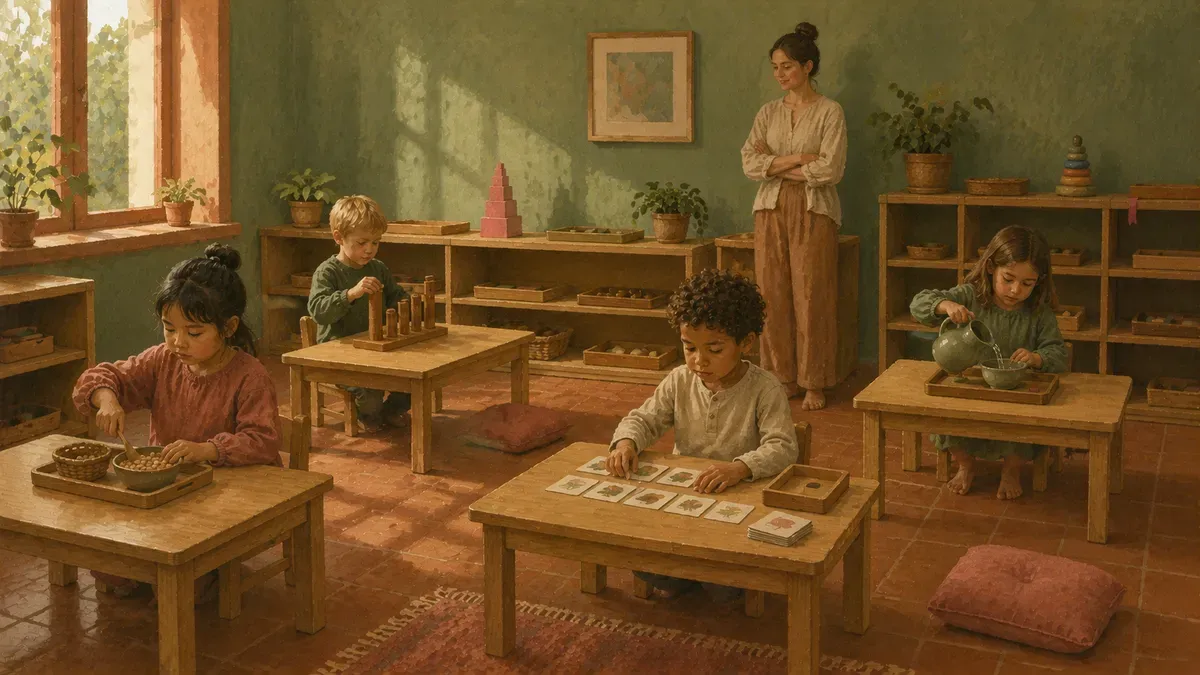
Whether a Montessori classroom is in the budget or not, most of what matters at three happens at home anyway.
A formal preschool Montessori program does offer things you can’t replicate: trained guides, a complete set of materials, and a room of same-age peers doing the same child-led work. A 2025 national study covered in background on the Montessori method and its principles found that public Montessori preschool programs cost approximately $13,000 less per child than traditional preschool while producing stronger long-term outcomes, including elevated reading, memory, and executive function by kindergarten. That’s a real argument for a Montessori pre-k slot when one is available.
None of it requires an enrollment fee.
- Trays on a low shelf
- A slow, simple presentation
- The three-period lesson
- Independence at snack and cleanup
It requires a philosophy shift.
What I noticed with Eli, and later with June, is that walking away is the hardest part, but it’s the part that makes it work. The setup from this article is enough to get there.
When your child does move into a Montessori kindergarten room, the materials scale up but the method stays the same. If they’ve already poured, transferred, and sorted at home, they walk in knowing how to work. Browse our full library of printable Montessori resources for tools that bridge home and classroom.
Found this useful? Save it for the next rough afternoon.
Questions parents ask me about this
What are the best Montessori activities for 3-year-olds?
The best ones are real, completable jobs: pouring water between pitchers, spooning dried beans into a muffin tin, threading large beads, and food prep tasks like peeling a banana or chopping soft fruit with a child-safe knife. Three-year-olds are in a sensitive period for order and hands-on learning, so activities with a clear start, middle, and end hold their attention far better than open-ended crafts. Start with practical life work before moving to sensorial or language trays.
How long should a 3-year-old work on one Montessori activity?
Two minutes is a win. Thirty minutes of uninterrupted focus happens too, and both are completely normal. The goal isn't a set duration; it's uninterrupted repetition for as long as the child chooses. If they abandon a tray after one pour and wander off, that cycle was complete for them.
Do I need to buy expensive materials to do Montessori at home?
No. A pitcher, a bowl, some dried beans, and a low shelf cover most of what a three-year-old needs. Many classic Montessori materials have pantry or thrift-store versions that work just as well. Buy the household version first; most pricey Montessori toys duplicate things you already own.
How many activities should I put on the shelf at once?
Three to four trays is the right range. More than that overwhelms the choosing process and leads to dumping rather than working. Rotate the rest out of sight, and swap in something new once an activity stops drawing your child back. A smaller shelf with complete, well-spaced trays invites more focused work than a crowded one.
What if my 3-year-old won't sit still for an activity?
That's a signal about the activity, not the child. A sensory-seeker who needs to move before they can focus will get more from heavy work first: carrying a basket, pushing a laundry bin, digging in the garden. Once the body is settled, a tray activity has a better shot. Follow what your child's body is asking for before you expect them to sit down.
Is Montessori better than a regular preschool for a 3-year-old?
Neither format works for every child or every family. A classroom brings trained guides and a full material set that home setups can't match, and public Montessori preschool programs have shown significant cost and outcome advantages over traditional programs. A home setup built around the same principles, real tasks, child-led repetition, and a low orderly shelf, delivers most of the same benefits without an enrollment fee. The method matters more than the address.
Should screen time replace any of these activities?
Not as a swap. Screens and hands-on work serve different purposes, and one doesn't substitute for the other. A practical life tray builds hand strength, concentration, and a sense of real accomplishment that passive viewing doesn't. On the days you have nothing left, screens are fine. But they're a break, not a replacement.
Written by
Nora Hayes
Mom of two and a former preschool aide. I share the screen-free sensory play and calm-down ideas I test at my own kitchen table, plus what the moms in my little meet-up swear by. A parent passing on what works, not a doctor or a therapist.
More about NoraKeep going
All Montessori-
 Montessori
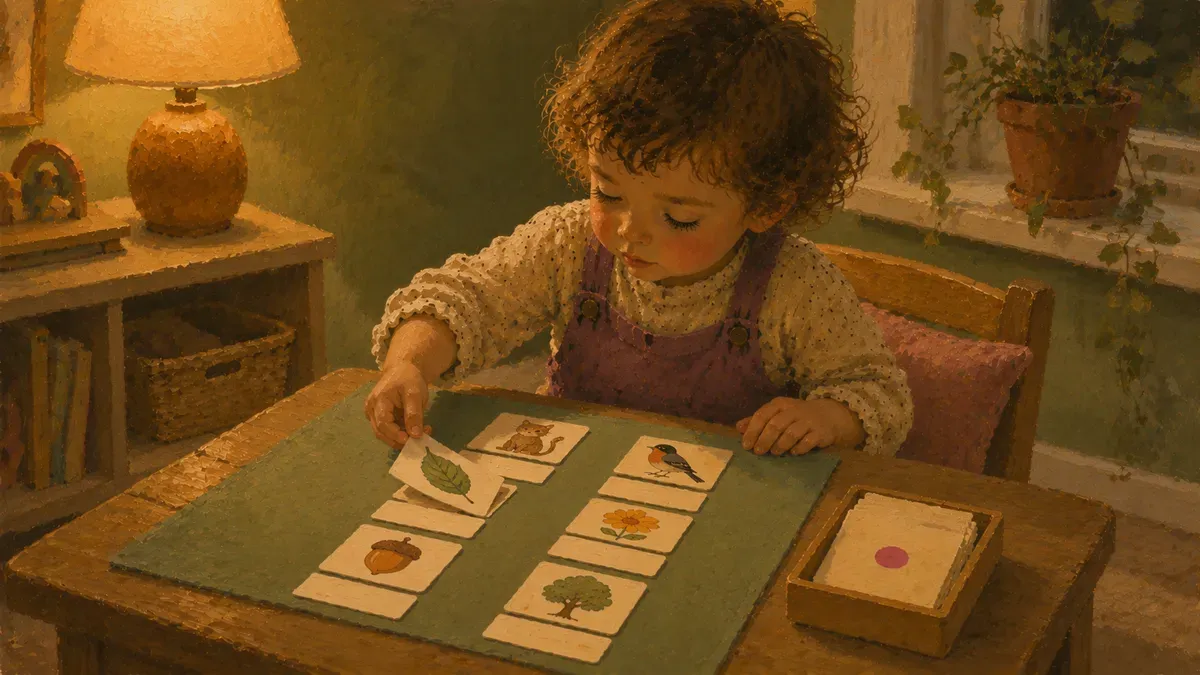
Step by Step Montessori 3-Part Cards Walkthrough
Confused by 3-part cards? This step by step Montessori walkthrough shows the exact order to present them so your child matches and self-corrects.
-
 Montessori
Sensorial Montessori Activities That Calm Toddlers
Sensory-seeking toddler heading for a meltdown? These 10 sensorial Montessori activities calm and refocus little hands fast.
-
 Montessori
Practical Life Montessori: 20 Kitchen Activities
Practical life Montessori starts in your kitchen. Get 20 no-buy activities using spoons, jars, and bowls you own. Set up a tray today.
-
 Montessori
Montessori Activities for 2 Year Olds: 30 Ideas
30 Montessori activities for 2 year olds, sorted by mess level. Pick a no-mess tray or a sensory bin and set it up tonight.