Preschool Fine Motor Activity From Your Junk Drawer

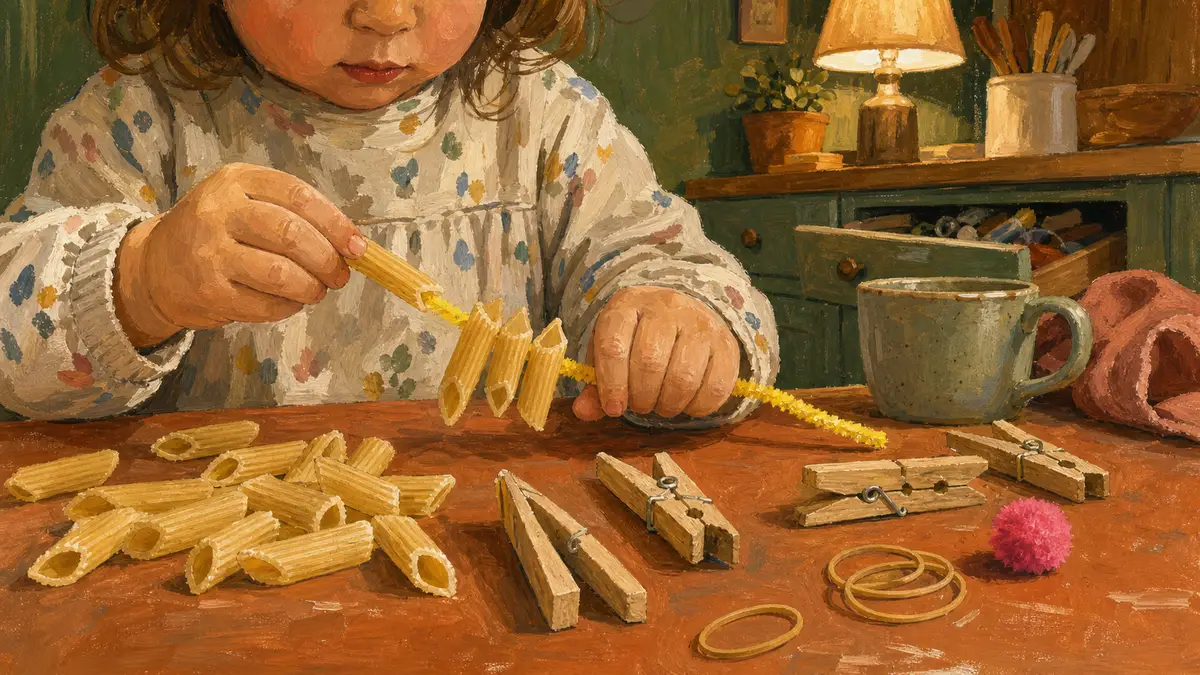
Clothespins, a colander, dry pasta, painter’s tape: the everyday junk you already own makes a real preschool fine motor activity that builds the hand strength and pincer grip your kid needs before a pencil ever shows up, no craft-store run required.
I’m Nora Hayes, a former preschool aide and mom of two, and I take this seriously because a 2024 meta-analysis found a large link (r = 0.60) between these little hand skills and how kids later do at math. Below I’ll walk through which junk-drawer items to grab, how to match each one to a specific pre-writing skill, what to try when your kid hard-passes, and the red flags that mean it’s time to loop in an OT.
What a Preschool Fine Motor Activity Actually Builds
Fine motor is a shorthand for a chain of physical skills, not a single thing.
The base layer is hand strength: the small muscles in the palm, thumb, and fingers that power every grip your kid uses. Below that sits the pincer grasp, the two-finger-and-thumb hold that lets them pick up a Cheerio, snap a puzzle piece, or later hold a pencil without strangling it. These two build together, and preschool is exactly when that window is open.
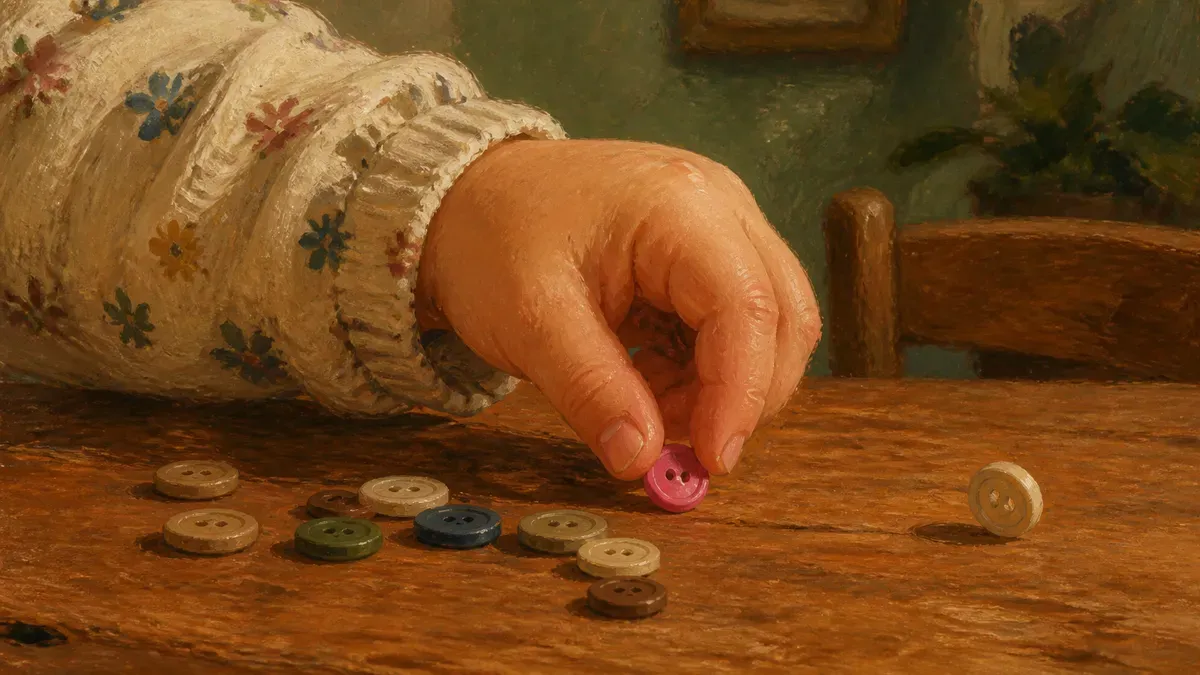
The CDC’s developmental milestones for 4-year-olds lay out what “on track” looks like in practice: holding a crayon or pencil between fingers and thumb (not a fist) and drawing a person with three or more body parts. That fist grip is a stage, not laziness. Those small muscles just need time to build the endurance for a fingertip hold.
- Bilateral coordination: one hand holds the paper while the other draws, one steadies the bowl while the other stirs.
- Hand-eye coordination, which tightens every time a kid aims a bead at a lace or threads pasta onto a pipe cleaner.
By ages 5 to 6, The OT Toolbox notes that a dynamic tripod grasp becomes typical, where the fingers (not the wrist) are doing the driving. That shift from the whole-arm movement of a toddler to finger-led precision is what years of small motor skill activities for preschoolers are quietly building toward.
None of this needs to look like school. It just needs to happen.
The Junk-Drawer Fine Motor Activities You Already Own
Open the drawer next to your stove and you’ve got a week of fine motor work sitting in it. Clothespins, tongs, an old spray bottle, a handful of dry penne. Here’s how to turn that random pile into the three skills a pencil actually needs.
- Pinch and grab: clothespins, tongs, and tweezers
- Squeeze and strengthen: spray bottles, sponges, and play dough
- Two-hand coordination: threading pasta, unscrewing lids, and lacing
Pinch-and-Grab Games With Clothespins and Tongs
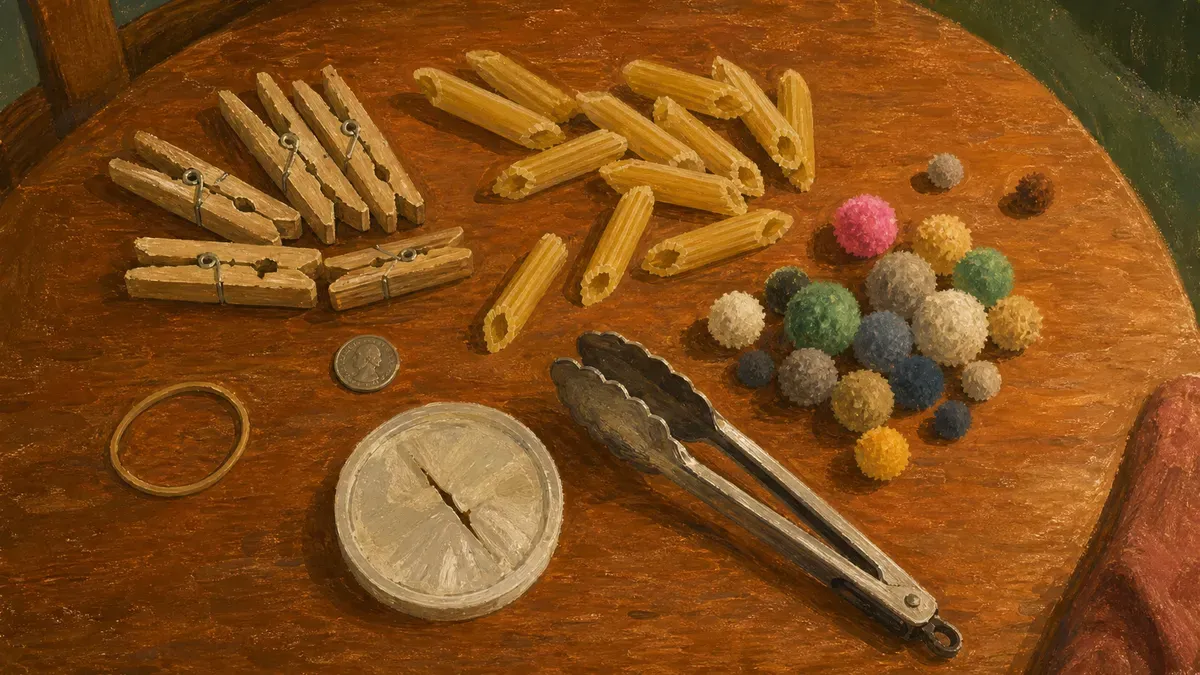
The wooden clothespin is the cheapest fine motor activity for preschool you’ll ever set up. Have your kid clip pins around the rim of an empty cereal box, or pinch a few open and snap them shut over a paint stick. That pinch is the whole point.
Per Tools to Grow OT, clothespin work targets skilled control of the thumb, index, and middle fingers while the pinky side of the hand stays tucked and stable, which is exactly the setup a pencil grip and a pair of scissors both lean on.
Tongs and tweezers work the same muscle groups with a different grip.
- Bowl of dry beans or pom-poms transferred into an ice tray, one slot at a time
- Coins dropped through a slit cut in a yogurt lid
Any of these forces finger isolation and precision, the slow building blocks of pincer grasp, and most of them run on stuff already in your kitchen.
Squeeze Setups That Build Hand Strength
A dollar spray bottle is one of my favorites for the kid who needs to move. Fill it with water, send them to “clean” the porch railing or wilt the dandelions, and they’ll squeeze that trigger a hundred times without noticing. According to NAPA Center, spray bottles build hand strength and teach the two sides of the hand to work separately, while eyedroppers ask the thumb and first two fingers to pinch, doubling as a strength and pincer drill.
Wet sponges, a single-hole punch on scrap paper, and a fistful of play dough do the heavy lifting on the small hand muscles too. These strength activities are why a kid eventually controls how hard the crayon presses instead of snapping it. If you want more squeeze-based ideas, my roundup of fine motor activities for preschoolers using play dough breaks down a few more.
Threading and Two-Hand Jobs With Pasta and Jar Lids
Now make both hands work at once. Hand your child a pipe cleaner and a bowl of penne and let them thread the pasta on, one hand holding while the other feeds. Lacing beads, threading buttons, and unscrewing jar lids all do the same thing, training the bilateral coordination NAPA Center ties to handwriting, cutting, and coloring.
That split-job skill, one hand stabilizing while the other does the fine work, is what steadies a paper while the pencil moves.
For a grab-bag of these, the fine motor skills games for preschoolers I keep in busy bags travel well and build the same spatial awareness and hand-eye coordination behind steady letters.
Match Each Activity to a Pre-Writing Skill
Hand strength and bilateral coordination are the foundation. But knowing which junk-drawer activity actually builds which skill is what turns random play into something useful.
The bridge to pencil work runs through visual-motor integration, not just strong fingers. Research on fine motor skills and handwriting readiness shows VMI is more predictive of handwriting outcomes than fine motor skill alone. It’s the brain learning to translate what the eye sees into what the hand does.
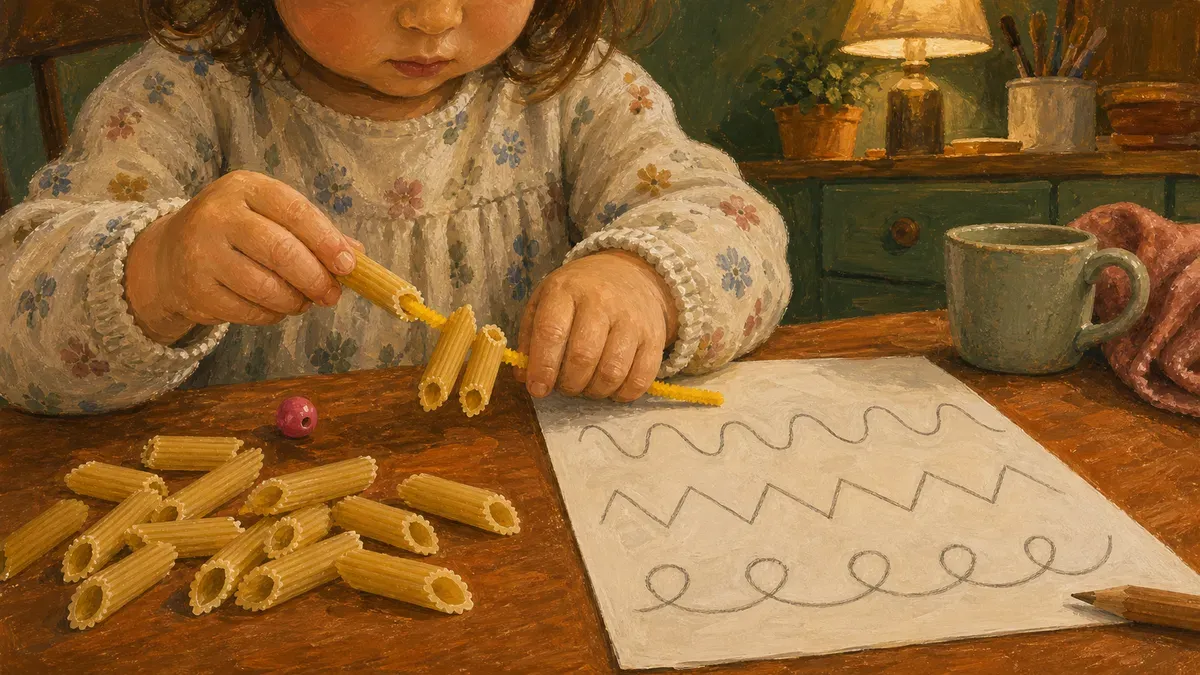
Threading a pipe cleaner through pasta holes does exactly that: the child judges the angle, corrects mid-motion, and guides a tool through a target.
That’s the same visual-motor loop behind tracing a line on paper.
So when you’re pulling activities from the junk drawer, think about which layer they’re hitting:
- Hole punching and paper tracing, VMI, the direct bridge to writing lines
That last one matters most for writing readiness. Fine motor tracing handwriting scissor skills hit all three layers at once: pencil grasp, pressure, and the visual-motor loop. You don’t need formal activity sheets to start. A finger drawn through spilled flour or a crayon following a taped line on the floor counts just as much as any printed worksheets for fine motor activities.
When a child is ready for paper, simple line-tracing is the first real pre-writing task. Horizontal lines, then vertical, diagonal, then curves. The visual motor activities that come before formal letters build the spatial awareness to form shapes consistently. A tripod grasp will follow once those muscles and that brain-hand connection are both online.
What to Do When Your Kid Refuses the Activity
Some days the colander and pasta sit there untouched while your kid melts down over the wrong bowl. That’s not a failure of the activity. It’s information.
Refusal usually points to one of three things: the task is too hard, too easy, or the kid isn’t regulated enough to try anything yet.
- Too hard: they’re skipping a step in the developmental progression. If finger isolation isn’t there yet, threading pasta feels impossible and they bail fast. Drop back one level. Swap threading for rolling play dough snakes or squeezing a wet sponge, both of which build the same small muscles with less demand on precision activities.
- Too easy: they’ve outgrown it. Add tongs instead of fingers. Smaller manipulatives. A narrower target opening. Same activity, harder version.
- Not regulated: no precision activity lands when a kid is already flooded. Sensory play is the fix here. Ten minutes of heavy work (pushing, carrying, digging) before you pull out the fine motor tray changes the whole attempt.
The refusal conversation goes differently if your kid can’t tolerate sitting at all. There’s a whole approach built around vertical surfaces, floor work, and movement. I covered those setups in fine motor activities kid cant sit, and it’s worth a look before you give up on a skill entirely.
If your kid refuses one category of manipulative (say, anything slimy), that preference is useful data. It tells you something about their sensory play comfort zone, not their developmental ceiling.
Fine Motor Red Flags: When to Loop In an OT
Refusal and struggle are not the same thing. A kid who refuses threading beads is telling you something about their mood or sensory state. A kid who can’t get two fingers to cooperate after months of practice is telling you something different.
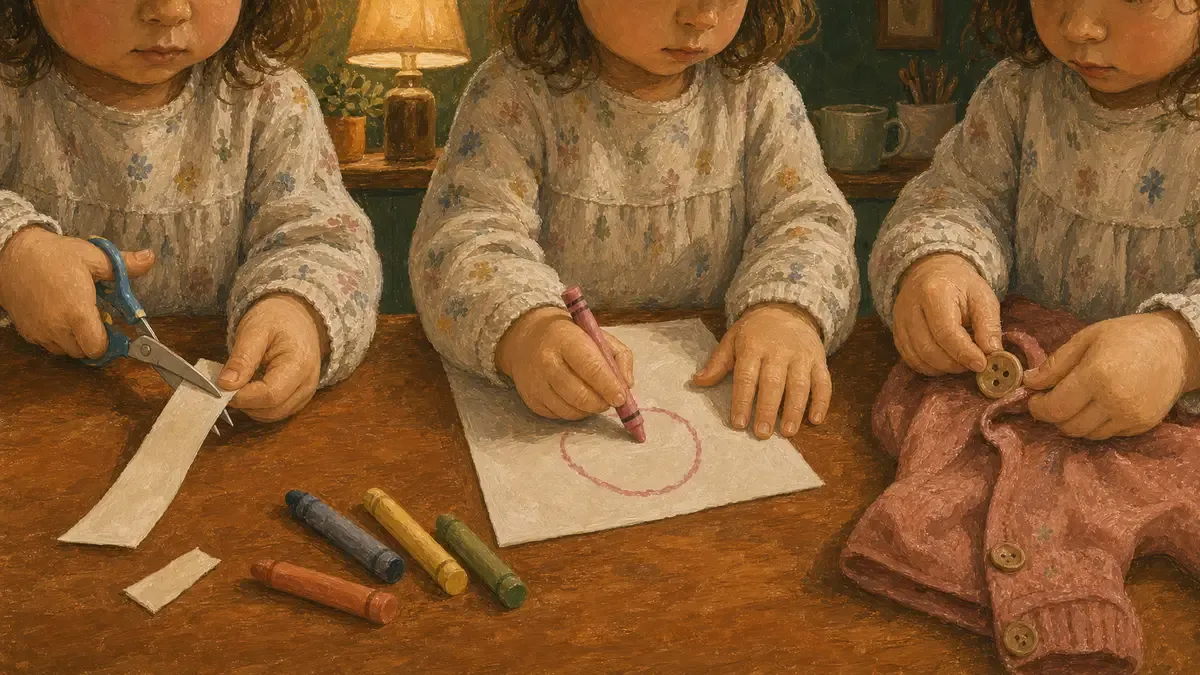
The developmental benchmarks are reasonably clear. According to occupational therapy guidance on fine motor development, by age 3 a child should be able to copy a circle and use child scissors with some control. By age 4, they should draw a person with recognizable body parts and manage simple button manipulation.
Persistent gaps past those ages (not a bad day, but a consistent pattern over weeks) are worth a conversation with an OT.
Things worth tracking if you’re keeping a mental checklist:
- Scissor skills haven’t appeared by the end of the preschool year
- Tripod grasp hasn’t started showing up spontaneously, even loosely, by age 5
- Your child avoids all hand tasks and the avoidance is getting more pronounced, not less
- Fine motor tasks produce frustration out of proportion to the difficulty (consistent meltdown at any pencil or cutting activity)
- Writing readiness benchmarks feel very far off compared to same-age peers
None of these is a diagnosis. An OT can assess where the gaps actually are in the developmental progression and build a roadmap for your specific kid, including ot activities that work even for kids who resist most fine motor work.
Occupational therapy is not a last resort. The earlier you loop them in, the more runway you have.
A 5-Minute Lazy-Mom Setup That Actually Sticks
You don’t need a sensory play station or a Pinterest-worthy shelf of manipulatives. You need a system you’ll actually repeat on a Tuesday when you’re running on cold coffee.
Here’s what works at my house:
- Pick one container. A muffin tin, a shoebox lid, a small tray.
- Pick one manipulative. Dried pasta. Coins. A pile of clothespins. Whatever’s already in the drawer.
- Name the precision activity out loud: “See if you can fill each cup with exactly three pieces.” That’s it. That’s the task.
- Walk away for seven minutes. Let them figure it out.
The same simple setup, repeated three times a week, builds more than an elaborate activity done once.
That’s the developmental progression in practice: small, repeated, boring-on-the-outside tasks that quietly build the hand strength and pincer control that feed writing readiness. No special tools required.
When June was 2.5, I set out a muffin tin and a cup of dried chickpeas every morning while I made breakfast. She spent six weeks putting them in and taking them out. Her OT later called that exact kind of work a precision activity. I called it the thing that kept her busy while the coffee brewed.
For more on how these skills connect (tracing, scissor practice, and what to do next), check out our complete fine motor skills hub.
Found this useful? Save it for the next rough afternoon.
Questions parents ask me about this
At what age should a preschooler start fine motor activities?
You can start from the toddler years. Simple squeezing, pinching, and pouring are fair game well before age 3. By the time a child is 3 to 4, most kids are ready for activities that target more specific skills like scissor use, pincer grasp, and drawing. The earlier you weave small, simple tasks into daily routines, the more practice they accumulate without it feeling like structured work.
How many minutes of fine motor practice does a preschooler need each day?
A few minutes counts. Short, repeated sessions throughout the day build more skill than one long sit-down, because preschoolers fatigue quickly and lose interest fast. Squeezing a spray bottle, picking up cereal with two fingers, or tearing painter's tape off a surface. That all adds up. Aim for something short most days rather than a long activity session once a week.
Do fine motor worksheets work as well as hands-on activities?
Worksheets can help with visual-motor integration, particularly tracing, because tracing on paper is a direct bridge to writing. But they work best alongside hands-on activities, not instead of them. A child who hasn't built hand strength and pincer grasp first will struggle on paper. The hands-on work builds the physical foundation that makes the worksheet meaningful.
What's the difference between fine motor and gross motor skills?
Gross motor skills use the large muscles (running, jumping, climbing, throwing). Fine motor skills use the small muscles in the hands and fingers for precise, controlled movements. Both matter, and they develop together: kids often need to move their big muscles first before they can settle and focus on small-muscle work. If your child can't sit to do a task, see the refusal section above for specific setups that work.
Which junk drawer items are choking hazards I should avoid?
Skip anything small enough to fit entirely in your child's mouth: coins, button batteries, small buttons, and beads under about an inch. Dry pasta and larger clothespins are generally fine for kids 3 and up who are past the mouthing stage. Under 2, stick to taste-safe materials only and skip the junk drawer entirely until you know your child isn't mouthing objects.
Can these activities help a left-handed preschooler?
Yes, and most of the activities here work identically for left- and right-handed kids. The goal is to strengthen whichever hand your child is already favoring, not to switch it. Let them lead. Hand dominance usually settles between ages 3 and 5, and before it's clear, some kids naturally try both. The same activities build the same skills regardless of which hand ends up dominant.
How do I know the fine motor activities are actually working?
Look for small shifts over a few weeks, not overnight results. A child who once fisted a crayon starts holding it differently. Scissors that were completely awkward start making cleaner cuts. Picking up small objects becomes quicker and less frustrating. Progress at this age is gradual and not always linear. A rough day doesn't mean it isn't working. If you've been consistent for a couple of months and you're still seeing real struggle with age-expected tasks, that's the time to reach out to an occupational therapist for a proper assessment.
Written by
Nora Hayes
Mom of two and a former preschool aide. I share the screen-free sensory play and calm-down ideas I test at my own kitchen table, plus what the moms in my little meet-up swear by. A parent passing on what works, not a doctor or a therapist.
More about NoraKeep going
All Fine Motor-
 Fine Motor
Cutting Worksheets: 15 Activities Beyond Straight Lines
Bored of straight lines? These cutting worksheets and 15 activities build scissor skills fast. Grab the free printables and start today.
-
 Fine Motor
Activities to Build Fine Motor Skills With Pom Poms
The hand strength behind neat handwriting starts with play. Try 20 pom pom activities to build fine motor skills your kid will actually beg to do.
-
 Fine Motor
Fine Motor Skills Activities for Preschoolers
Ready to write? Spot the 12 readiness signs and the fine motor skills activities for preschoolers that build the hand. Start now.
-
 Fine Motor
Fine Motor Skills Activities for 3-4 Year Olds
Worried your 4-year-old still scribbles? These fine motor skills activities for 3-4 year olds bridge scribbles to real letters. Start today.