Fine Motor Skills Activity: 5-Minute Warm-Up

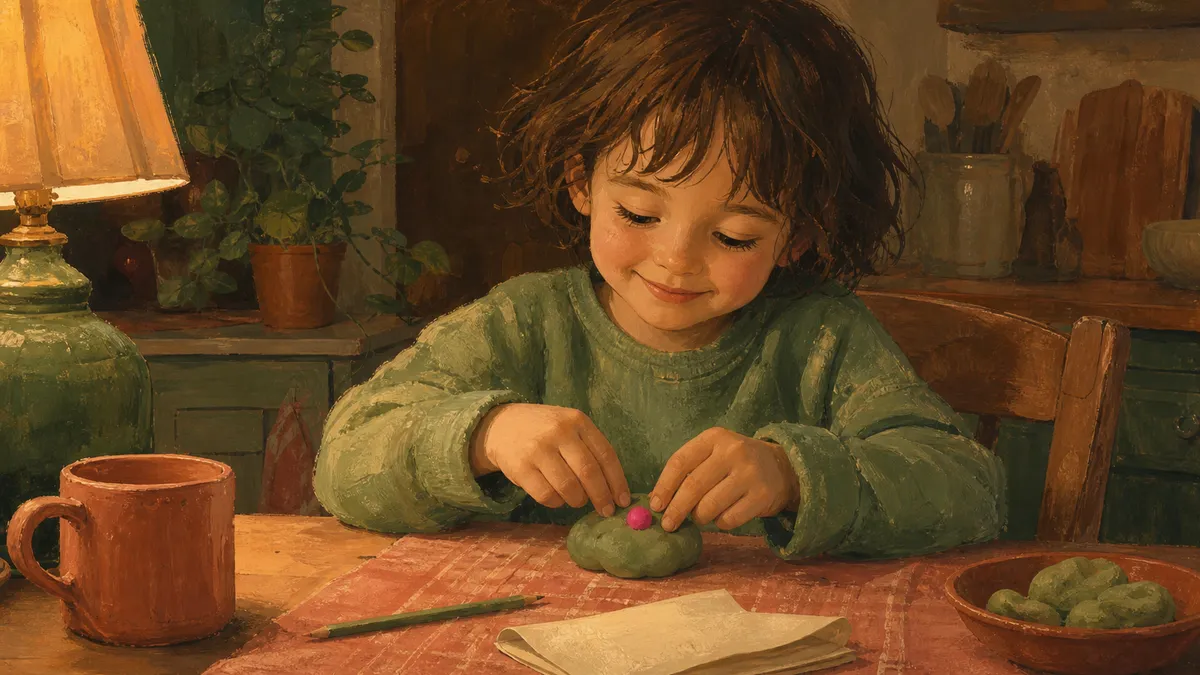
A fine motor skills activity before handwriting is just five minutes of waking up the small muscles in your kid’s hands so the letters that come next aren’t a fight. I’m Nora Hayes, a former preschool aide who ran this with my own two plus a living-room group of kids, and the warm-up does for little fingers what a few jumping jacks do before a run.
Below you’ll get the exact five-minute routine, no-prep versions for the mornings you’ve got nothing, the moves that fit kindergarten hands, and how to make it stick.
The plan in brief:
- Wake the hands with 60 seconds of finger stretches, fist squeezes, and wrist rolls.
- Squish play dough or pinch tweezers for 2 minutes to fire up the pincer grasp.
- Trace three big shapes in the air, then sit down to write while hands are warm.
Why a Quick Warm-Up Makes Handwriting Go Better
Most kids sit down to practice letters the same way you’d ask someone to thread a needle right after waking up. The hands need a minute first. Here’s what’s actually happening when you give them one.
What Warming Up Does for Little Hands
A child’s hand contains dozens of small muscles, and those muscles need activation before they’re asked to do anything precise. The pincer grasp (thumb and index finger pinching together) and the tripod grasp (three fingers holding a tool) both depend on those small muscle movements firing accurately. When those muscles are cold, the pencil wobbles, pressure is uneven, and the child is already fighting the tool before they’ve written a single letter.

A short warm-up changes the feeling immediately. Squeezing, stretching, and pulling motions prime the muscles for the kind of controlled hand strength that pencil control requires. By the time the child picks up their pencil, the grip is settled and the fingers know what to do.
Why Fine Motor Skills Come Before Letters
Letter formation is the output. Fine motor skills are everything that has to work before you get there.
Research on fine motor development in young children in a 2018 study of 52 preschool children found that manual dexterity was the only significant predictor of writing speed, with fine motor precision closely tied to handwriting legibility. The child who struggles to control a pencil isn’t struggling because they don’t know the letter shape. They’re struggling because the finger dexterity and eye-hand coordination that handwriting demands aren’t quite there yet.
That’s where fine motor activities like warm-ups earn their place. They train the precision and coordination that letter practice assumes already exists. You can also weave in fine motor tracing handwriting scissor skills once the basics are in place, but the foundational movement comes first.
The 5-Minute Fine Motor Warm-Up Routine
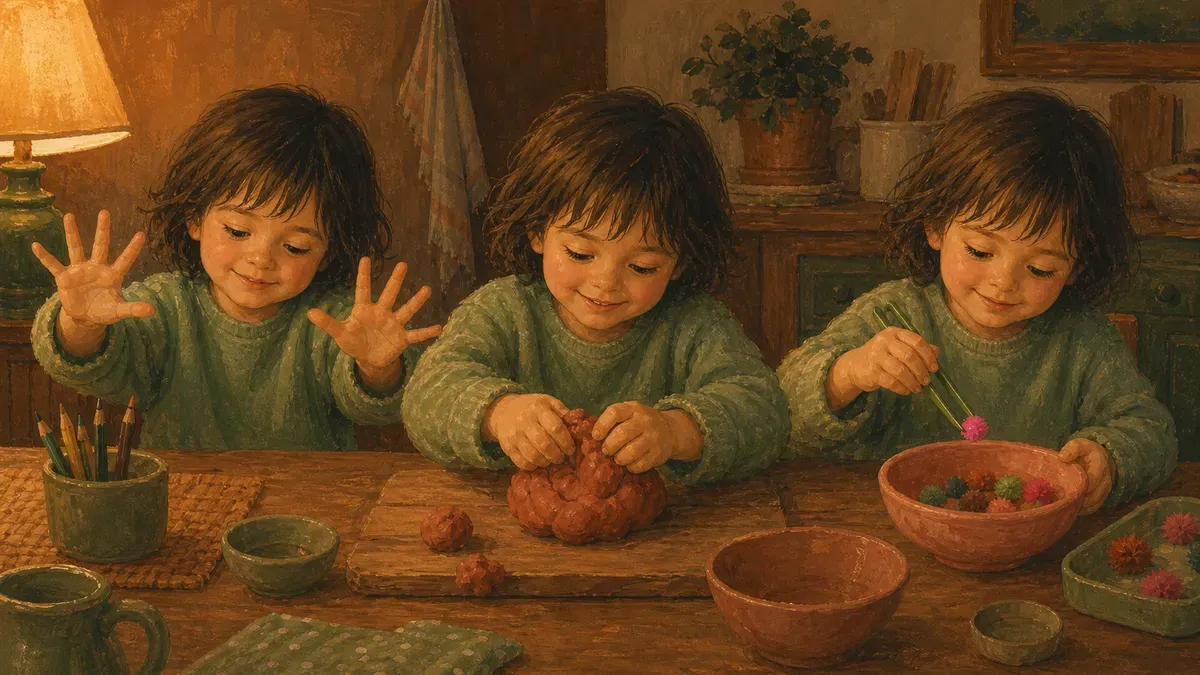
- Zero-material hand activation: 60 seconds of fists, fans, and wrist rolls
- Dough or putty grip work: 2 minutes building the pincer, tripod, and in-hand moves
- Standing arm movements to map the shapes, then transition straight to paper: 2 minutes
Minute 1: Finger Stretches and Hand Shakes
Start the timer and wake the hands up with nothing but the hands themselves. Have your kid open their fingers wide like a starfish, then ball them into a tight fist, five or six times through. Add a few wrist rolls in each direction and some loose shakes, like flicking water off after the sink.
These fine motor exercises take about a minute and need zero materials. The fist squeezes give a little proprioceptive input, the kind of deep pressure that helps a wiggly kid settle. The starfish-to-fist move builds hand strength and gets those small muscle movements going. Finger isolation comes next: thumb to each fingertip, one at a time, both hands.
No bin, no prep, no mess. Just sixty seconds of silly hand stuff before anything touches paper.
Minutes 2-3: Squish, Pinch, and Pull
Now bring in something to grip. Two minutes with play dough or putty is the heart of this warm-up, and it does more than keep little fingers busy. According to occupational therapy hand warm-up guidance, squishing and rolling dough hits pinch strength, the pincer grasp, the tripod grasp, and that tricky separation between the two sides of the hand, all of which feed straight into pencil control.
So here is how to work out fine motor skills with the exercises you already have in a drawer. Here is the sequence: roll the dough into snakes, pinch it flat with thumb and finger, then poke it full of holes.
- Roll into snakes: works the whole hand and wrist
- Pinch flat: builds pinch strength and the tripod grasp
- Poke holes: isolates finger control
- Dig out hidden beads: builds in-hand manipulation, moving things without help from the other hand
- Tweezers or kid tongs (optional): pinch pom-poms from one cup to another to level it up
For more dough-based ideas, our fine motor activities for preschoolers round-up has a whole list.
Minutes 4-5: Air-Trace Into Writing
Finish standing up. Have your kid “draw” giant shapes in the air with one pointed finger: a big circle, a tall line down, a square. This pre-writing practice maps the motion before the pencil ever joins in, and it pulls together eye-hand coordination and the precision the next few minutes will ask for.
Then, while the hands are still warm, sit down and slide right into the paper. No break, no snack run. That fine motor skills activity flows into the handwriting session because the hands never cool off. The warm-up was the on-ramp; the writing is the road.
No-Prep Warm-Ups for Busy Mornings
Some mornings the play dough is buried under yesterday’s dishes and you have three minutes before the bus. These two approaches cover what actually works when you have nothing ready.
Zero-Material Hand Exercises
Finger taps are the fastest on-ramp there is. Touch your thumb to each finger in order, then reverse. Do it twice. Ten seconds, zero materials, and the small muscle movements in the hand are already firing.
Each move isolates finger dexterity and builds hand strength without asking you to find a single thing.
- Thumb-to-finger sequence (repeat twice per hand)
- Pretend piano: tap each finger independently on the table
- Fist open-and-close, curling fingers one at a time
- Bilateral coordination tap: press palms firmly together and hold while tapping a slow count
These fine motor skills exercises fit in a car seat, a waiting room, or the three steps between the kitchen and the front door. Finger isolation practice this quick genuinely warms the hand before the pencil arrives.
Grab-and-Go Items From Around the House
Once you know what to grab, the kitchen becomes a therapy drawer.
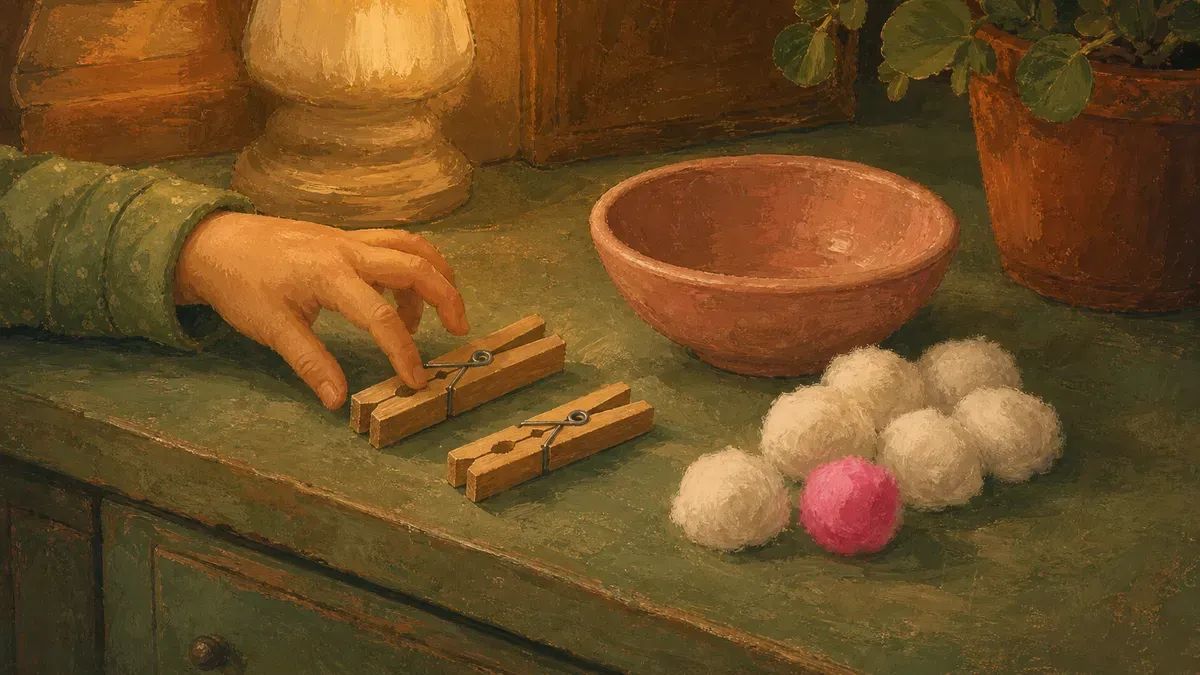
Clothespins are the single best found-materials tool for pincer grasp work, and there are a few ways to use them.
- Squeeze one open, clip it to a cup rim, release. A minute of that covers grip-strengthening ground as well as a lot of pricier kits
- Pair with a small bowl and cotton balls: pick each ball up with the clothespin and drop it in (the child has to regulate exactly how much pressure to apply through the tool, which is the point)
For threading and lacing without digging out beads, run a shoelace through a colander. Same motor pattern, nothing to lose under the couch. Pom-poms are another pantry staple that opens up a whole category of activities to strengthen fine motor skills. If you have a bag, the 20 pom pom activities quietly build hand strength post walks through the full list.
Set three clothespins on the counter tonight. Tomorrow morning you have OT-style exercises ready before you pour coffee.
Warm-Ups That Work for Kindergarten Hands
Kindergarten hands are mid-shift developmentally. Matching the warm-up to where they actually are is what keeps the routine challenging without being frustrating.
Picking the Right Level for Age 5 and 6
At five and six, most kids are still settling into which hand leads. Switching hands mid-task during scissors or writing is worth watching, per kindergarten handwriting readiness milestones. Your warm-up can quietly support hand dominance: start each activity on the child’s preferred side so the leading hand warms up first.
Arch development is the other piece.
- Palm arch separates the pinky-ring side (stability) from the thumb-index side (movement). Without it, a five-year-old grips the pencil with a fist.
- To build that separation, have the child tuck a small cotton ball under their ring and pinky fingers while doing finger taps with the other three.
Most kids think it’s funny, which keeps them in it.
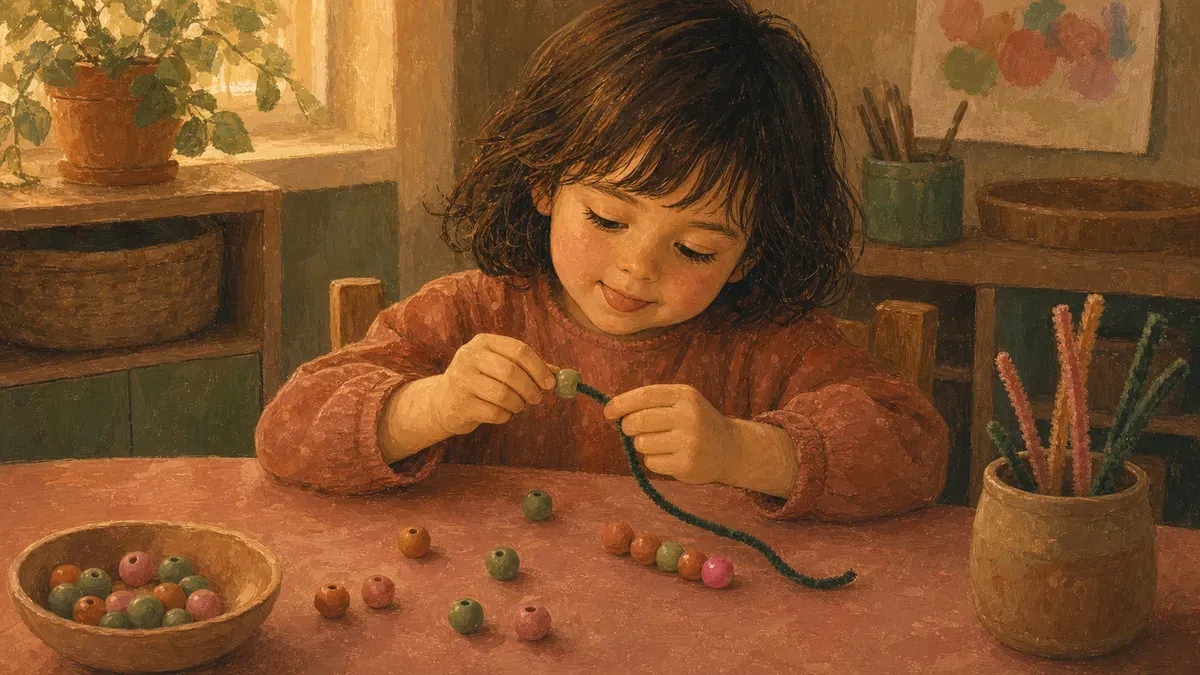
The tripod grasp is still forming too. Threading beads onto a pipe cleaner is one of the better fine motor kindergarten activities because it demands the same pinch that handwriting does, at a pace that doesn’t punish a slower grip.
Classroom-Friendly Group Warm-Ups
Teachers: this whole routine fits at desks, no materials, two minutes before a writing lesson.
- Finger taps: touch each fingertip to the thumb, both hands at once, two rounds. Bilateral coordination and finger isolation in a single move.
- Tabletop drumming: palms flat, lift one finger at a time and tap it down. Say the finger name out loud. Builds independent finger control, and kids enjoy the silliness.
- Air letters: trace a capital letter with the full arm, then shrink it to fingertip size. Bridges big movement to fine motor skills for kindergarten without paper in sight.
For fine motor skills activities for preschoolers joining a class early, keep movements bigger and slower: full arm circles before finger taps, and skip air letters until they can isolate fingers confidently.
Five minutes of these motor skills for kindergarten before a handwriting lesson means fewer cramped grips and a lot less “my hand hurts.” Run it every day for a week and notice the difference by Friday.
Turning the Warm-Up Into a Daily Habit
Running the routine once is easy. Running it on the fourth rainy Thursday when your kid is already cranky is the actual test. Getting them to show up willingly and knowing when the work is landing are what make the difference between a week-long experiment and a real habit.
Making It Stick Without a Battle
The fastest way to kill any routine is to make it feel like school. Keep the warm-up playful: let your child pick which tool you use that day, race to finish the finger taps first, or narrate in a ridiculous sports-announcer voice. That alone buys you genuine participation.
Tie it to something that already happens. Right after breakfast, right when the backpack comes off, right before you set out the worksheet. When the warm-up hooks onto an existing cue, you stop negotiating it into existence every morning.
For kids still working on the pencil grip toddlers develop before handwriting, consistency matters more than doing it perfectly. Three of the five minutes still counts. The fine motor skills and pencil grasp sharpen session by session. No single morning makes the difference, but the streak does.
Signs the Warm-Up Is Paying Off
You won’t see a change on day one. By the end of the first week, look for these shifts:
- Fewer complaints of hand fatigue mid-page
- A steadier grip that holds closer to a tripod grasp instead of fisting the pencil
- Lines landing on the baseline, pencil control tightening up
- Less erasing, more willingness to start the page
Research on in-hand manipulation and handwriting legibility found that finger dexterity and precision with small objects directly predict how neat letters come out. A warm-up that targets those skills is doing real work before the pencil touches paper.
For what comes after the habit is set, our full tracing, handwriting, and scissor skills guide walks the next progression.
Found this useful? Save it for the next rough afternoon.
Questions parents ask me about this
What is a quick fine motor skills activity before handwriting practice?
Finger stretches, a short play dough squish, or a minute of tweezers work are all solid choices. The goal is to wake up the small muscles in the hand before they're asked to grip a pencil, so even 60 seconds of pinching or squeezing counts. You don't need materials. Finger taps and fist curls work just as well on a busy morning.
How long should a fine motor warm-up be before writing?
Five minutes is enough. That's what the routine in this article is built around, and it's plenty of time to move through stretches, a squish activity, and air tracing before picking up a pencil. Going longer doesn't hurt, but it's not necessary to see the benefit.
Do warm-ups really improve a child's handwriting?
For most kids, yes. You'll notice less hand fatigue, a steadier grip, and lines that stay on track better than they do cold. Consistent warm-ups prime the grip and coordination that pencil work demands, which is why the benefit shows up as fewer complaints and steadier lines, not as a single dramatic shift. Consistent warm-ups make the actual writing session easier even if they don't fix underlying struggles overnight.
What fine motor warm-up can I do with no materials?
Finger taps, fist curls, wrist rolls, and pretend piano (touching each fingertip to the thumb one at a time) all work at any table with nothing in hand. Air tracing big shapes before picking up a pencil is another zero-prep move. These work in classrooms, cars, or mornings when you just can't find the play dough.
Can play dough be used as a handwriting warm-up?
Absolutely. It's one of the best options. Squishing, pinching, and rolling small balls targets the pincer and tripod grasp directly, which is exactly what pencil holding relies on. A two-minute play dough session, followed immediately by writing with no cool-down gap, carries that activation straight to the page.
How often should kids do fine motor exercises?
Daily is the goal, because hand strength and pencil control build through repetition rather than one-off sessions. That doesn't mean a formal routine every day. Threading beads, using clothespins, or tearing paper during play all count. When exercises get pushback, attach the warm-up to something they already love (play dough before drawing, or a quick finger game before a favorite show works well).
What if my child resists the warm-up routine?
Keep it playful and keep it short. Attaching it to something they already want helps (play dough before drawing, a quick finger game before a favorite show). Consistency matters more than compliance. Two minutes of genuine participation beats five minutes of resistance every time.
Written by
Nora Hayes
Mom of two and a former preschool aide. I share the screen-free sensory play and calm-down ideas I test at my own kitchen table, plus what the moms in my little meet-up swear by. A parent passing on what works, not a doctor or a therapist.
More about NoraKeep going
All Fine Motor-
 Fine Motor
Cutting Worksheets: 15 Activities Beyond Straight Lines
Bored of straight lines? These cutting worksheets and 15 activities build scissor skills fast. Grab the free printables and start today.
-
 Fine Motor
Activities to Build Fine Motor Skills With Pom Poms
The hand strength behind neat handwriting starts with play. Try 20 pom pom activities to build fine motor skills your kid will actually beg to do.
-
 Fine Motor
Fine Motor Skills Activities for Preschoolers
Ready to write? Spot the 12 readiness signs and the fine motor skills activities for preschoolers that build the hand. Start now.
-
 Fine Motor
Fine Motor Skills Activities for 3-4 Year Olds
Worried your 4-year-old still scribbles? These fine motor skills activities for 3-4 year olds bridge scribbles to real letters. Start today.