Activities to Build Fine Motor Skills: 20 Pom Pom Ideas

Some links here are affiliate links. If you buy through one, I may earn a small commission at no extra cost to you. As an Amazon Associate I earn from qualifying purchases. I only point to things I'd actually use with my own two.
Pom pom activities are the cheapest way to build fine motor skills, the pinch and grip a kid needs long before they ever hold a pencil. Kindergarteners spend close to half their classroom day cutting, writing, and fiddling with small things, per one classroom-time study. You only have to buy one thing. A 900-count bag of craft pom poms in a dozen colors, an Amazon’s Choice with more than 1,700 reviews, lasts through all twenty ideas here. I’m Nora Hayes, a former preschool aide and mom to a sensory-seeker, and below you’ll find 20 activities I’ve run at my kitchen table, sorted so you can grab one and go.
Why a Bag of Pom Poms Builds the Hand a Kid Writes With
A bag of pom poms is a cheap muscle gym for a kid’s hand. Pinching, squishing, and dropping those fuzzy little balls trains the exact grip a pencil needs later, and it does it through play instead of drills.
The Tiny Muscles That Hold a Pencil
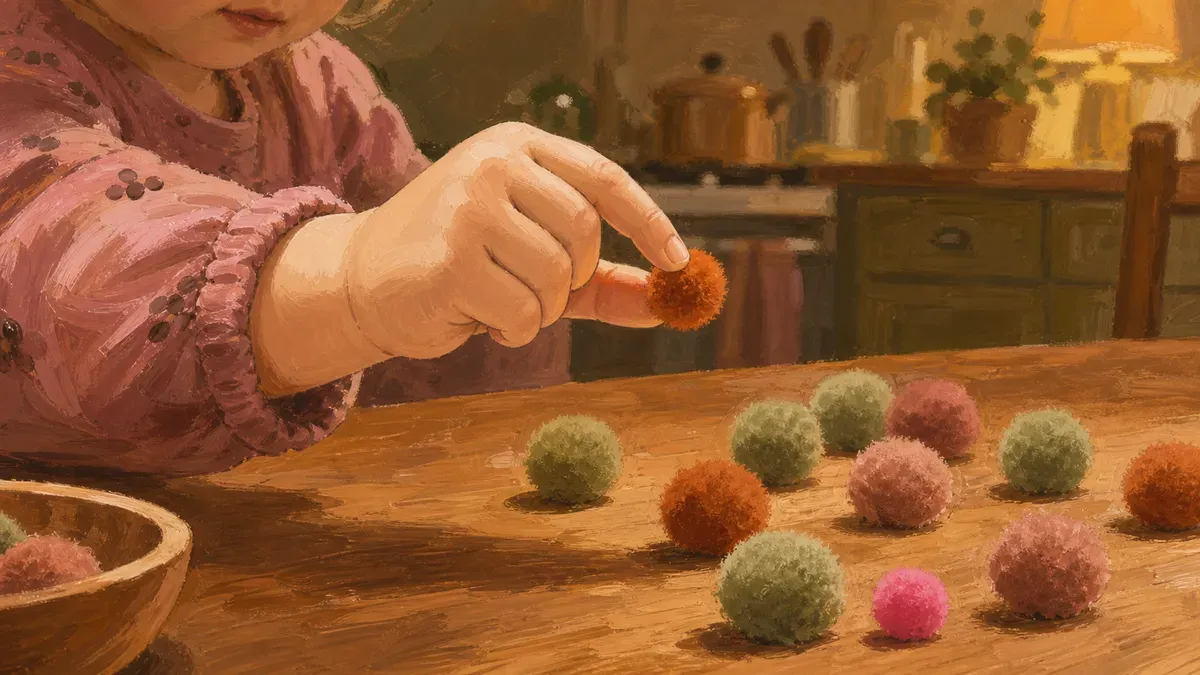
When your kid pinches a pom pom between thumb and finger, they’re using a pincer grasp. That tidy little pinch runs on the small muscles tucked deep in the palm, the ones that build the hand’s arches and bend the knuckles.
Here’s the part that matters: those same finger muscles show up again the day your kid wraps a fist around a crayon. The thumb joint that flexes to catch a tiny pom pom is the same one that drives a proper pencil grip, according to research on hand strength and writing readiness from The OT Toolbox.
So every pinch is quiet grip strength training. You’re building hand-eye coordination and the small muscles a pencil leans on, long before anyone hands your kid a worksheet. If you want the bigger map of what comes when, here’s the real order fine motor activities develop in.
Why Pom Poms Beat Worksheets for Strength
A worksheet asks a hand to do hard work it isn’t strong enough for yet. A pom pom doesn’t.
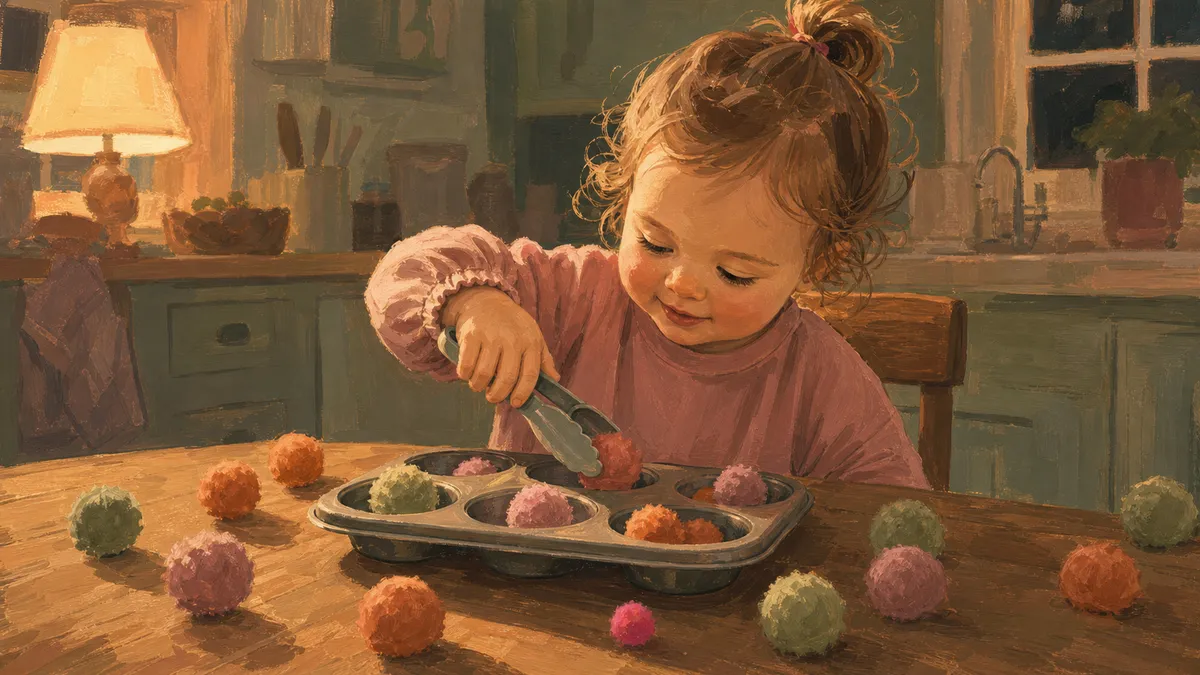
That squishy, grabbable texture gives little fingers something to fight against, and that resistance is where strength comes from. Tongs, a muffin tin, a fistful of pom poms, this is sensory play and dexterity practice rolled into one, and your kid thinks it’s a game.
Worksheets train the shape of a letter. Pom poms train the hand that will make it. The first one without the second is a kid white-knuckling a pencil with muscles that aren’t ready.
That’s the case for everyday materials over flat manipulative drills, and it’s why these fine motor skills come easier through play. Pencil and paper come once the hand is built, and you can lean into fine motor tracing handwriting scissor skills then.
20 Pom Pom Activities to Build Fine Motor Skills
A bag of pom poms turns into twenty different workouts for the hand, and here they are sorted by what they actually train: pinch strength, whole-hand control, and the precision that ties fingers to eyes. Pick the one that matches the day you’re having.
- Tweezers and clothespins: four activities that build the pinch grip kids need before a pencil
- Scoops and bottles: four whole-hand games where two hands have to work together
- Sorting by color, count, and pattern: four activities that pair hand practice with early learning
Pinch-and-Sort Activities for Grip Strength
Start here if the goal is the tiny muscles that hold a pencil steady. These squeeze-and-pinch games ask the thumb and first two fingers to do the work, which is exactly the grip a kid needs before any worksheet.
Grab a set of tweezers, a clothespin, and an old eye dropper, and you’ve got three activities right there.
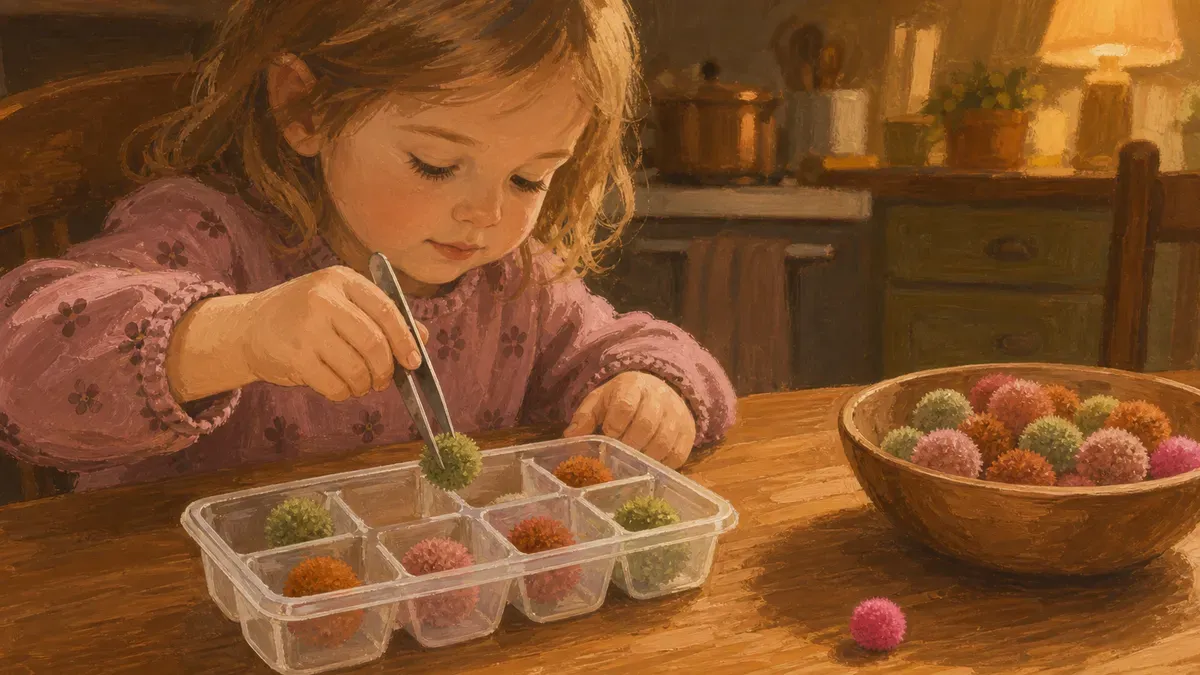
- Tweezer transfers: move pom poms one at a time from a bowl into an ice cube tray. Slow, deliberate, weirdly satisfying.
- Clothespin drops: pinch a pom pom in the clothespin, carry it across the table, release it into a cup.
- Eye-dropper races: skip the water, just have your kid pinch the bulb to grab and drop small pom poms. A six-pack of toddler pipettes (4.8 stars, 3,000-plus reviews) is easier to squeeze than a leftover medicine dropper. Two kids, two droppers, first to fill the muffin tin wins.
- Tong relay: salad tongs for the littlest hands that can’t manage tweezers yet.
That tong-to-tweezer order isn’t random. Tools to Grow notes that squeezing a clothespin pulls on the same muscle groups scissors use, and kids can climb from salad tongs to clothespins to child-sized tweezers as their pinch strength grows. So a child who can’t manage tweezers isn’t behind. They just need the bigger tool first.
Here’s the climb, easiest grip to most precise:
| Tool | What it is | Parents’ rating | Reach for it when |
|---|---|---|---|
| Kid-size salad tongs | 4-piece plastic tool set, ages 3+ | 4.6★, 19,000+ reviews | Little hands that can’t work a pincer yet |
| Clip-style clothespins | 42-piece clip set with letters, ages 3-6 | 4.6★, 200+ reviews | The middle step, same squeeze scissors need |
| Children’s tweezers | 12-piece plastic set, ages 2+ | 4.8★, 400+ reviews | Fingertip precision, once the pinch is there |
These are the fine motor strengthening activities I reach for when a kid needs precision work but doesn’t know that’s what they’re doing. If your child resists sitting down cold, run a quick fine motor skills activity warm-up first to loosen the hands.
Scoop, Drop, and Stuff Games for Whole-Hand Control
Pinching is half the picture. The other half is the whole hand and wrist working together, and these activities to improve fine motor skills lean into that.
Scooping is the quiet star here. Hand your kid a big bowl of pom poms and an empty container, and let them get to work. One hand scoops, the other steadies the container, and that two-handed teamwork is the point.
- Spoon scoop: transfer pom poms between bowls with a spoon, no spilling allowed.
- Bottle stuffing: push pom poms one by one through the neck of an empty water bottle. The narrow opening forces real precision.
- Play dough press: roll out play dough and press pom poms deep into it, then dig them back out.
- Muffin tin sort: scoop a spoonful and dump one pom pom per cup.
The scooping isn’t just busy work. The OT Toolbox explains that the bilateral coordination a child builds when the dominant hand scoops and the non-dominant hand stabilizes transfers straight to holding paper while writing, working clothing fasteners, and cutting with scissors. Same wiring, different job.
There’s a manipulative quality to bottle stuffing that wins over kids who won’t sit for sorting. It’s part hand-eye coordination, part stubborn problem-solving, and it builds dexterity without feeling like practice. If pom poms are too small for a mouthing toddler, size up to cotton balls.
Color, Count, and Pattern Play for Precision
Now stack a second skill on top of the first. These activities to build fine motor skills pair the pinching with sorting, counting, and pattern work, so young children get hand practice and early learning in one go.
Here’s where the eyes lead the hands.
- Color sort: tweeze pom poms into matching cups by color. Red to red, blue to blue.
- Counting tray: drop the right number of pom poms into numbered muffin cups, one through ten.
- Pattern strips: lay pom poms along a paper strip in a repeating sequence, red-blue-red-blue, then make it harder.
- Letter fill: trace a big letter on paper and fill the lines with pinched pom poms.
That eyes-guiding-hands skill has a name, visual-motor integration, and it’s worth a kid’s time. A 2024 meta-analysis of children ages 3 to 10 found visual-motor integration showed the strongest link to math ability of any fine motor subgroup, with a correlation of r = 0.47, and a medium tie to reading at r = 0.37. So a color-sorting game isn’t just keeping hands busy. It’s wiring the same precision behind early numbers and letters.
These activities to enhance fine motor skills are the ones I’d start with for a kid who already loves to organize. The sorting gives them a reason to keep pinching long after a plain transfer game would’ve lost them. Match the activity to the child in front of you, and the practice takes care of itself.
Matching the Activity to Your Child’s Age and Stage
A two-year-old and a five-year-old reach into the same bin and do completely different work with it. Here’s how to pick the right pom pom job for the kid in front of you, toddler through pre-K.
Toddlers: Big Grabs and Simple Sorting
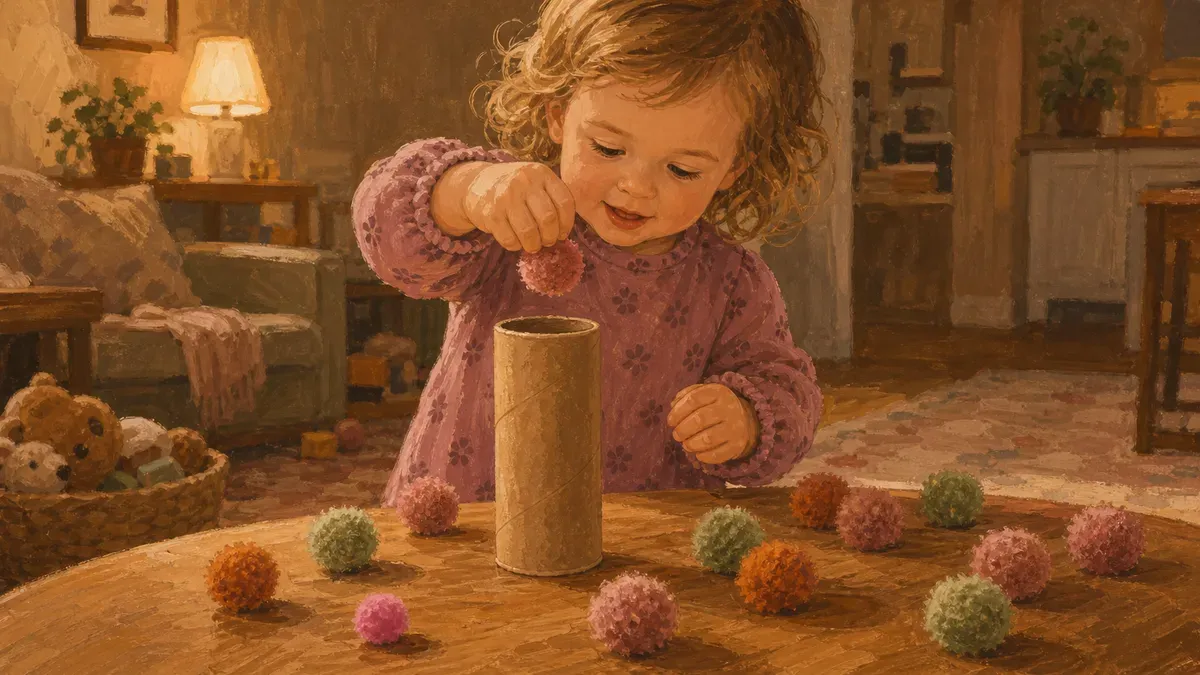
For a toddler, don’t reach for the tweezers yet. Their hands aren’t built for precision, and pushing it just turns the bin into a fight. This is the age of big grabs: scooping a fistful, dropping pom poms through a cardboard tube, stuffing them into an empty wipes container one at a time.
That whole-hand work is the foundation. The fingertip pincer grasp shows up between nine and twelve months, per fine motor developmental milestones by age, but it’s nowhere near refined in a two-year-old. So activities to support fine motor skills at this stage lean on the bigger small muscles first.
- One color into one cup. Dead simple, and that’s the point.
- Stuffing and dropping before sorting: let them repeat the motion until it clicks.
- Resist adding more cups until they nail the one.
Toddlers and preschoolers follow a real developmental progression, and rushing past the grab-and-drop stage skips the hand strength everything else is built on. Manipulative activities they can actually finish keep them coming back.
Preschool and Pre-K: Tools and Patterns
By preschool, the hand is ready for more. Around ages three and four, kids develop a real variety of grasping patterns, including a precision pinch, with that neat fingertip pincer grasp getting refined closer to age five. That’s your green light for tools.
Hand a pre-K kid tweezers, clothespins, and a pipe cleaner for threading, and you’re scaffolding straight toward writing readiness. That grip work builds the controlled, independent hand use that writing tools demand later. These activities to promote fine motor skills aren’t busywork; they’re pre-writing skills in disguise.
- Red, blue, red, blue down a row of clothespins.
- Thread five pom poms, count them, start over.
- Two colors first; add a third only when the pattern sticks.
The thinking and the pinching happen together, which is exactly what writing demands later. Now you can add patterns. For more in this stage, my roundup of fine motor skills activities for preschoolers goes deeper on the bridge to handwriting.
When a Kid Refuses or Struggles With Fine Motor Play
Some kids dump the pom poms on the floor and walk off, and that’s real, not a failure on your part.

Sensory-Friendly Tweaks for Resistant Kids
A refusal is usually information, not defiance. The tabletop is too still, the pinch is too hard, or the setup feels like a test, so change the setup, not the kid.
My go-to with a wound-up sensory-seeker is to add input first, then the play. Push a stack of books across the room, do five wall pushes, carry the laundry basket. Heavy work settles a body enough to sit. My son still needs it before anything that asks for small, careful hands.
Then lower the stakes on the activities to increase fine motor skills you already planned:
- Bury the pom poms in a rice bin or a sand tray so the grabbing comes with a texture they crave
- Trade tweezers for fingers, or fingers for a chunky scoop, whatever they’ll actually pick up
- Move it to the floor, the bath, or a window with tape, anywhere that isn’t the dreaded chair
- Swap in resistance they like, squishing dough or pulling pom poms out of a slit in a yogurt lid
Those tactile and resistance swaps are the kind of thing an occupational therapist suggests for kids who resist standard tabletop work, as this guidance on when to see an occupational therapist lays out. For more, my notes on fine motor activities kid cant sit cover the full setup.
Signs It Might Be Time to Ask an OT
Most refusal is just a kid being a kid on a given afternoon. But a steady pattern is different from a bad Tuesday.
A few things worth watching, especially when they stick around past the age you’d expect them to ease up:
- Trouble grasping or letting go of objects
- Ducking out of any drawing the moment it appears
- Real difficulty picking up small things
- Weak grip strength that doesn’t build with everyday materials
- Never bringing both hands together for a task
None of these is a diagnosis, and I’m a parent, not a clinician. They’re flags that a check-in might help. If a few of them stick around, ask your pediatrician about an evaluation. An OT watches how your child actually moves and builds from there, and there’s no harm in asking early.
Building the Habit Beyond the Pom Pom Bin
Pom poms are a starting point, not the whole plan. The goal is putting fine motor skills into motion across the whole day, not just during a dedicated activity slot.
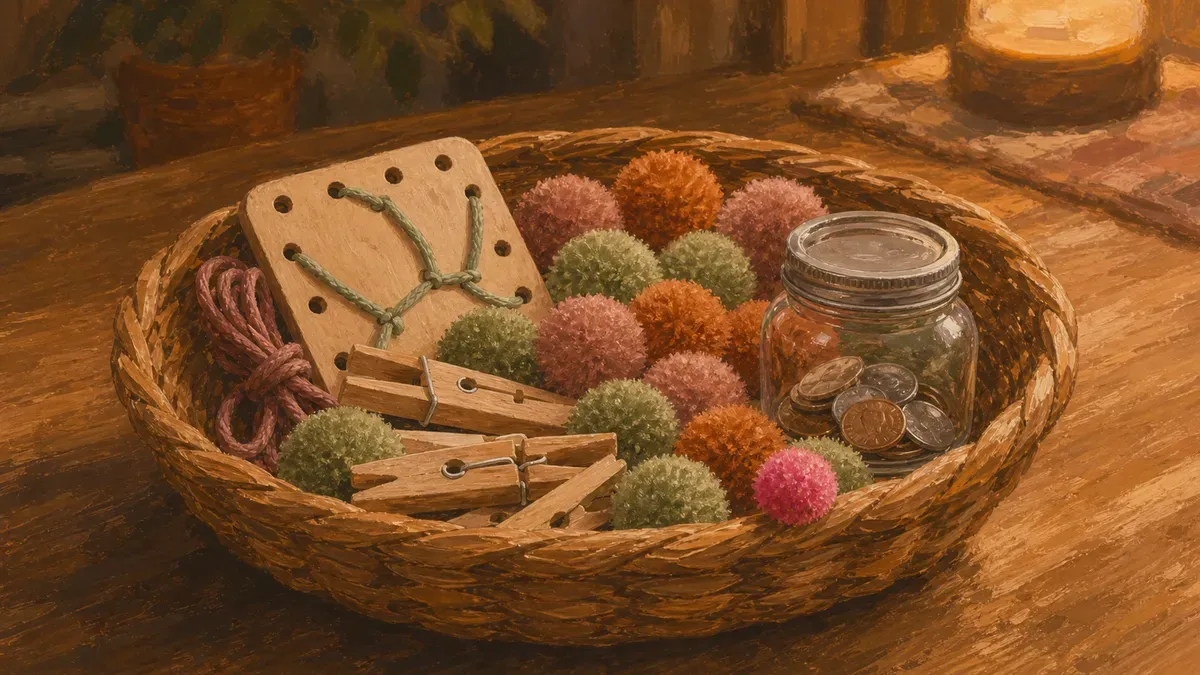
Most of the best everyday materials are already in your kitchen. Everyday tasks are full of real dexterity work:
- Peeling a sticker off the backing
- Squeezing a juice pouch
- Snapping a lid on a container
- Turning a doorknob
- Buttoning a jacket
The developmental progression from grabbing to pinching to controlled hand movement happens through repetition woven into ordinary life, not just during a sit-down play session.
Busy bags help a lot here. A small basket by the couch with a few rotating items (a jar with coins, a lacing card, a clothespin and some cardboard) gives you something to hand over during the slow parts of the day. Our fine motor skills games for preschoolers post has a rotation that takes about ten minutes to assemble.
Writing readiness catches up when hands are getting varied work over weeks and months, not in one focused afternoon. If you want ideas past pom poms, browse our full library of fine motor and handwriting skill-builders. It covers tracing, scissors, and everything in between.
Found this useful? Save it for the next rough afternoon.
Questions parents ask me about this
What age should a child start pom pom fine motor activities?
Babies as young as six months can interact with pom poms under close supervision, grabbing them with a whole-hand rake grip. Toddlers around 12 to 18 months are ready for simple drop-in-the-container play. The more precise work, tweezers and threading, fits better around age three or four when the pincer grasp has had time to develop.
Are pom pom activities safe for toddlers who still mouth objects?
Not on their own. Standard craft pom poms are a choking hazard for any child who still mouths things regularly. If your toddler is in that stage, sit right next to them and run the activity as a supervised game rather than independent play. Some parents swap in jumbo pom poms and keep the session short with full eyes on it.
How long should a fine motor activity session last for young kids?
Shorter than you think. Toddlers often max out around five to ten minutes before interest drops off, and that is a full, useful session. Preschoolers can sometimes go twenty minutes if the setup holds their attention. When they walk away, let them go and try again tomorrow.
Do pom pom activities really help with handwriting?
They build the foundation, not the finished skill. Pinching, squeezing, and transferring small objects strengthens the same intrinsic hand muscles that later grip a pencil. Think of it as getting the hand ready for writing before a pencil ever enters the picture. The connection is real, but it works over weeks of varied activity, not a single afternoon.
What can I use instead of tweezers for pom pom activities?
Clothespins are the easiest swap and they work the pinch muscles just as hard. Salad tongs work well for younger kids who need a bigger tool to grip. Fingers alone count too, and scooping with a spoon is a legitimate step down in difficulty. Match the tool to where your child is rather than pushing straight to the hardest option.
How often should kids do fine motor activities each week?
Some form of hands-on, manipulative play every day is ideal, even if it is just five minutes. You do not need a formal setup each time. Everyday tasks count: snapping buttons, opening containers, tearing crusts off toast. The more varied the hand work across the week, the better the cumulative effect.
Written by
Nora Hayes
Mom of two and a former preschool aide. I share the screen-free sensory play and calm-down ideas I test at my own kitchen table, plus what the moms in my little meet-up swear by. A parent passing on what works, not a doctor or a therapist.
More about NoraKeep going
All Fine Motor-
 Fine Motor
Cutting Worksheets: 15 Activities Beyond Straight Lines
Bored of straight lines? These cutting worksheets and 15 activities build scissor skills fast. Grab the free printables and start today.
-
 Fine Motor
Fine Motor Skills Activities for Preschoolers
Ready to write? Spot the 12 readiness signs and the fine motor skills activities for preschoolers that build the hand. Start now.
-
 Fine Motor
Fine Motor Skills Activities for 3-4 Year Olds
Worried your 4-year-old still scribbles? These fine motor skills activities for 3-4 year olds bridge scribbles to real letters. Start today.
-
 Fine Motor
Scissor Practice Worksheets: 10 Steps to Cutting
Most kids snip before they cut shapes. Use these scissor practice worksheets and 10 activities to build the skill step by step. Start today.