Calming Center Essentials: The Only Checklist You Need

I am a parent sharing what worked at my house, not medical advice. For anything to do with your child's development or sensory needs, talk to your OT or doctor.
Some links here are affiliate links. If you buy through one, I may earn a small commission at no extra cost to you. As an Amazon Associate I earn from qualifying purchases. I only point to things I'd actually use with my own two.
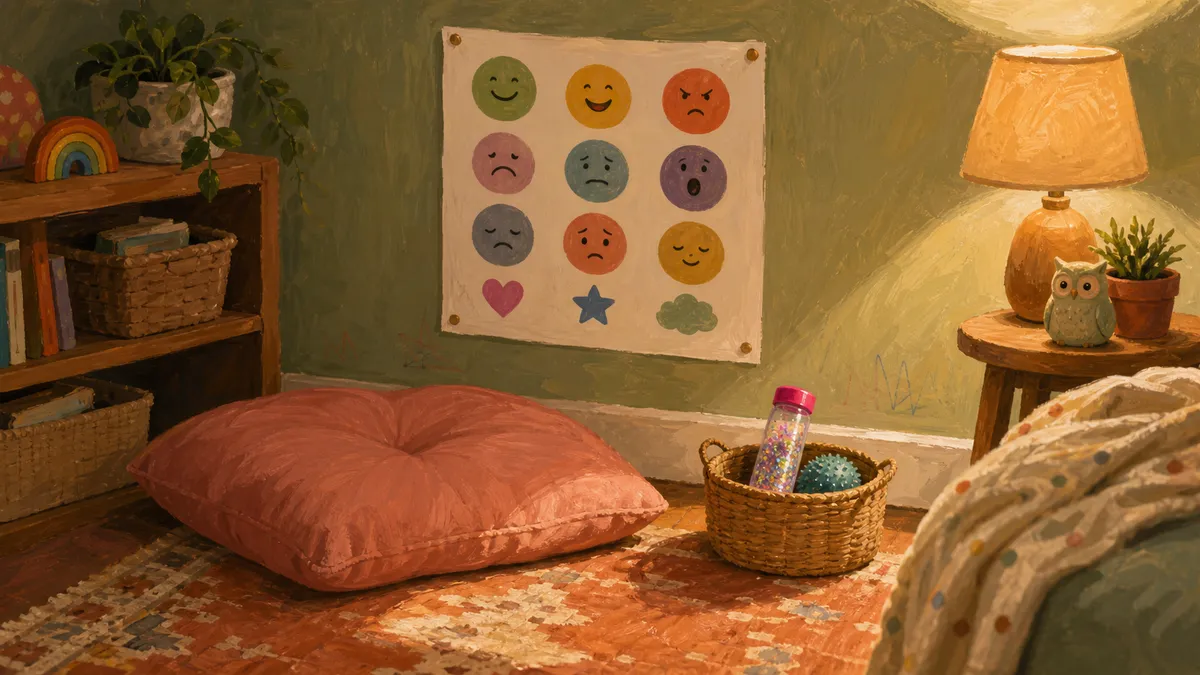
A calming center is a small, cozy spot your kid goes to before a meltdown hits, stocked with a few self regulation tools that actually help them settle, not a time-out chair with a new name. Get the items right and they’ll use it on their own; get them wrong and it turns into a pile of stuff they walk straight past, which is exactly what happened with my first try.
I’m Nora Hayes, a former preschool aide and mom of an autistic 7-year-old, and this post covers what a calming corner really is, why the tools matter, and the short checklist of emotional regulation tools that earn their spot.
What a Calming Center Really Is (and Isn’t)
A calming corner is a cozy, judgment-free spot in your home where a kid can land before a meltdown goes full five-alarm. That’s it. A pillow, a basket of sensory tools, maybe a feelings poster on the wall.
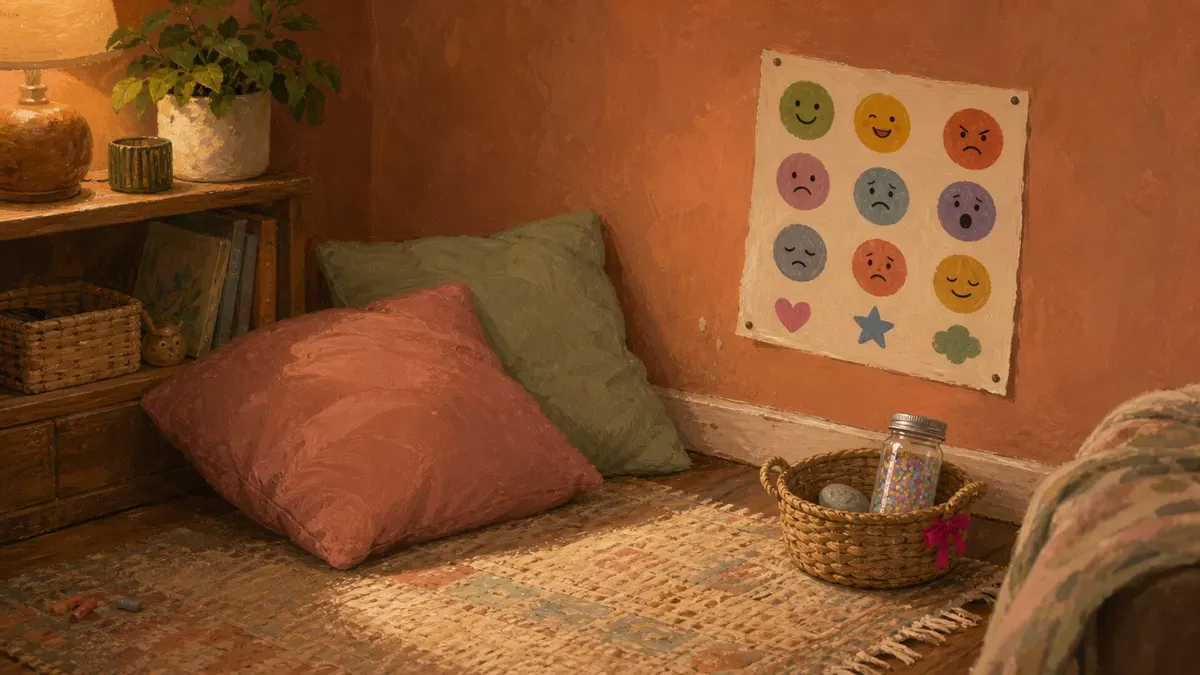
The mistake most parents make is treating it like a calm down area that only comes out after the screaming starts. By then, the window is closed. A calming center works when a child uses it before they’re completely dysregulated, not as a consequence, but as a pit stop.
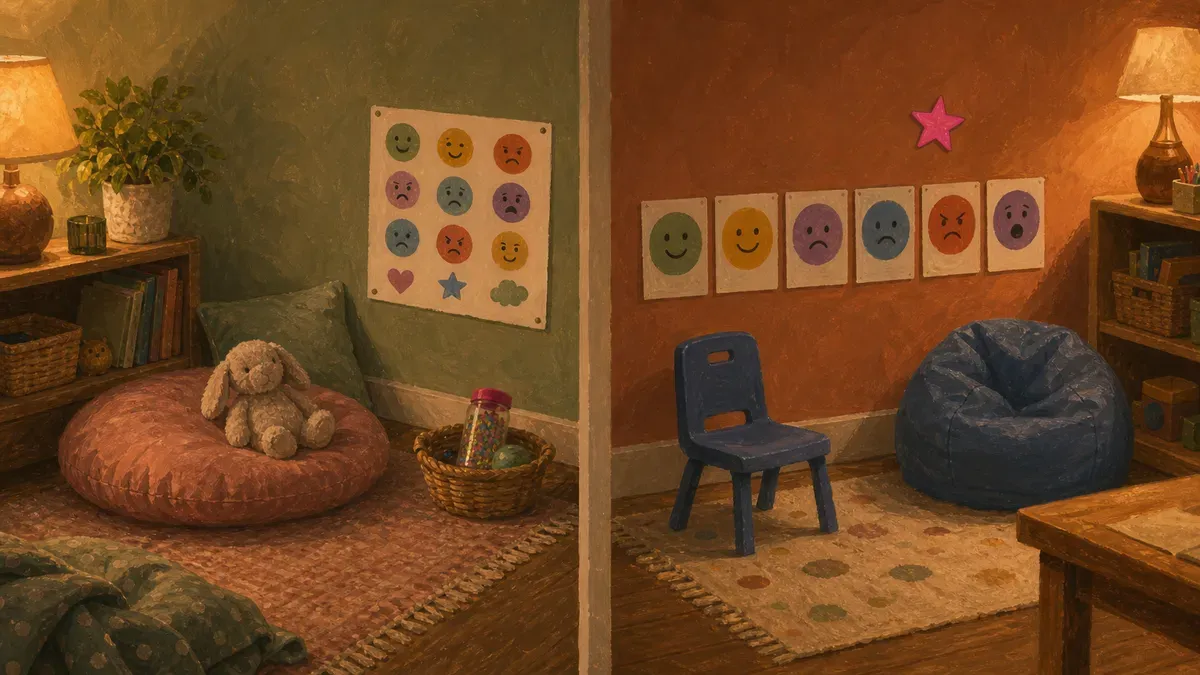
This is the core difference between a time-out chair and a time-in space. A time-out removes connection. A time-in keeps it. The therapeutic purpose isn’t to punish or isolate; it’s to give a kid a place to land with something useful in their hands.
That distinction matters, because it changes everything about what goes in it. If you’re ready to set up a calm down corner in the next ten minutes, the tools you pick will determine whether your kid actually uses the space.
Why the Right Tools Help Kids Calm Down
When a child melts down, their nervous system has flooded. The thinking part of the brain goes offline and the body is stuck in fight-or-flight. You can’t reason with a kid in that state. What you can do is give their body something concrete to interrupt the spiral.
That’s what the right tools do. A weighted lap pad, a glitter bottle, a deep breathing card: none of these are magic. They work because they give the body a job while those brain pathways start coming back online. It’s the same reason you’ve taken a slow breath in a tense moment. Physical input changes internal state.
Research on self-regulation in children from Stanford found that guiding kids through just one minute of slow deep breathing measurably reduced heart rate and boosted markers of a relaxed nervous system. One minute.

Co-regulation matters too. When you stay calm beside a child moving through big emotions, your steadiness helps regulate theirs. The space holds them; you help their system settle. A calming corner works best when it’s been practiced on a good day, so that when dysregulation hits, the familiarity feels safe rather than foreign.
More on how this plays out: calm down corner emotional regulation and a full list of emotional regulation activities for kids that hold up when the day goes sideways.
The Calming Center Checklist: Tools That Actually Belong
So what actually goes in the corner? Here’s the short list I keep coming back to, split into the three jobs a good calming center has to do: give the body something to fiddle with, give the feelings a name, and help everything slow down.

Sensory and Fidget Items
Start with stuff for the hands, because a wound-up body calms faster when it has a job. A few go-tos that earn their spot:
- Fidgets and a stress ball (one or two of each)
- Kinetic sand in a small tub, the kind that stays squishy instead of drying to a brick
- A smooth worry stone that fits in a small palm
- A homemade sensory bottle (water, glitter glue, a squirt of dish soap)
That sand is the one my Eli digs into without being asked, and going by the 19,000-plus reviews behind it, plenty of other kids do the same. It carries the Amazon’s Choice tag, which here mostly means you’re not gambling on a knockoff that clumps and stains the rug.
A weighted blanket is the heavier hitter. A 2024 systematic review and meta-analysis in the Journal of Psychiatric Research found weighted blankets had a small but positive effect on reducing anxiety. Small is honest, and small still counts at 4pm on a hard day. The weighted blanket I keep folded in the corner sits at 4.7 stars across 1,700-plus reviews; match the weight to your kid, not to a chart, and skip it entirely for the under-twos.
Visual Supports and Feelings Check-Ins
Kids can’t calm a feeling they can’t name yet. That’s where the visual stuff comes in, and it’s the quiet backbone of the whole corner.
Keep a simple feelings chart at kid-eye level, plus a couple of feelings posters if you’ve got wall space. The one I point parents to is an Amazon’s Choice pick holding 4.7 stars across 100-plus reviews, though a page you print at home does the same job. Emotions check-in cards work even better for the runners, the kids who’d rather hand you a card than say a word out loud. A coping strategies wheel gives them the next move once they’ve landed on a feeling: spin it, pick “squeeze something,” go.
Naming the feeling is half the work; the calming cards just hold the door open while they do it.
These are the self-regulation tools that build real emotional vocabulary over weeks, not minutes. Don’t expect a toddler to use them solo at first. You model it, you narrate it, and one ordinary Tuesday they surprise you by reaching for the green card on their own.
Comfort and Breathing Aids
The last layer is the soft stuff, the things that whisper “you’re safe here” before a single word gets said.
Soft stuff makes the corner feel like a landing pad, not a timeout chair:
- A bean bag chair or floor pillow (sinking into it signals the body to power down)
- A stuffed animal, the well-loved kind, not the display kind
- A Hoberman sphere (expand to breathe in, collapse to breathe out)
- Breathing cards with pictures for the kids who won’t follow verbal cues
- A calming jar for something to watch while the glitter, and then the kid, settles
The bean bag pulls the most weight here. It’s an Amazon’s Choice at 4.3 stars with north of 25,000 reviews behind it, and the reason is plain: a kid who flops into one gets that full-body squeeze that tells the nervous system to stand down. The Hoberman sphere is the sleeper pick. Quieter at 4.4 stars over 200-plus reviews, sure, but it hands a kid who won’t parrot “smell the flower, blow the candle” something real to do with their hands while they breathe.
If you’d rather start from a ready-made list, building a DIY calm down corner kit walks through the same pieces without the guesswork.
Adding Zones of Regulation Tools to the Space
The Zones of Regulation framework gives the corner’s visual supports a shared language you and your kid can actually use. According to zonesofregulation.com, OT Leah Kuypers developed the system starting in 2008 and published it in 2011. Four color-coded zones (Blue, Green, Yellow, Red) help a child name where their body is right now, then pick a coping strategy that fits.
Sorting zone tools by color makes the emotions check-in automatic. Four labeled bins or pockets, one per zone, is enough:
- Blue (tired, bored, low energy): reach for the quietest, heaviest item in this bin
- Green (calm, focused, ready): this is maintenance mode, a quick check-in is enough
- Yellow (wobbly, wiggly, anxious): the body needs an outlet before the brain can settle
- Red (overwhelmed, flooded): less is more. One simple tool, not a menu of choices

You don’t need matching bins from a boutique supply site. A row of labeled gallon bags works just as well. What matters is that your kid starts to connect a color to a feeling in their own body. For a closer look at what each zone of regulation looks like in real kids, that post breaks it down by age and behavior.
Matching the Center to Your Kid and Your Space
Zones and tools only work if they fit the child using them. Age and where the space lives shape everything else.
Toddlers vs. School-Age Kids
A two-year-old and a seven-year-old are not working on the same problem.
- Toddlers need sensory items to squeeze, shake, or sink their hands into
- A feelings chart can live on the wall, but she points at the sad-face and moves on
- That tactile connection is doing real work even without the words
Around five or six, language starts catching up to emotion. A longitudinal study tracking 120 children ages 2 to 5 found that toddlers relied mainly on automatic self-soothing, while five-year-olds increasingly used language-based reasoning and attention-control strategies. At the corner, the kinetic sand stays, but now a coping card with words actually gets used.
- A feelings wheel with nuanced words, so kids can name what’s happening
- A “what I need right now” card with simple options
- Visual supports still matter at this age; they just carry more language
Home vs. Classroom Setups
At home, the space can be as personal as your kid wants it.
- One stuffed animal or a specific blanket your kid chose
- A photo of the dog, a favorite small toy, whatever settles them
- Privacy is easy at home: nobody else is watching
A classroom corner runs on different rules. A 2021 study from Northwest Iowa University found it reduced negative behaviors and improved emotional self-management across grades 1 through 6, but only when the setup stayed simple and judgment-free.
- Nothing breakable, nothing that causes envy between kids
- Visual supports posted at eye level so the whole room can use them
- A quiet check-in from the teacher keeps it from feeling like a walk of shame
For ideas for a cozy corner preschool space in small classrooms, that post has low-prep options that work for groups. Our complete guide to building a calm-down space walks through the whole setup from scratch.
Found this useful? Save it for the next rough afternoon.
Questions parents ask me about this
What should go in a calming center for kids?
A calming center works best with three kinds of tools: something for the hands (a fidget, a stress ball, or a sensory bottle), something for feelings (a simple feelings chart or a few picture cards), and something for breathing (a visual breathing card or a calming jar to shake and watch). Keep it small. Four or five things that actually get used beat a shelf of tools nobody touches.
How long should a child stay in a calming center?
There's no fixed rule, and setting a timer usually backfires. Kids stay until their body feels ready, which might be two minutes or might be ten. Watch for the physical signs: breathing slows, shoulders drop, they start to engage with a tool instead of just sitting there stiff. That's the cue they're ready to come back.
What if my child refuses to use the calming center?
Refusal usually means the space isn't familiar yet. Practice visiting on good days, not just the hard ones, so it doesn't feel like a consequence. Sit in it with them, use the tools yourself, make it a regular low-stakes stop. Most kids warm up once they associate it with something other than "go there when you're in trouble."
How do you build a calming center on a budget?
You already own most of what you need. A pillow and a blanket from the couch, a clear bottle filled with water and glitter, a printed feelings chart, a few craft pom-poms for squeezing. The space matters more than the products. A dedicated corner with familiar items outperforms an expensive kit a child never bonds with.
What calming center tools work for an autistic or ADHD child?
It depends more on the individual child than the diagnosis, but sensory-seeking kids often respond well to heavy, tactile tools: a weighted lap pad, kinetic sand, a firm squeeze toy. Kids who are easily overwhelmed may prefer quieter items: a soft fidget, a single feelings card, dim lighting. Follow what your child's body is telling you, and when in doubt, ask their OT for a starting point tailored to that kid.
How do you help a child transition back to activity after calming down?
A brief check-in works better than a sudden push. Ask something simple: "Does your body feel ready?" or "What do you need before we go back?" Some kids benefit from a small movement break first, like a few jumping jacks or a walk to the kitchen, before returning to whatever they stepped away from. Keep the transition low-pressure so the calming center stays a safe place to return to next time.
Is a calming center the same as a time-out spot?
No, and this distinction matters. A time-out is imposed by an adult as a consequence for behavior. A calming center is a resource the child can choose, ideally before they hit full meltdown. The goal is to give kids a place to regulate, not to isolate or punish them. When it's used as a time-out substitute, kids stop trusting it and stop going voluntarily.
Written by
Nora Hayes
Mom of two and a former preschool aide. I share the screen-free sensory play and calm-down ideas I test at my own kitchen table, plus what the moms in my little meet-up swear by. A parent passing on what works, not a doctor or a therapist.
More about NoraKeep going
All Calm & Big Feelings-
 Calm & Big Feelings
Emotional Regulation Activities for Kids That Work
Most calming tricks fail mid-meltdown. These emotional regulation activities for kids work when nothing else does. Find the one that fits your child.
-
 Calm & Big Feelings
Calm Corner Ideas: 25 Picks Under Your Coffee Budget
Skip the $200 setups. These 25 calm corner ideas cost less than a latte and soothe big feelings. Build one your kid loves this week.
-
 Calm & Big Feelings
Cozy Corner Preschool: Calm Down Ideas for Throwers
Throwing the calm-down tools? Build a cozy corner preschool space that survives big feelings, with throw-proof tools and steps that work.
-
 Calm & Big Feelings
Calm Corner Classroom Setup for Autistic Kids
Most calm corners fail autistic kids because they skip the sensory profile. Build a calm corner classroom that works in 5 steps. Start here.