Cozy Corner Preschool Ideas for Kids Who Throw Tools

I am a parent sharing what worked at my house, not medical advice. For anything to do with your child's development or sensory needs, talk to your OT or doctor.
Some links here are affiliate links. If you buy through one, I may earn a small commission at no extra cost to you. As an Amazon Associate I earn from qualifying purchases. I only point to things I'd actually use with my own two.
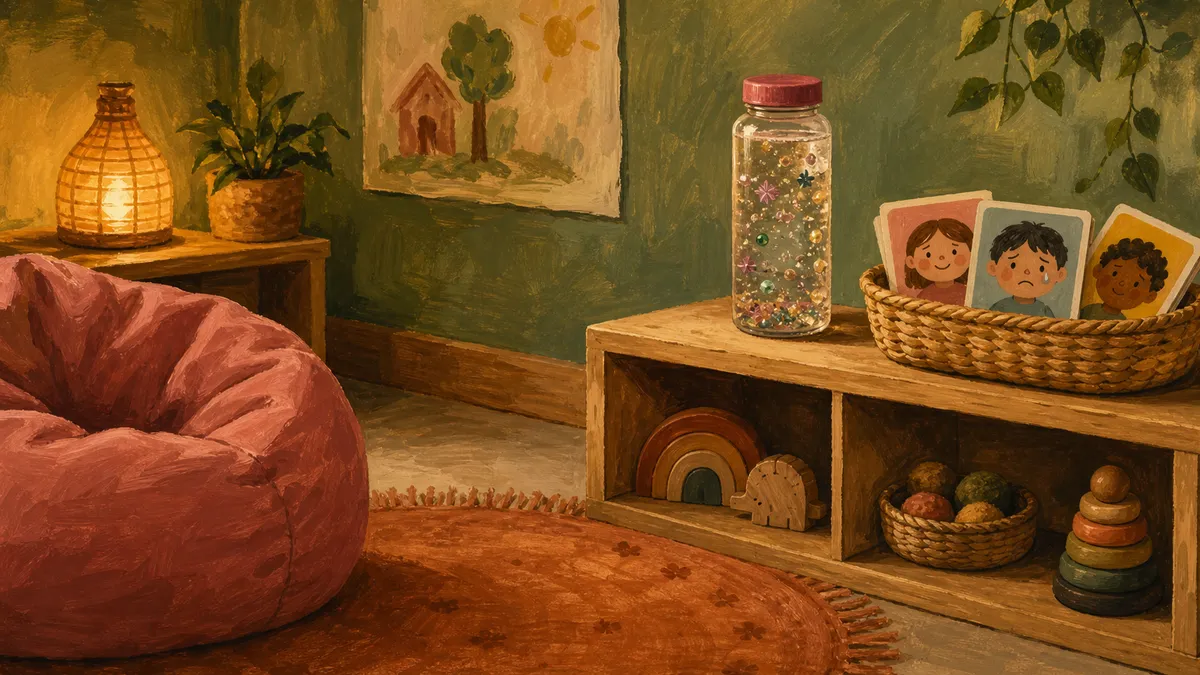
The cozy corner ideas that work for preschoolers who throw are simple: soft-only tools, no hard objects, and a parent sitting alongside them until the space feels like a safe spot instead of a penalty box.
Throwing is almost never defiance (it’s a wound-up body that hasn’t learned to use a coping tool yet), and a corner stocked with the wrong stuff makes that harder, not easier. I’m Nora Hayes, a former preschool aide raising an autistic sensory-seeker, and below I’ll walk you through what goes in the corner, how to teach the routine, and exactly what to do when something flies anyway.
The plan in brief:
- Stock the corner with soft, throw-proof tools only: a beanbag, a weighted lap pad, a sealed sensory bottle.
- Sit with your child the first ten visits and co-regulate before you expect them to use it solo.
- When a tool gets thrown, calmly pull it for the rest of the session and name the feeling instead of punishing.
Why Preschoolers Throw the Calm-Down Tools
Here’s what nobody tells you when you set up that beautiful cozy corner: the first thing many preschoolers do is throw the sensory bottle across the room. Not because they’re bad, and not because the corner is a bad idea. Because throwing is what big feelings look like in a three-year-old’s body.
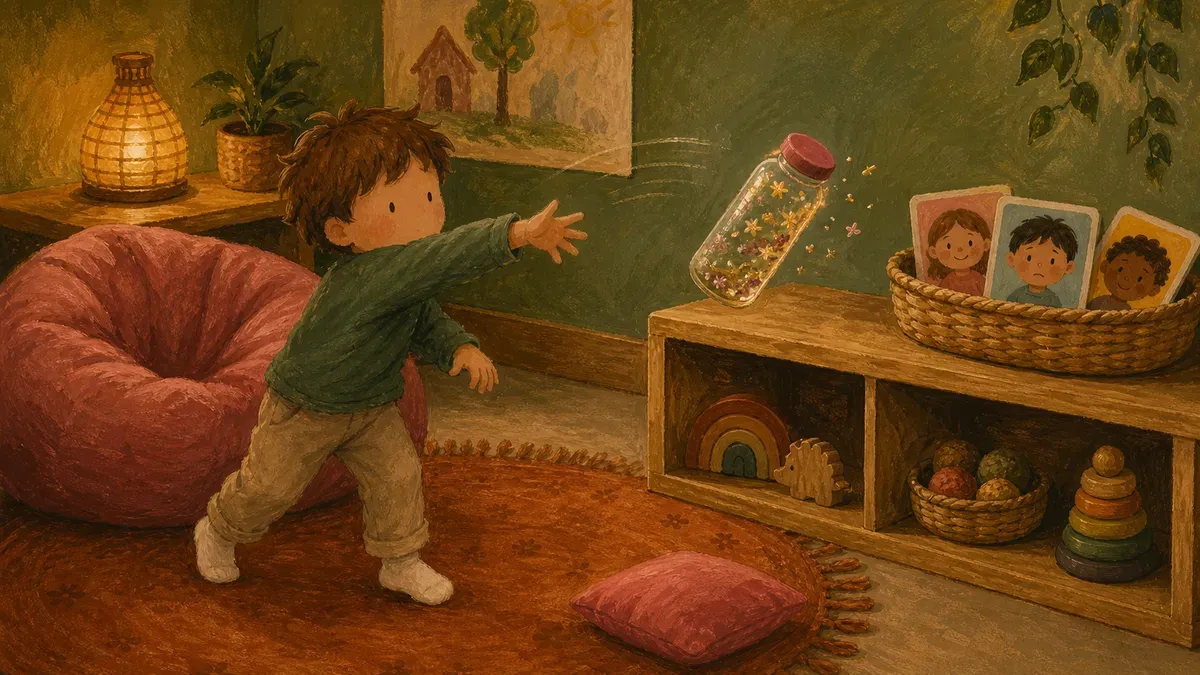
The brain science backs this up. Research on preschool brain development and emotional regulation shows the prefrontal cortex (the part that governs impulse control) doesn’t fully mature until around age 25. At three or four, it’s barely online. When a child hits the wall of overwhelm, the thinking brain checks out and the body takes over. Throwing is the body’s answer to a feeling that has nowhere to go.
- Self-regulation at three and four is genuinely uneven, and most kids are just starting to build it.
- A 2016 longitudinal study via PMC/NIH found roughly 20% of preschoolers respond correctly on behavioral self-regulation tasks less than 35% of the time.
- That’s a developmental gap, not a discipline problem.
If you want to go deeper on kid throws things theyre angry and what’s actually happening neurologically, I’ve written about that separately. For calm down tools to actually work, the corner has to be built around what preschool bodies can handle, not what looks good in a photo.
How to Build a Cozy Corner Preschoolers Can’t Wreck
A corner a three-year-old can’t wreck comes down to three choices: where you put it, what goes in it, and how you show them what it’s for. Get those right and the throwing mostly takes care of itself.
- Find a quiet pocket away from foot traffic and mark it with a soft rug.
- Fill it with only soft, sealed, or weighted items that can’t hurt if they get thrown.
- Hang a feelings chart and picture cards at eye level so your child can use the corner without help.
Pick a Low-Traffic Spot With Soft Boundaries
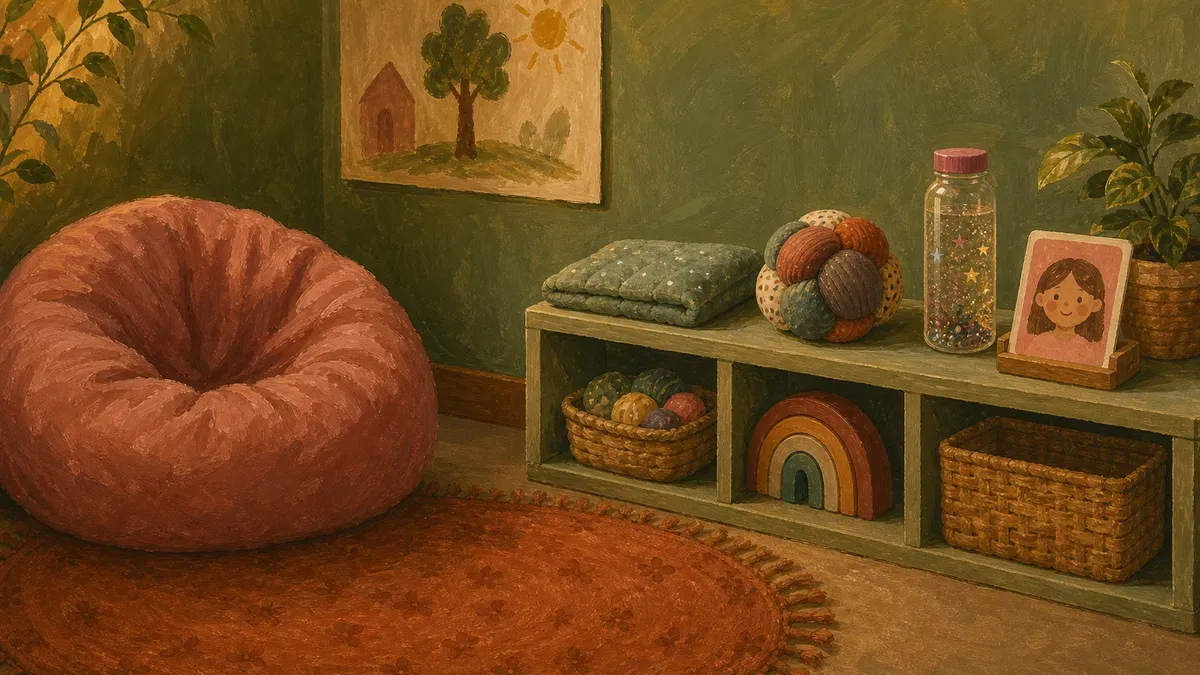
Don’t park the corner by the front door or smack in the middle of the play zone. A wound-up kid in the thick of the action just gets more wound up. The good2know Network’s social-emotional learning standards for preschool say to tuck a safe space away from doors and busy centers, using low shelves or furniture as soft dividers, while keeping the child in your sightline the whole time.
So find a quiet pocket.
- Corner behind the couch
- Nook by a bookshelf
- Dead space beside a dresser
Mark it with a soft rug, not a hard plastic edge that bruises a shin when a body flops down. A low shelf gives you a wall without boxing anyone in, and it doubles as a visual cue that this is a different kind of spot. That gentle boundary is half of good classroom management: the kid knows where the cozy corner starts before anyone says a word.
Stock It With Throw-Proof Calming Tools
Here’s the rule that saves your evening: if it would hurt or break when it gets launched, it doesn’t go in. Build the calm down kit out of soft, sealed, and weighted things only.
- Beanbag or floor cushion: the soft landing pad, and a safe thing to throw if a body needs to throw something. The one I steer parents to is an Amazon’s Choice with 25,000-plus reviews behind it.
- Weighted lap pad: deep-pressure input that helps a revved-up kid settle; keep it light and sized to your child, never heavy (occupational therapists say no more than 5% of their body weight). This one is the highest-rated pick in the corner, 4.7 stars.
- Sealed sensory bottle: glitter and water in a bottle with the lid hot-glued shut so it can’t pop open and spill. Make one yourself for a couple of dollars, or if craft night is never happening, a pre-sealed calm-down bottle (also an Amazon’s Choice) works straight out of the box.
- Fabric fidget toys: knotted scarves, a stretchy band or soft squishy fidget with no hard parts to fling. 800-plus parents rate that set 4.6 stars, and there’s nothing on it to chip a tooth.
Skip anything rigid, anything with a battery, anything that shatters. Throw-proof sensory tools mean you’re never policing the corner, just letting them use it.
Add Visual Cues a Three-Year-Old Can Follow
Your preschooler can’t read the label, so the corner has to talk in pictures. A simple feelings chart at their eye level, taped low on the wall, does more than a lecture ever will.
Use photos or cartoon faces for mad, sad, scared, and calm, plus a picture card next to each tool showing what it’s for. Squeeze the band. Hug the lap pad. Shake the bottle. Those picture cues build real emotional awareness, and they’re the everyday version of the social-emotional learning every classroom is chasing.
Want the whole thing mapped out? Here’s how to set up a calm down corner at home, start to finish.
Calming Activities That Hold Up to Big Feelings
A throw-proof tool is only half the job. The other half is giving a wound-up kid something to do with their body, so here are the moves that work mid-storm and the sensory swaps that catch the urge to chuck things.
Breathing and Movement They Can Do Mid-Meltdown
Don’t ask a melting-down three-year-old to sit and breathe. They can’t, not yet. Give them something physical first, then let the breath catch up.

A pinwheel is my go-to. Blowing it slow is deep breathing in disguise, and a 2025 review in the journal Children found play-based breathing exercises like pinwheels and bubble blowers especially helped younger kids through stressful moments. The metal-spun ones outlast the flimsy party kind by a mile, which is why the set I keep in our bin has 500-plus reviews behind it. Bubbles do the same job if the pinwheel walks off.
For the kid who needs to move, not sit, try a wall push. Hands flat, push like you’re shoving the house over, count to ten. Squeezing a firm cushion works the same way.
These big-muscle calming activities for preschoolers give the nervous system a job, which is what actually settles a body too revved up to be still.
Sensory Tools That Redirect the Urge to Throw
Throwing isn’t random. It’s a body hunting for big, satisfying input, so the fix is to feed that same hunger with something that can’t fly across the room.
Two categories do the most work here.
- Kinetic sand or playdough: pressing, kneading, and squishing deliver deep, organizing input that helps a keyed-up kid slow down, the same calming effect occupational therapists describe in heavy sensory play. Give it a fixed spot and the mess stays put.
- Push-pull tasks: a laundry basket loaded with books to shove across the rug, a weighted tote to drag back. Real effort, nothing airborne.
You don’t need a cart of fancy sensory tools or fidget toys to pull this off. Most are dupes of stuff already in your pantry, and there are calm corner ideas on any budget that lean on what you own. A bin of dry beans, a stack of books, a ball of dough. That’s the whole kit.
Teaching Preschoolers to Use the Corner
A bin of dry beans and a sealed sensory bottle won’t do anything if your child has never practiced reaching for them. Two pieces to this: introduce the corner before a meltdown hits, then sit there with them until they know what to do.
Practice the Corner When Everyone Is Calm
Do the first tour on a Tuesday morning when nobody is crying. Sit down yourself. Pick up the pinwheel, blow it slow, let them copy you. Point to the feelings chart at eye level. Say, “This is our calm spot. We come here when feelings get big.”
Kids learn a safe space by experiencing it when they feel safe, not when they’re already underwater.
Run through it a few times a week for a couple weeks before you expect the corner to work during a real storm. Make it feel routine in your preschool classroom or home corner, low stakes, no pressure. If they want to hang out there on a quiet afternoon, let them. That positive association is the whole point. Emotional regulation is a skill built in calm water before you ever need it mid-wave.

Co-Regulate Before Expecting Solo Calming
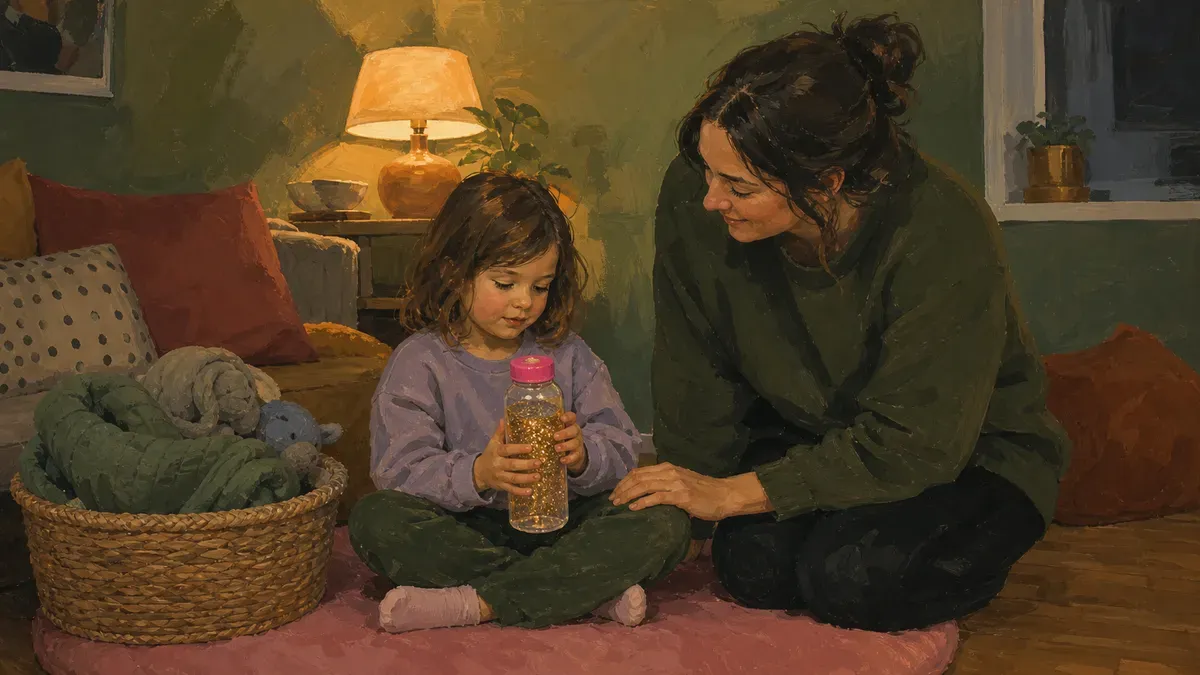
When real big feelings hit, a dysregulated preschooler can’t self-regulate alone. They need to borrow your calm first.
Zero to Three puts it plainly: children don’t learn to regulate by being told to calm down. They learn by being calmed with.
- Sit with them in the corner for the first many visits
- Breathe slowly so they can follow your rhythm
- Name the feeling out loud
- Be their emotional support until they can start doing it themselves
A Harvard Health piece on co-regulation makes the same point from the adult side: if you walk over frazzled, that’s what they’re borrowing.
For step-by-step language and pacing, the guide on how to teach toddler use calm down corner walks through it well. And if you’re building this into a wider calm down corner emotional regulation practice, co-regulation is where the foundation sets.
Most kids need ten or more guided visits before they’ll head to the corner solo. The calming strategies for preschoolers that stick are the ones practiced together before you step back.
What to Do When a Child Throws a Tool or Refuses to Go
Even after all that practice, things go sideways. Here’s how to handle the two moments that undo a corner faster than anything else.
Respond to a Thrown Tool Without Punishing
When the sensory bottle flies across the room, take a breath before you react. Walk over calmly, pick it up, and put it out of reach for the rest of the session. That’s the whole behavior management move: remove the calm down tool quietly, no lecture, no drama.
Then name the feeling. “You threw that. You’re really mad right now.” One sentence. You’re not punishing; you’re labeling what happened so their brain can start connecting the emotion to the moment.
The corner stays a tool for emotional regulation only if it stays free of consequences.
Brown University Health found that children experience fewer emotional outbursts when the corner is presented as support, not punishment. Treat the thrown item like a dropped plate, not a challenge to your authority. Stay close, stay regulated, and give them the borrowed calm they still can’t generate alone.

Handle a Child Who Won’t Go to the Corner
Don’t force it. A safe space a child is dragged to becomes a place they avoid, and at that point you’ve lost the corner entirely.
Bring the co-regulation to them instead. Sit on the floor where they are. Offer a small sensory item if you have one nearby. Your emotional support in that moment is more useful than the physical corner, which is just the container.
The OT Toolbox, citing occupational therapy best practice, is clear that using the corner as a time-out is the fastest way to kill it. Once a child connects it to punishment, they stop going voluntarily.
For situations where refusal becomes a pattern, see the guide on kid refuses go calm down corner for more specific language and pacing. Keep practicing during calm moments. The resistance usually fades.
When the Cozy Corner Stops Working
Sometimes it just does. The corner that worked for three weeks gets ignored, or the beanbag becomes a projectile again. That’s not failure. It’s a signal.
The most common reason is that the tools went stale. Young kids habituate fast. Rotate one or two items every couple of weeks. Swap the sensory bottle for a new one, swap the feelings chart for a different visual. Small changes reset the novelty without rebuilding the whole setup.
The second reason is drift. The calming corner starts as a voluntary pause and slides into behavior management territory the moment an adult directs a kid there mid-meltdown instead of offering it first. Sit there yourself during calm moments to reset the association.

A third cause: the setup never matched the child’s actual emotional regulation needs. A sensory-seeker who needs to move won’t settle with a squeeze ball. A child who needs dim and quiet won’t use a corner near the door. Watch what your child reaches for when they’re already calm, and stock that.
Research highlighted by Mental Health Center Kids found that first-grade students in early elementary classrooms with a calming corner showed measurable improvement in coping and personal control, and they specifically asked for more corners because the one available was sometimes already in use. Demand, not rejection. Worth remembering when yours sits empty for a week.
When you’re ready to refresh the setup, see our complete guide to building calm spaces for the layout choices that hold up past the first month.
Found this useful? Save it for the next rough afternoon.
Questions parents ask me about this
What makes a good cozy corner for preschool classrooms?
A good cozy corner sits away from doors and busy activity centers, with the child visible to the teacher at all times. It has a soft rug, a low shelf as a gentle boundary, and a small set of tools the child can reach independently: a feelings chart at eye level, a sealed sensory bottle, a beanbag, and one or two simple breathing cues like a pinwheel. Keep it uncluttered. Too many choices overwhelm a kid who is already dysregulated.
How is a cozy corner different from a timeout?
A timeout removes the child as a consequence; a cozy corner is a tool the child chooses (or is gently guided to) before or during a big feeling. The goal is never to isolate or punish. It is to give a regulated adult and a calm space so the child can borrow that calm. The moment a corner starts being used as a consequence, kids stop going there voluntarily, and the whole thing stops working.
What age can preschoolers start using a cozy corner?
Most kids can begin learning the routine around age three, though they will need a lot of adult support at first. Preschoolers' brains are still years away from mature self-regulation, so the early visits should always be with a co-regulating adult sitting alongside them. Expect ten or more guided visits together before a child starts using the corner on their own with any consistency.
What calming tools are safe for a child who throws things?
Stick to soft, sealed, and weighted items: a beanbag, a small weighted lap pad, a hot-glue-sealed sensory bottle, and a stretch band for resistance. Avoid anything rigid, breakable, or with a loose lid. For kids who need movement, wall pushes and squeezing a firm cushion give the same heavy-work input as throwing, without anything becoming a projectile.
How do you keep a cozy corner from being used to avoid activities?
Build the corner into transitions rather than letting it become an exit ramp. If a child consistently heads there to skip circle time, stay nearby and co-regulate briefly, then walk back together when the feeling settles. The corner is a place to settle and return from, not somewhere a child stays to escape the day, and a gentle, consistent adult presence keeps that boundary clear without making the corner feel punitive.
How should teachers and parents talk about cozy corner use at home?
A quick note home about your classroom tools helps families mirror the routine: a feelings chart on the fridge or a sensory bottle on the shelf gives the corner a familiar face at home. "Corner" or "cozy spot" works fine at home; the label matters less than the routine. Consistency between settings helps kids transfer the skill instead of treating it as a school-only thing.
Written by
Nora Hayes
Mom of two and a former preschool aide. I share the screen-free sensory play and calm-down ideas I test at my own kitchen table, plus what the moms in my little meet-up swear by. A parent passing on what works, not a doctor or a therapist.
More about NoraKeep going
All Calm & Big Feelings-
 Calm & Big Feelings
Emotional Regulation Activities for Kids That Work
Most calming tricks fail mid-meltdown. These emotional regulation activities for kids work when nothing else does. Find the one that fits your child.
-
 Calm & Big Feelings
Calm Corner Ideas: 25 Picks Under Your Coffee Budget
Skip the $200 setups. These 25 calm corner ideas cost less than a latte and soothe big feelings. Build one your kid loves this week.
-
 Calm & Big Feelings
Calm Corner Classroom Setup for Autistic Kids
Most calm corners fail autistic kids because they skip the sensory profile. Build a calm corner classroom that works in 5 steps. Start here.
-
 Calm & Big Feelings
Zones of Regulation Red Zone: A Parent's Plan
Your kid is in the zones of regulation red zone and nothing works. Here's what to say, what to skip, and how to ride out the worst 10 minutes.