Calm Corner Ideas: 25 Budget Picks for Big Feelings

I am a parent sharing what worked at my house, not medical advice. For anything to do with your child's development or sensory needs, talk to your OT or doctor.
Some links here are affiliate links. If you buy through one, I may earn a small commission at no extra cost to you. As an Amazon Associate I earn from qualifying purchases. I only point to things I'd actually use with my own two.
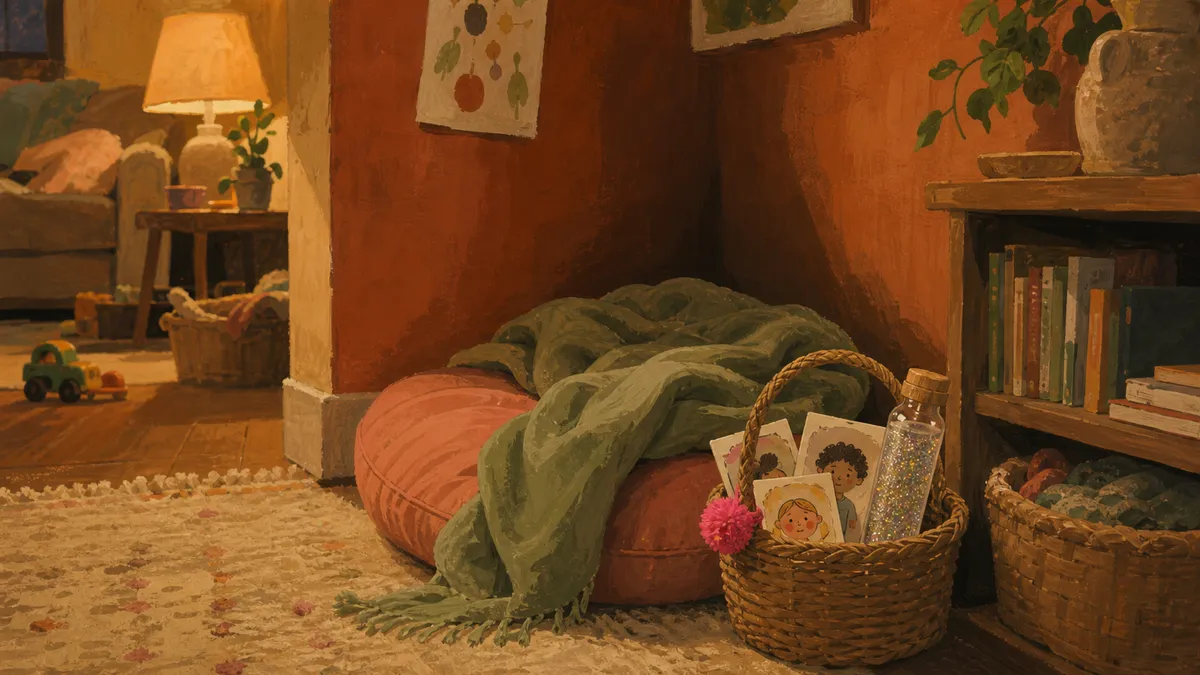
A calm corner is a cozy spot your kid goes to before a meltdown hits category five, stocked with a few simple tools that help them settle down. It matters because little kids feel big things and don’t yet have the words for any of it, and a soft pillow with a sensory bottle gives them somewhere to land instead of the floor.
I’m Nora Hayes, a former preschool aide and mom to an autistic 7-year-old, and below I’ll walk you through 25 calming corner ideas you can build with stuff you mostly already own, no pricey sensory gear required.
What a Calm Corner Is (and What It Isn’t)
Before you gather pillows and sensory bottles, it helps to know what you’re actually building and what it’s supposed to do.
The Job a Calming Space Actually Does
The calm corner isn’t a consequence spot. It’s where your child goes before things fall apart, to get ahead of the meltdown.
- Time-out: sent there after the meltdown, as a consequence
- Time-in (calm corner): a cozy spot they use before things go sideways, practiced during calm moments so it’s familiar when they’re not
The Conscious Discipline model describes it as a defined area of roughly 4 to 6 square feet set apart from the main activity space, where children practice calming tools during calm moments. You teach the corner when everyone’s fine so it’s familiar when they’re not.
Zero to Three notes that young children rely on co-regulation through responsive adult relationships while their own self-regulation skills are still developing. Sitting with your kid in the corner, breathing with them, naming what they feel: that is the tool. The pillow is just the stage.
Why Cheap Setups Work Just as Well
If you want the deeper dive, our guide to emotional self-regulation in children covers what the research actually says. The short answer is that the family environment and a consistent adult presence matter more than what you put in the corner. A pricey weighted lap pad doesn’t calm a dysregulated child. The routine does. The familiar face does.
The Incredible Years program notes that positive acknowledgment like “you worked hard to calm your body” can be as effective as any sensory product. A child who feels seen regulates faster than one surrounded by overstimulated noise and unfamiliar gear.
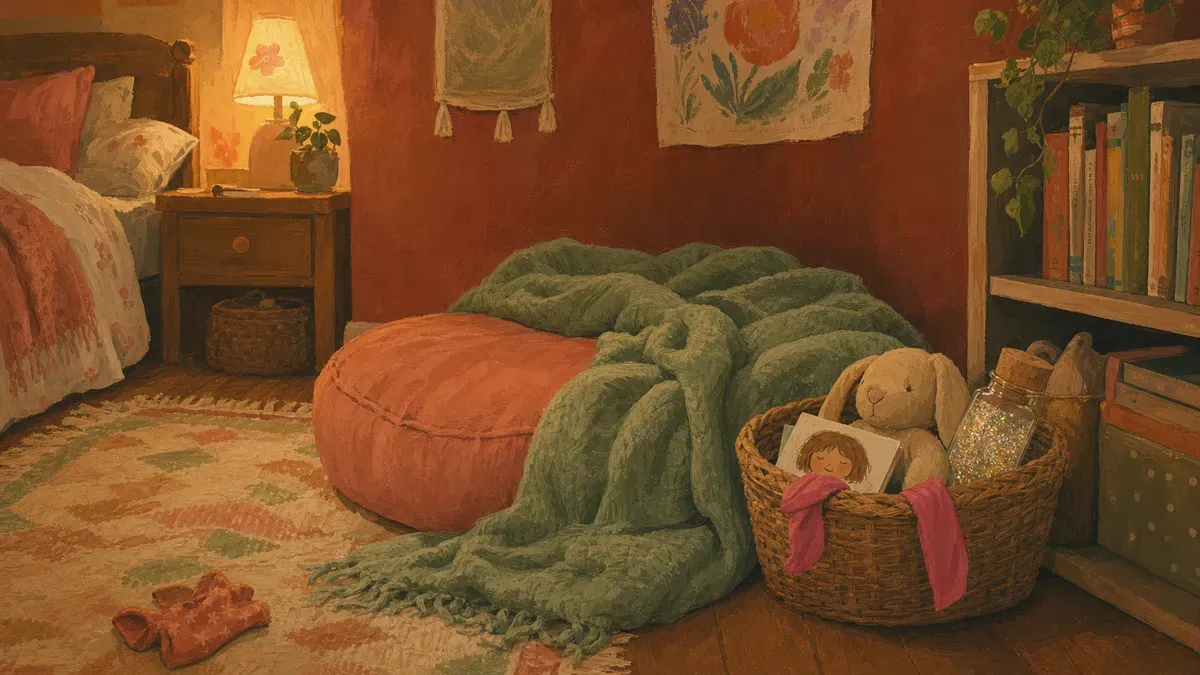
Stress relief comes from predictability. A corner with a cushion, a soft blanket, and a basket of comforting items your kid already loves is fully functional. Dysregulation doesn’t need a cure from a catalog. It needs a consistent spot and a calm adult nearby.
Budget Sensory Tools That Soothe Big Feelings
If the corner is just a cozy spot, the tools are what give little hands something to do while the storm passes. Two kinds earn their keep: small fidgety things that grab attention, and weighted, push-against-me things that calm the body down.
DIY Sensory Bottles and Fidgets
Most of these you can make tonight from the recycling bin and the craft drawer.
A glitter calming jar is the one I keep coming back to. Empty water bottle, a squeeze of clear Elmer’s glue, glitter, a drop of food coloring, warm water, lid glued on tight. Your kid shakes it, then watches the glitter drift down, and you get a quiet stretch of settling time before it all sinks. No batteries, no mess once the lid’s on.

For cheap fidgets, a few favorites:
- A sock stuffed with dried beans or play dough, knotted at the top, makes a squishy stress ball for free
- A square of bubble wrap taped to cardboard gives endless popping with zero cleanup
- Dollar-store sensory bottles and squishy fidget pals from Dollar Tree, for the days you want something done for you
None of these fix a meltdown. They give a wound-up kid somewhere to put the feeling, which is half the battle. If your fidget basket is getting thin, these calming corner ideas restock it for almost nothing. And when you’d rather refill the whole thing in one shot, an 80-piece squishy set ships with its own bucket, which is the part that keeps them off the floor by Thursday. Reviewers agree it earns its keep: 4.6 stars from 2,900-plus of them.
Cheap Deep-Pressure and Heavy-Work Picks
Fidgets work the hands. Deep pressure works the whole nervous system, and it’s the quieter, sturdier half of a good corner.
There’s a real reason a tight squeeze settles a kid. Deep pressure helps the body shift toward calm, releasing dopamine and serotonin while pushing back against the stress hormone cortisol. That’s the science behind why weighted blankets and bear hugs work.
You don’t need the $80 version. A few cheap options get you there:
- A rice-filled lap pad: a pillowcase or two washcloths, a few cups of dried rice or beans, stitched shut, built entirely from dollar-store supplies (no-sew version here)
- A weighted stuffed animal draped across the lap, thrifted if you get lucky. If you don’t, a ready-made weighted turtle does the same grounding job at 4.5 pounds, and 900-plus reviewers give it 4.7 stars
- A firm cushion to push, squeeze, or lie under
Then there’s heavy work, the proprioceptive input that resets a body before it tips over. Heavy work doesn’t have to be fancy:
- Pushing a loaded laundry basket across the floor
- Carrying a stack of books to the corner
- A few wall push-ups on the way in
It costs nothing and prevents more meltdowns than any reward. Stock both kinds, and you’ve built most of a DIY calm down corner kit for the price of a coffee.
Calm Down Corner Ideas Using Things You Already Own
Here’s the part nobody selling you a kit wants to admit: most of what makes a corner work is already in your house. Pull from three buckets, and you’ve got a full setup for nothing.
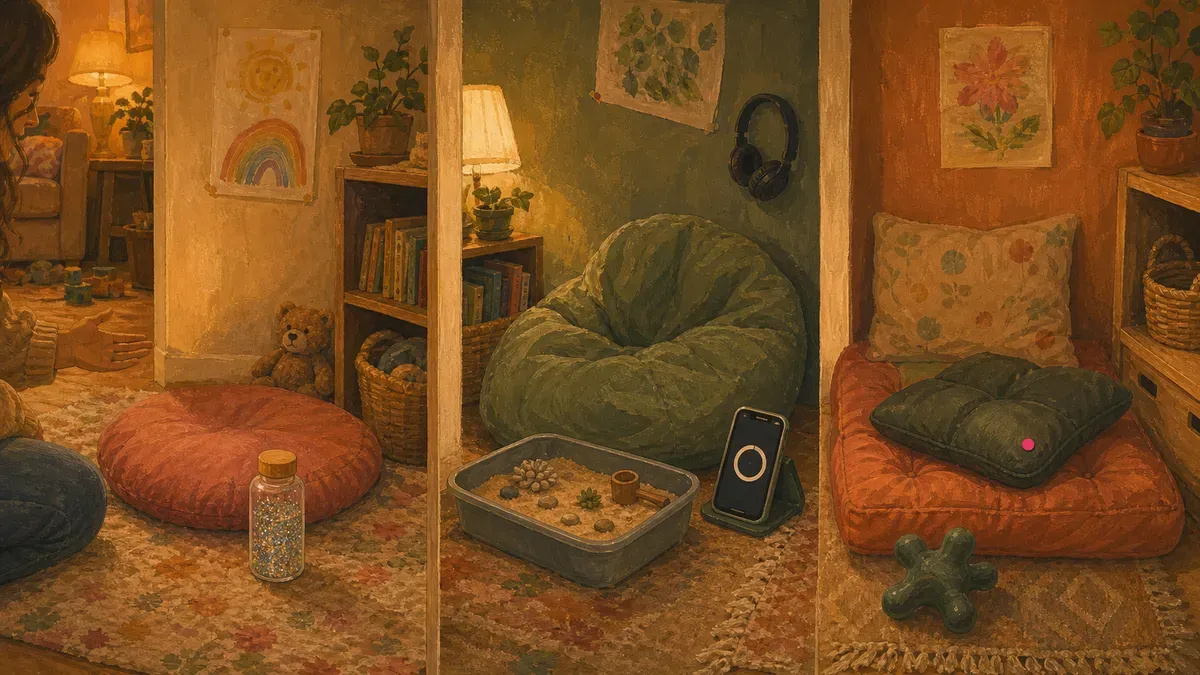
- Comfort zone: couch cushions, a throw, and a tucked-away corner
- Calm-down moves: finger breathing, pretend candles, a feelings chart
- Wall prompts: feelings faces, yoga cards, a timer on an old phone
Cozy Seating from Pillows and Blankets
Start with the floor. A couple of couch cushions, the throw pillows off the bed, a folded duvet on top, and you’ve made a landing pad softer than anything in the toy aisle.
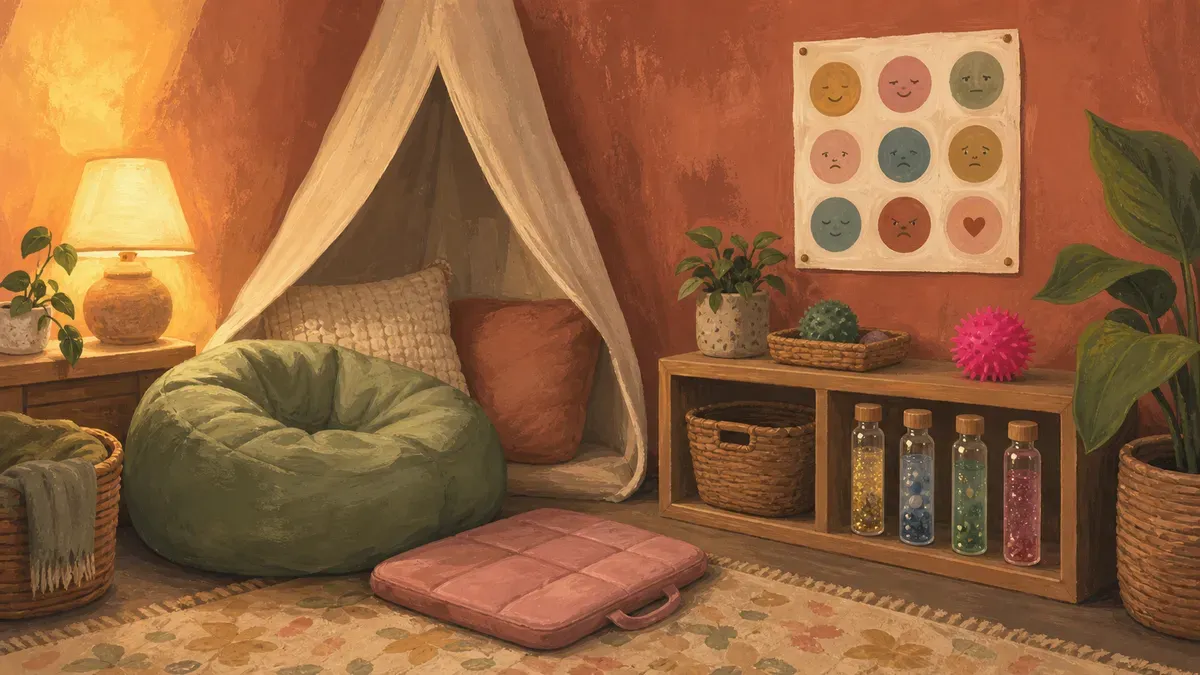
What you’re really building is a small, contained safe space, low enough that a wound-up kid can flop into it without a running start. Tuck it into a quiet corner, away from the TV and the doorway traffic. Drape a blanket over the back of a chair or a baby gate and you’ve got an indoor tent, the same trick a preschool teacher uses for the classroom cozy corner: walls make small bodies feel held.
A few additions make the spot double as a reading nook too:
- A basket of soft, squishable items
- A couple of board books
- A cozy stuffed animal
Some of the best calm corner ideas are just “a quiet place to hide for a minute,” and at our house, my sensory-seeking seven-year-old still climbs into his little sister’s blanket fort on a hard day.
Free Mindfulness and Breathing Activities
Breathing is the cheapest regulation tool there is, and it works fast. A Stanford University study of 342 young children found that even one minute of guided deep breathing produced measurable drops in heart rate. One minute. That’s a tantrum’s worth of time.
You don’t need a script. Trace the outline of your kid’s hand with a finger, breathe in going up, out coming down. Pretend you’re blowing out birthday candles or cooling soup. Make a paper feelings chart with four faces and let them point instead of explain.

For the days they need to move first, mix a batch of two-ingredient playdough, flour and water, and let the squishing be the brain break. These mindfulness activities and breathing exercises run a pantry’s worth of nothing, and I’ve got more emotional regulation activities for kids that follow the same rule. Slow the body, the feelings follow.
Printable Visuals and Calm-Down Posters
Little kids do better with a picture than a lecture. Visual aids on the wall give them a coping strategy to point at when the words are gone, which is the whole reason a calm-down poster earns its tape.
Print a strip of feelings faces, a few yoga cards, or affirmation cards, and tape them at kid height. A simple visual menu turns the corner into a place that prompts instead of waits:
- Squeeze the pillow
- Take five breaths
- Hug the stuffed animal
A visible timer does quiet work too. One peer-reviewed study of 44 kids ages 7 to 9 found a visible visual timer significantly lowered anticipatory anxiety, so a free timer app on an old phone earns its spot. If you want a ready-made option, a calm down corner poster you can print tonight saves you the design work. The wall does the reminding so you don’t have to.
Matching Your Calm Corner to Your Child’s Age and Needs
A corner that works for a three-year-old looks nothing like one that helps a seven-year-old. Here’s how to set each up so it actually gets used.
Toddlers and Preschoolers
Under five, the corner is less about what’s in it and more about who’s there with them. Guidance on sensory processing and occupational therapy makes clear why: the prefrontal cortex reaches only about 90% of adult size by age 6, and full maturity won’t arrive until around age 25. Toddlers literally cannot regulate on their own yet. The expectation that they should is the setup for everyone’s frustration.
So the corner becomes a Time-In spot, not a solo station.
- You sit with them, no solo visits yet.
- A soft blanket and one or two comforting items (that glitter jar from a recycled bottle is perfect).
- Simple materials, low demand, an adult nearby co-regulating until the storm passes.
When you’re ready to make the routine stick, tips on how to teach toddler use calm down corner on their own will help bridge that gap from “I sit with you” to “you can go there yourself.”
Big Kids and Sensory-Sensitive Children
Older kids need the same basics, just sturdier. A push cushion holds up better than a fluffy throw when a child really needs to press and squeeze. The DIY rice lap pad works until it starts leaking, and mine did. So a cotton lap pad built for daily pressing earns its few dollars: Oeko-Tex certified, so nothing funky sits against the skin, and an Amazon’s Choice pick sitting at 4.7 stars across 4,500-plus reviews. For a sensory-seeker, vestibular input before the corner, like jumping or spinning first, often makes the settling tools land better once they arrive.
For autistic kids or children with sensory processing differences, an occupational therapist can build a proper sensory diet: a tailored plan of physical activities and accommodations matched to a child’s specific profile, as Understood.org explains. That plan can be written into an IEP, which means the school is legally required to follow it.
- Self-regulation strategies work best when home and school share the same tools and language.
- Bringing a photo of your corner setup to an OT appointment gives them something concrete to build on.
Setting Up the Space and Making It Stick
A corner only works if your kid actually uses it, which comes down to three things: building it together, fitting your real home, and practicing until the routine is automatic.
- Build it together: let your kid pick the spot, the stuffed animal, the pillow. Ownership is what makes them use it.
- Fit your real home: a closet corner, a hallway end, a tent on the living room floor. No spare room required.
- Practice the routine on good days: a dysregulated brain can’t learn new steps, so drill it when everyone’s calm.
Building the Corner With Your Child
The corner your kid helps build is the corner your kid will use. Hand them the choices: which spot feels cozy, which stuffed animal guards the basket, which pillow they want to flop on. A space chosen for a kid is a space they ignore.
Let them pick, even if the choices make no sense to you. A toy dinosaur and a crinkly scarf might be exactly what settles them.
You’re also practicing co-regulation, sitting on the floor together, and that shared time builds the buy-in. Without a lecture, you’re showing them this is a safe space, somewhere you reach for coping strategies together. For a deeper look, here’s our complete guide to building a calming routine. For the slow version of all of this, here’s our complete guide to building a calming routine.
Fitting It Into Small Spaces and Apartments
No spare room? You don’t need one. Square footage is not the point. One defined spot that feels quieter than the rest of the house is.
A shared bedroom corner works. So does the end of a hallway, a closet with the door off, or the gap beside the couch.

A pop-up tent does that instantly, turning any floor into a defined nook. IKEA’s play tents are the cheap ready-made route, and they fold flat when you need the room back. If a store run isn’t happening, a pop-up play tent does the same room-within-a-room trick and shows up with a little camping-gear set, the bit that makes a kid actually want to climb in and stay a while. It has more than 11,000 reviews behind it at 4.7 stars; check the current price on Amazon. A basket of calm-down tools works just as well: carry it room to room, set it on a shelf, and pull it out when you need it. For more layouts, see how to set up a calm down corner at home.
Teaching the Routine and the Return
You teach the routine when your kid is calm, never mid-meltdown, because a dysregulated brain can’t learn a new step.
Occupational therapists and educators describe a simple four-step return: check how you feel, use a calming strategy, check again, then head back to the activity or come find you.
Name the feeling out loud as you go. “You’re frustrated, let’s take three breaths.” That naming is the Time-In, the co-regulation that does the heavy lifting. The habit takes days or weeks to stick, per the OT Toolbox, so go easy on the days it doesn’t. Try again tomorrow.
Found this useful? Save it for the next rough afternoon.
Questions parents ask me about this
What are some affordable calm corner ideas for kids?
Most of the best calm corner tools cost nothing or next to nothing. A folded duvet on the floor, a pillow, and a homemade glitter jar from a recycled bottle will do more than an expensive sensory kit. Free printable feelings charts and a finger-tracing breathing card are all the visual support most kids need to start. The pantry version of almost any sensory product works just as well.
How much does it cost to set up a calm corner?
You can build a functional corner for under five dollars, or free if you use what you already own. Seating from cushions and blankets costs nothing. A homemade lap pad, a sock filled with rice, and a paper feelings chart put you well under five dollars total. A simple play tent expands the setup if you want a dedicated spot, but it is not required.
What should go in a calm down corner?
Think three categories: somewhere cozy to land, something to do with the hands, and a feelings tool. A soft seat or pile of blankets is enough for the first category. A fidget, a sensory bottle, or a piece of bubble wrap handles the second. A simple feelings chart or a breathing card covers the third. Start with one item per category and add only what your child actually reaches for.
Is a calm corner the same as a time-out?
No, and the difference matters. Time-out sends a child away as a punishment; a calm corner is where a child goes to get back to okay, with a caregiver close by. The whole idea is co-regulation: a parent or caregiver stays close and helps the child calm down, rather than sending them away alone. Kids learn to use the space voluntarily when it stays associated with comfort, not with being in trouble.
At what age can a child use a calm corner?
You can introduce a soft, simple version from toddlerhood, but kids under five need an adult present because their brains are not yet wired to regulate independently. A corner for a toddler is mostly a cozy landing spot for the two of you together. Children typically start using a calm corner on their own more reliably after age five or six, and even then, habit takes weeks of consistent practice to build.
How do I make a calm corner in a small space or classroom?
A corner does not need a dedicated room or even a permanent setup. In a small home, a cozy gap beside the couch, a hallway nook, or a cleared closet shelf works fine. Toss a few tools in a basket and you can move the whole setup to wherever you need it that day. In a classroom, a tent or a low shelf with its back to the room creates enough visual separation to feel like a different space without taking much square footage.
How do I get my child to actually use the calm corner?
Teach the routine when things are calm, not in the middle of a meltdown. Walk through it together, let the child pick where to sit and which tools to keep there, and practice going to the corner as a game on a normal afternoon. When a hard moment does come, name the feeling out loud and go to the space with them rather than directing them there alone. Expect the habit to take days or weeks of repetition before it sticks on its own.
Written by
Nora Hayes
Mom of two and a former preschool aide. I share the screen-free sensory play and calm-down ideas I test at my own kitchen table, plus what the moms in my little meet-up swear by. A parent passing on what works, not a doctor or a therapist.
More about NoraKeep going
All Calm & Big Feelings-
 Calm & Big Feelings
Emotional Regulation Activities for Kids That Work
Most calming tricks fail mid-meltdown. These emotional regulation activities for kids work when nothing else does. Find the one that fits your child.
-
 Calm & Big Feelings
Cozy Corner Preschool: Calm Down Ideas for Throwers
Throwing the calm-down tools? Build a cozy corner preschool space that survives big feelings, with throw-proof tools and steps that work.
-
 Calm & Big Feelings
Calm Corner Classroom Setup for Autistic Kids
Most calm corners fail autistic kids because they skip the sensory profile. Build a calm corner classroom that works in 5 steps. Start here.
-
 Calm & Big Feelings
Zones of Regulation Red Zone: A Parent's Plan
Your kid is in the zones of regulation red zone and nothing works. Here's what to say, what to skip, and how to ride out the worst 10 minutes.