Zones of Regulation, Explained for Parents

I am a parent sharing what worked at my house, not medical advice. For anything to do with your child's development or sensory needs, talk to your OT or doctor.
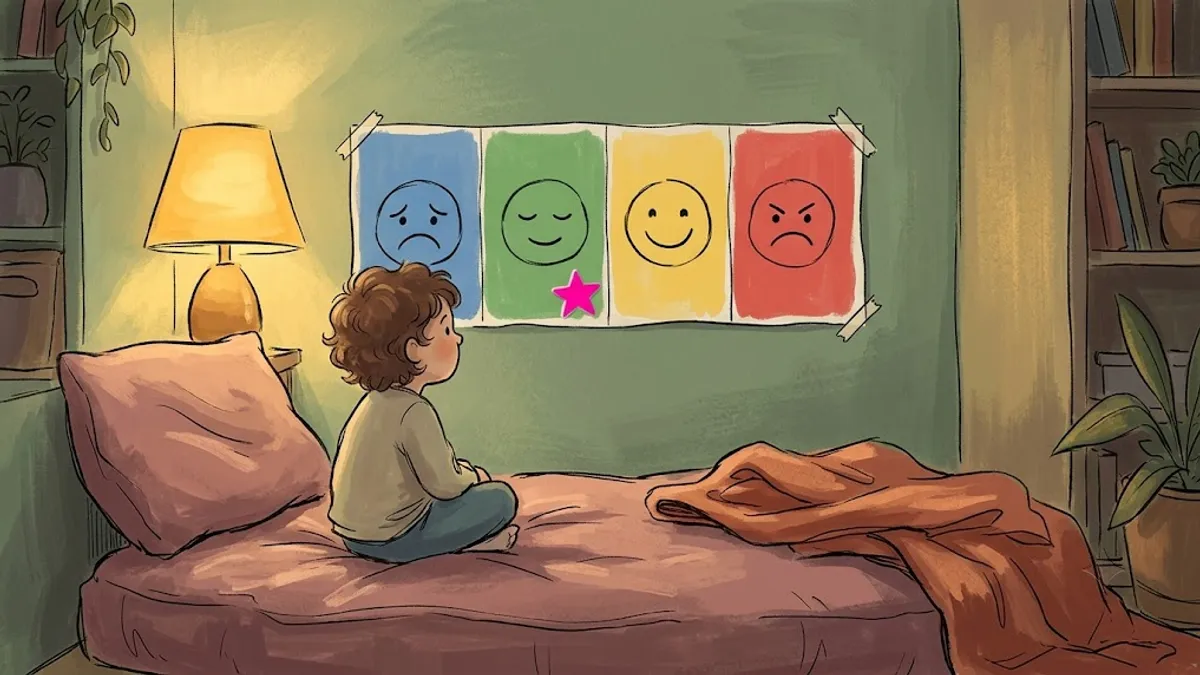
The Zones of Regulation is a simple color system that helps a kid name what they’re feeling, blue for low and sad, green for calm and ready, yellow for wound-up, red for the full meltdown. I’m Nora Hayes, a former preschool aide raising a sensory-seeking autistic 7-year-old, and I’ve watched this little chart do more for big feelings than any reward chart ever did, which is why teachers, OTs, and SLPs lean on it so hard.
Here you’ll find all four zones explained, why none of them is the “bad” one, how to start using the system at home tonight, and which tools pair with each color, all without spending a dollar.
What the Zones of Regulation Actually Are
The short version: it’s a color-coded language for the state your kid’s body is in right now. 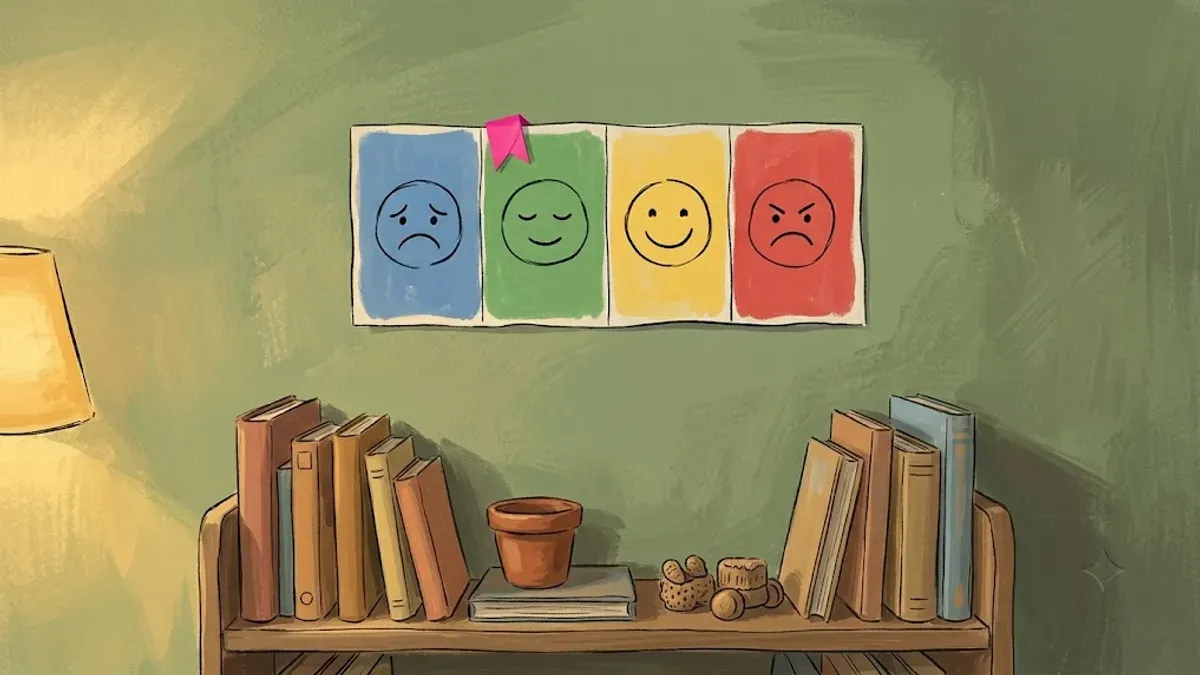
Where the framework came from
An occupational therapist named Leah Kuypers built this. She developed it as her capstone project in 2008 while finishing her master’s in education and a graduate certificate in autism spectrum disorders at Hamline University. Per the program’s own website, Think Social Publishing put it into print in 2011, and the goal from the start was a judgment-free vocabulary both kids and the adults around them could use.
That detail matters. The language isn’t clinical. It doesn’t require a diagnosis or a therapist’s office. Naming the right color from the four zones is the first step toward doing something about it.
Occupational therapy starts with what’s happening in the body, then figures out what the environment needs to do to help.
This social-emotional learning framework takes that same logic and translates it into evidence-informed language that teachers, OTs, and SLPs already share.
What ‘self-regulation’ really means
Self-regulation is noticing how alert or upset your body feels and doing something to get back to ready. That’s the whole definition.
A 2024 systematic review published on PubMed Central found that self-regulation in early childhood is an important predictor of success across health, well-being, and earnings throughout life. But you don’t need that research to believe it. You’ve watched a kid spiral from wound-up to meltdown because snack was ten minutes late.
The four colors make that invisible state visible. Arousal level is a concept most kids under five have zero language for. “I feel red” is something a three-year-old can say. A child who can name their zone can start to do something about it.
Kids need that regulation most at predictable rough patches:
- Before a transition (leaving the park, ending screen time)
- During a frustrating task (a puzzle that keeps falling apart)
- When something unexpected changes (dinner isn’t what they expected)
Interoception, the ability to sense what’s happening inside your own body, is the foundation of emotional regulation. Daily check-ins give kids that practice, and a calm down corner emotional regulation setup gives them a physical place for the tools, not just the words for them.
The Four Zones, by Color
Words are hard in the moment, so the framework hands a kid four colors instead. Each one maps to a body state, not a behavior. The clinician-and-family handout from NHS Borders lays out all four the same way, so here is the plain-English version of each zone of regulation and the energy levels it covers.
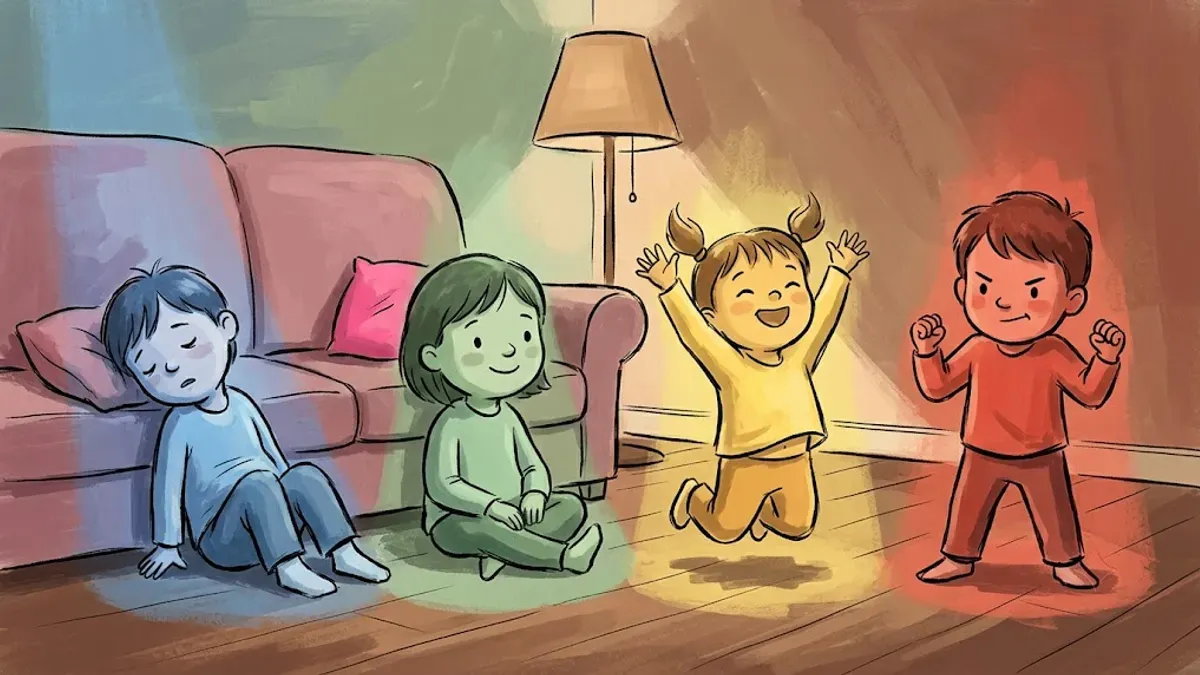
- Blue Zone is the low-battery color. Tired, sad, sick, bored, moving in slow motion. Think the slump after a long day or the foggy stretch right before nap. The body has dialed everything down.
- Green Zone is the calm, ready-to-go color. Happy, focused, content, settled in your skin. This is where learning and playing happen easily. Not hyper, not flat, just steady.
- Yellow Zone is the wound-up color. Anxious, excited, frustrated, silly, wiggly. The energy is climbing and control is starting to slip, but the kid is still mostly in charge of what happens next.
- Red Zone is the over-the-top color. Angry, terrified, panicked, completely out of control. This is the meltdown, the screaming, the can’t-hear-you-right-now state. The body has flooded and reason has left the building.
Most of us drift between Blue and Yellow all day long and snap back to Green without thinking about it.
The colors aren’t really about the feeling, they’re about the energy underneath it. Excited and anxious land in the same yellow space because the body does almost the same thing for both: racing heart, can’t-sit-still, buzzing. That’s why naming the zone is easier for a young kid than naming the exact emotion. “I feel yellow” comes out long before “I feel overstimulated.”
A zone is a snapshot of energy in the moment, not a label for who your kid is.
Same kid can ride through all four colors before lunch, and that’s normal. The blue slump after preschool, the green stretch building blocks, the yellow climb when the tablet gets taken away, the occasional red when it all tips over. Once you can spot the color, you can see it coming, which is the whole point. If you want the everyday version with real examples from couches and kitchen floors, here’s what each zone of regulation looks like at home.
Why There’s No “Bad” Zone (and Where Inside Out Fits In)
Spotting the color is step one. The part that trips most parents up comes next: there’s no wrong answer.
Every zone is okay, it’s what you do next that matters
The official framework guidance puts it plainly: “All the Zones are OK, and I really mean this.” Green is not the goal. When kids learn that Green is the “right” zone, they start masking the other three, which she calls “ultimately unhealthy and even harmful.”
The actual goal is self-awareness: noticing which zone you’re in and knowing what to try next. A child who says “I’m Yellow” and reaches for a coping strategy is doing the work, even if they never make it back to Green that afternoon.
Red and Blue aren’t failures. They’re information. A kid who can name dysregulation is already practicing something most adults never learned. When you co-regulate with them instead of correcting them, you’re building exactly the self-awareness the framework is designed to grow. The naming comes first; the coping strategies come after.
Using Inside Out to make the Zones click
If your kid has seen Inside Out, you’ve already got a shortcut. Pixar built those films on real emotion science: the Greater Good Science Center at UC Berkeley, including faculty director Dacher Keltner, consulted on both movies. The emotional vocabulary inside those films isn’t accidental.
Sadness maps to Blue. Joy and Calm map to Green. Anxiety and Excitement land in Yellow, inside out and zones of regulation overlap here almost perfectly. Anger lands in Red. Kids already have emotional awareness of those characters before you introduce a color chart.
You’re not teaching new feelings. You’re giving the ones they already know a color.
For introducing the learner zone to a toddler who isn’t reading yet, that movie connection is one of the easiest entry points there is. Point to Anger and say “that’s Red energy.” You don’t need a chart on the wall to start.
How to Use the Zones at Home
You don’t need a classroom or a laminator to bring this home. Three habits do most of the work: a daily zone check-in, a short script for the hard moments, and a little play to make the colors stick.
Start with a daily zone check-in
The trick nobody tells you: practice the words when everyone’s fine, not when the wheels are coming off. Ask “what zone are you in?” over breakfast, in the car, at bath time. Low stakes, no pressure, no fixing.
These daily check-ins are how the language stops feeling like a worksheet and starts feeling like “how are you.” My youngest, June (she’s 3), still says “yellow” for excited and “blue” when she’s done for the day, and she got there by hearing the question a hundred boring times first.
Name your own zone out loud too. “I’m a little yellow this morning, I need my coffee.”
That’s you modeling it. When you put words to your own state, you co-regulate without it ever looking like a lesson, and you’re handing your kid an emotional vocabulary one ordinary moment at a time.
What to actually say in the moment
The scripts that work are short, calm, and on the child’s team. Skip the lecture. Try, “I see you’re in the Red Zone. Let’s grab a tool together.” You named the state, you didn’t name the kid as the problem, and you offered to do it with them.
- Zones aren’t behavior labels. Red is a body running on empty, not a kid making a choice
- Mid-meltdown isn’t teaching time; one sentence and your presence is all you need
If big Red moments are your daily reality, what to do about your kid’s zones of regulation red zone goes deeper than I can here.
This calm-naming is exactly the kind of move you’ll see in any solid zones of regulation child therapy handout, because naming dysregulation without judgment is what lets a kid actually hear you. Save the talk-through for after, when everyone’s back to green and the meltdowns have passed.
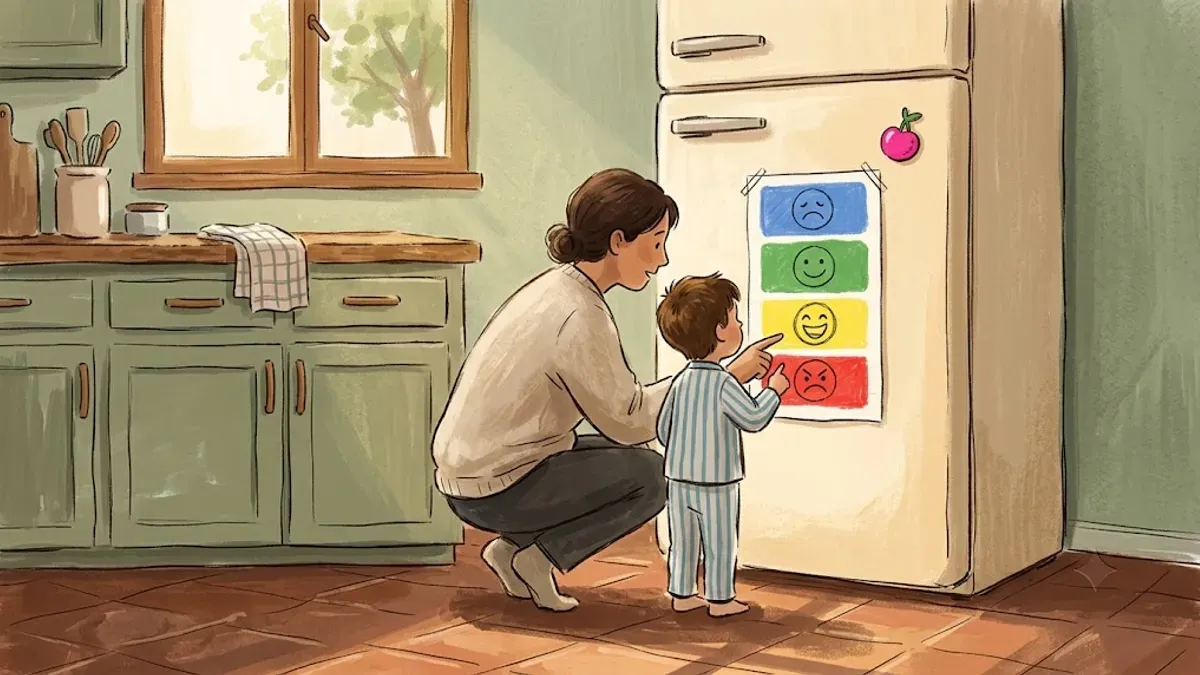
Make it playful with games, songs, and a feelings chart
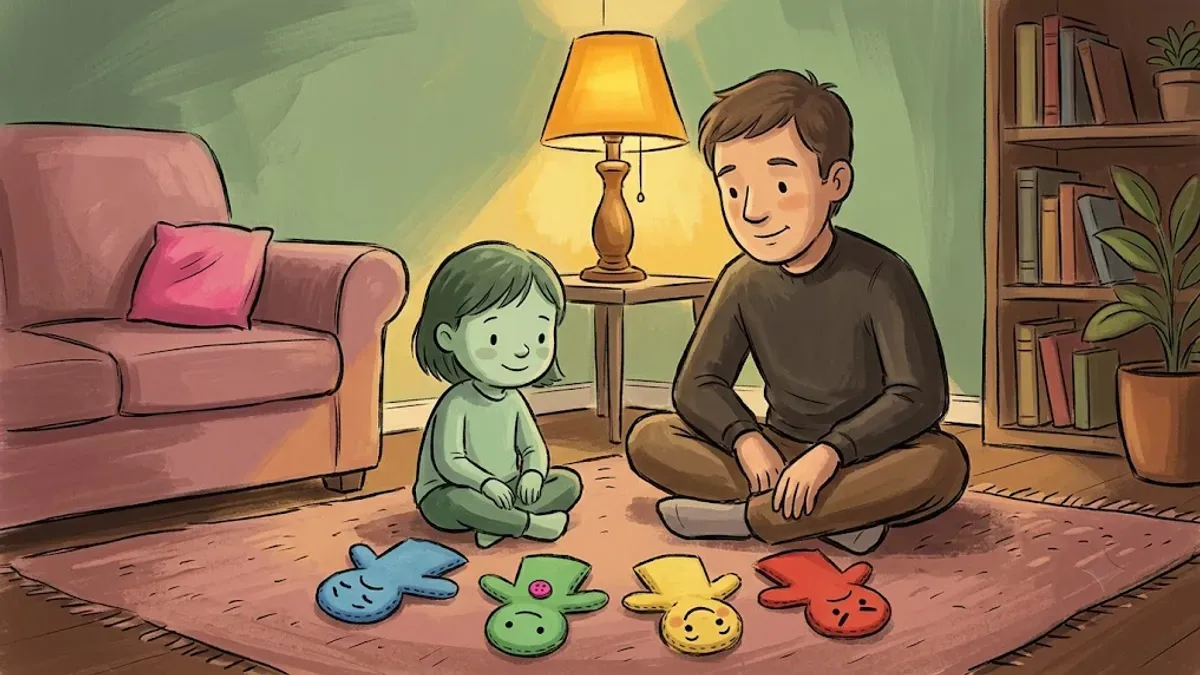
Kids learn this faster through play than through any chart you hang on the wall. Color-matching games work great: sort crayons into zones, slap a color when you call it, match a stuffed animal to how it “feels.”
There’s a well-known zones of regulation song floating around YouTube, and a catchy tune does the memorizing for you. Three-year-olds who can’t yet name “frustrated” will absolutely belt out the colors.
Then let your kid build the feelings chart, don’t pre-make a perfect one:
- They draw or photograph their own face in each zone
- They pick what each color means to them
- They post it somewhere they actually look, like the fridge
Ownership is what makes it a routine instead of a poster. These little regulation tools quietly teach self-management and put real words to their own energy levels. Pair the chart with a cozy spot to use it and you’ve basically got the bones of a calm-down corner. Here’s how to set up a calm down corner at home.
Coping Tools for Each Zone (Building the Toolbox)
Knowing your kid is in Yellow does nothing if they don’t have a way out. That’s what the toolbox is for: a short, kid-picked list of go-to moves for each color, ready before the storm hits.
The trick is matching the tool to the zone. A wound-up Yellow kid doesn’t need to relax, they need to burn it off first. A flat Blue kid doesn’t need to calm down, they need a little fuel. Same toolbox, opposite jobs.
Here’s how I sort our coping strategies at home:
- Blue (low, tired, sad): wake the body up. A drink of cold water, a silly dance, jumping jacks, two minutes of fresh air outside.
- Green (calm, ready): keep it here. This is where learning happens, so the “tool” is just noticing it and naming it out loud.
- Yellow (wound-up, anxious, excited): drain the tank. This is where heavy work earns its keep, pushing a wall, hauling the laundry basket, a wall-sit, then slow belly breaths once the body settles.
- Red (out of gas): safety and space first. A quiet corner, a tight squeeze if they want one, fidget tools to keep hands busy, no talking it through until the wave passes.
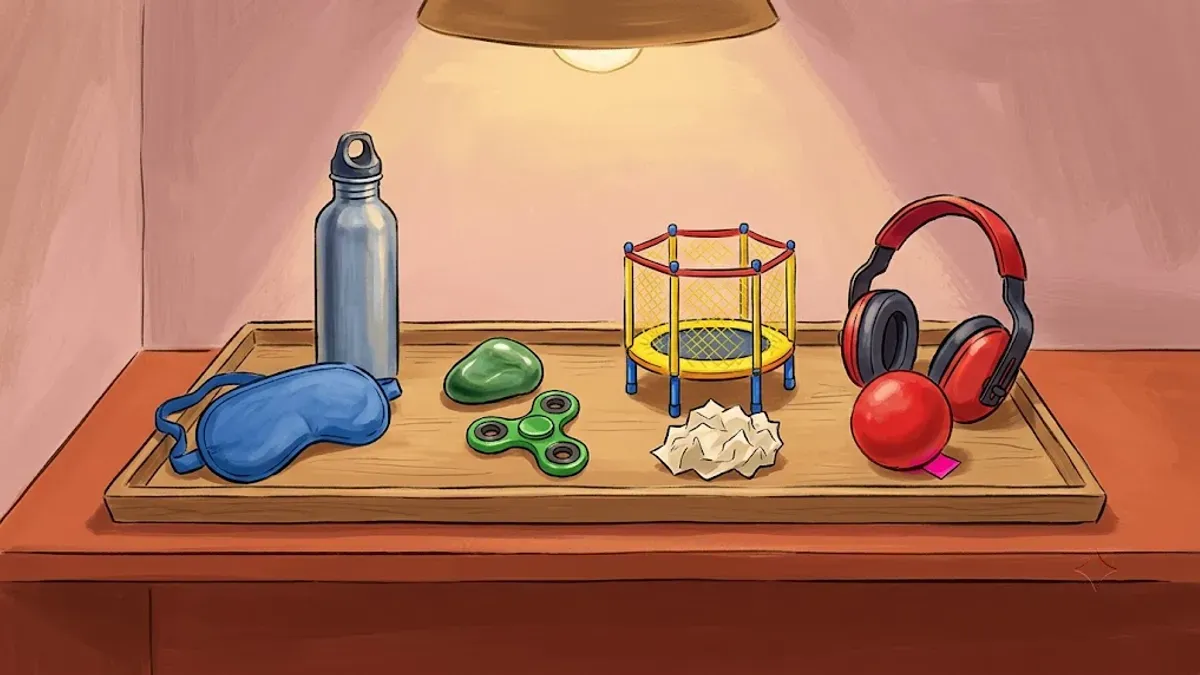
Notice that calming techniques aren’t the answer for every color. Half of regulation is up-regulating, getting a sluggish body moving, not just settling a fast one down. That surprised me the first year.
There’s real reasoning under the “feel it first” approach. A review in Frontiers in Psychology found that noticing internal body signals, your interoceptive awareness, is what lets us identify the physical states tied to emotion in the first place. Your kid has to feel the racing heart before any tool can land.
Which tools actually get used comes down to one thing: who picked them.
- Eli reaches for a wall-push every single time. He chose it.
- A breathing exercise I assigned him? Never happened.
- Start with a short list of options and let them own the final call.
For more starting ideas, here’s a list of emotional regulation activities for kids that actually hold up on a rough day. And short zones of regulation videos can demo a tool better than I can describe one, so save a couple your kid likes.
Books, Printables, Songs, and the Official Curriculum
You don’t have to buy anything to start, and you probably shouldn’t until you’ve tried the free stuff. Here’s what’s out there, from the no-cost downloads to the book to the full classroom curriculum, and which of it a home actually needs.
Free printables and worksheets to start with
Start here, because the whole system runs on paper you can get for nothing. The official site offers a handful of free zones of regulation printables at zonesofregulation.com, including an “All The Zones Are Okay” coloring page, a four-zone visual in English, French, and Spanish, and a language guide with co-regulation phrases.
That’s enough to tape a chart by the breakfast table and run your daily check-ins for weeks.
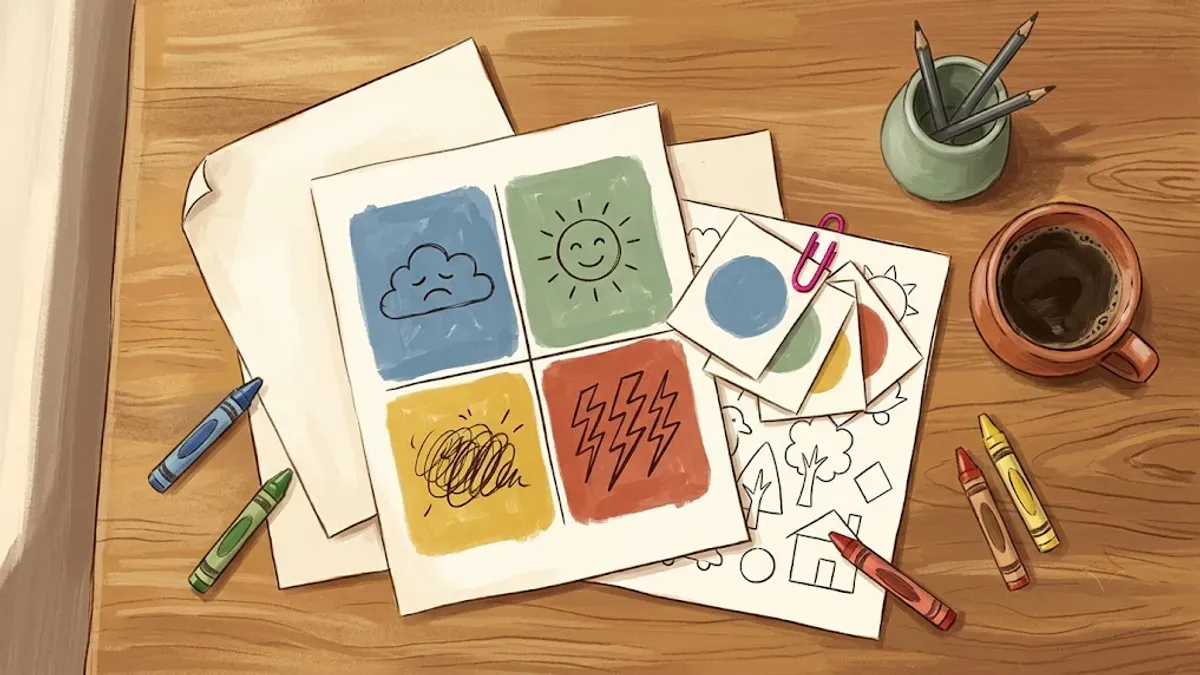
Search around and you’ll find plenty of free worksheets and coloring pages from teachers too: check-in sheets, fill-in feelings charts, blank zone posters. Many are available as a PDF download you can print in thirty seconds. Print a couple, see what your kid reaches for, and only then think about spending. These regulation tools cost a few sheets of printer paper and tell you whether the whole thing fits your family.
The book and kid-friendly videos
If the printables click and you want a little more structure, the book is the next logical step. It’s what the whole color-zone framework was built around, and the PDF version makes it easy to reference on a phone mid-morning. It walks you through the color language lesson by lesson, which helps if you’re the kind of parent who likes the why spelled out before you teach it.
The book leans school-ish, so I skim it for the ideas and skip the worksheet grind. What stuck at my house wasn’t a lesson plan, it was the everyday vocabulary it gave us.
Pair it with kid-friendly Zones videos and songs, which carry the social-emotional learning a lot more cheaply than a workbook. A three-minute clip naming the colors does more for emotional vocabulary in a wound-up toddler than ten minutes of me reading aloud ever has.
Is the official curriculum worth it for families?
Probably not, and that’s the honest answer most sites won’t give you. The curriculum and its digital version were designed for classrooms, where a single teacher walks a whole group through the same evidence-informed lessons on the same schedule.
The numbers tell you who it’s for. The complete framework book runs $54.99 at socialthinking.com (accessed June 2026), while the digital curriculum subscription sits at $144 per user per year on the standard plan (per the official pricing page, accessed June 2026; check the current price). That’s a school budget, not a kitchen-table one.
For home, the free downloads plus the book cover almost everything. Spend your energy on the setup instead, like a calm-down corner where these tools actually live. We walk through that in our full guide to setting up emotional regulation at home, which is where the printables stop being clutter and start getting used.
Found this useful? Save it for the next rough afternoon.
Questions parents ask me about this
What age should kids be to start learning the Zones of Regulation?
Most children can start recognizing the four colors somewhere between ages 3 and 5, when they have enough language to connect a word to a feeling. You don't need to teach the whole system at once. Introduce one color at a time during calm, low-stakes moments and let the vocabulary build slowly. Some younger kids engage with the colors as early as age 2 if a parent models it consistently, and older kids benefit from a fresh start even at 8 or 9.
Is the Zones of Regulation just for autistic or ADHD children?
No. The framework was designed for any child learning to notice and manage their own energy and emotions. It's used widely in general education classrooms, not only in special education or therapy settings. That said, many families of autistic and ADHD kids find it especially useful because it gives a concrete, visual language to what can otherwise feel invisible and hard to name.
How is the Zones of Regulation different from a regular feelings chart?
A feelings chart names emotions: happy, sad, angry, scared. The Zones framework goes one layer deeper by grouping emotions under an energy level, which is often easier for kids to identify in the moment. A child who can't tell you whether they're frustrated or anxious can usually tell you they feel Yellow. That distinction matters because the same coping tool doesn't work for every emotion, but it can work for an entire zone.
Is the Zones of Regulation backed by research?
The curriculum was developed by an occupational therapist and is grounded in well-established concepts from occupational therapy and social-emotional learning, including interoception and self-regulation research. In school and home settings, children using the framework show gains in self-awareness and emotional identification, particularly when adults use the language consistently. It's widely used in schools and therapy practices, though outcomes vary by child, implementation, and consistency.
Are the Zones of Regulation used in IEPs and therapy plans?
Yes, it's common. Occupational therapists, school counselors, and special education teachers often reference the Zones framework in IEP goals related to self-regulation and emotional awareness. If your child already uses the color language at school or in therapy, carrying it home is one of the most practical things you can do. Consistency between settings makes the skill stick faster.
What should I do if my child gets stuck in a zone?
Don't try to fix it mid-wave. When a child is deep in Red or Blue, that's not the moment for instruction. The tool work and zone conversations happen before and after, at calm and predictable times. Your job in the moment is co-regulation: stay calm, stay near, and wait. If a child is frequently stuck in one zone, bring that pattern to their OT or school team rather than troubleshooting alone.
Where can I find a free Zones of Regulation PDF?
The publisher's site has free downloads to get you started, including coloring pages, zone visuals, and a co-regulation language guide.
Written by
Nora Hayes
Mom of two and a former preschool aide. I share the screen-free sensory play and calm-down ideas I test at my own kitchen table, plus what the moms in my little meet-up swear by. A parent passing on what works, not a doctor or a therapist.
More about NoraKeep going
All Calm & Big Feelings-
 Calm & Big Feelings
Emotional Regulation Activities for Kids That Work
Most calming tricks fail mid-meltdown. These emotional regulation activities for kids work when nothing else does. Find the one that fits your child.
-
 Calm & Big Feelings
Calm Corner Ideas: 25 Picks Under Your Coffee Budget
Skip the $200 setups. These 25 calm corner ideas cost less than a latte and soothe big feelings. Build one your kid loves this week.
-
 Calm & Big Feelings
Cozy Corner Preschool: Calm Down Ideas for Throwers
Throwing the calm-down tools? Build a cozy corner preschool space that survives big feelings, with throw-proof tools and steps that work.
-
 Calm & Big Feelings
Calm Corner Classroom Setup for Autistic Kids
Most calm corners fail autistic kids because they skip the sensory profile. Build a calm corner classroom that works in 5 steps. Start here.