Calm Corner Classroom Setup for an Autistic Kid

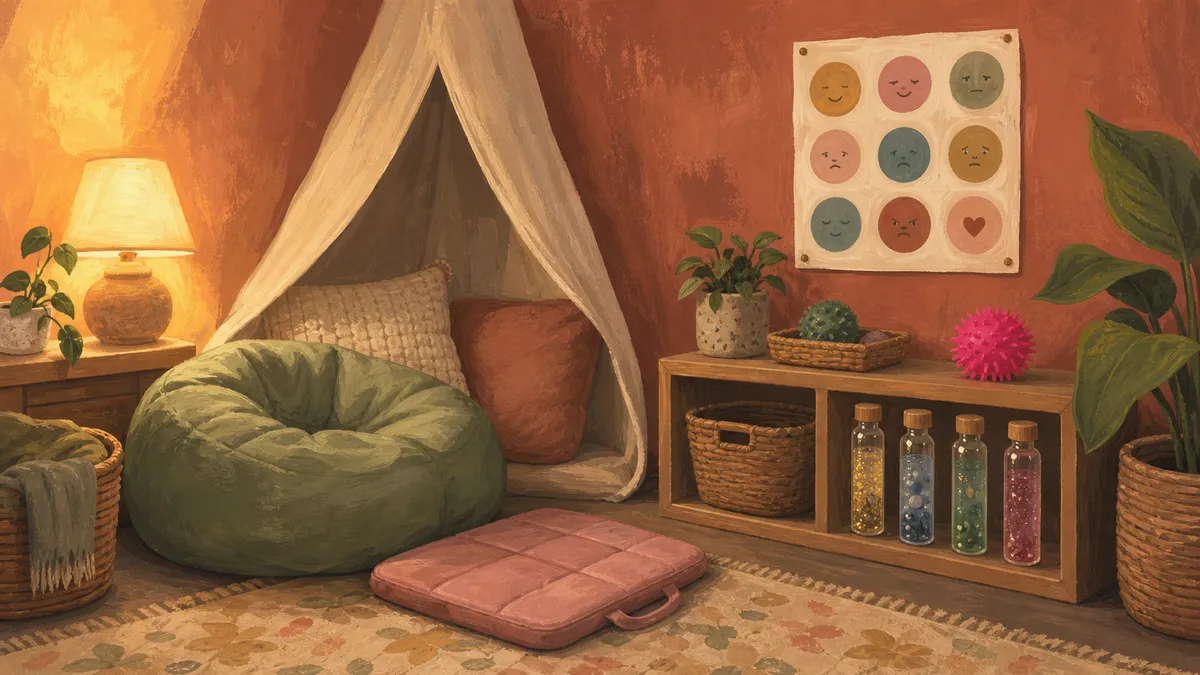
I am a parent sharing what worked at my house, not medical advice. For anything to do with your child's development or sensory needs, talk to your OT or doctor.
Some links here are affiliate links. If you buy through one, I may earn a small commission at no extra cost to you. As an Amazon Associate I earn from qualifying purchases. I only point to things I'd actually use with my own two.
A calm corner classroom only works when you build it around one child’s sensory profile, so map what soothes and what overwhelms before you spend a dollar on cushions or fidgets. I’m Nora Hayes, a former preschool aide and mom to an autistic sensory-seeker, and the corners that flop are almost always the ones stocked from a wish list instead of from watching the kid.
The plan in brief:
- Map the child’s sensory profile first: list what soothes and what overwhelms before buying anything.
- Stock the corner to match that profile: weighted input, noise reduction, and 2-3 chosen fidgets.
- Teach the corner when the child is calm, and practice it once a day for the first two weeks.
What Makes a Calm Corner Work for an Autistic Child
Most calm corners fail not because the idea is wrong, but because the setup ignores the actual child.
A generic Pinterest calming corner looks appealing: soft rug, fairy lights, a few stuffed animals. For a sensory-avoider who finds texture unbearable, that rug might be the last place they want to sit. For a sensory-seeker who needs heavy input to settle, fairy lights do nothing. The space has to match the nervous system using it, not the aesthetic of whoever set it up.

That’s the whole logic behind a calm down corner emotional regulation approach: you’re not decorating, you’re designing a regulation zone. Every sensory item in the space should serve a function. Noise-reducing headphones for the kid who gets overwhelmed in a calming corner in the classroom, a weighted lap pad for the one who needs proprioceptive input to slow down.
Self-regulation isn’t something you can demand from a dysregulated child. The corner works because it gives the nervous system something to do with the overwhelm instead of pushing it toward meltdown. If you need strategies for what comes after the corner doesn’t catch it in time, this guide to help autistic child through meltdown covers that ground.
Get the sensory items right for this specific child and the corner becomes a tool they’ll choose. Get them wrong and it’s just a rug in the corner that nobody uses.
Map the Sensory Profile Before You Buy Anything
Before you spend a dollar, watch your kid for a week. This section is two jobs: figure out what actually calms them versus what tips them over, then sort out whether they chase input or run from it.
Spot What Soothes and What Overwhelms
The same thing that melts one autistic kid into a puddle of calm will send another straight up the wall. A soft fleece blanket, a humming white-noise machine, a dim string of lights: soothing for one, unbearable for the next. So you don’t shop first. You watch first.
Keep a running list on your phone for a few days, two columns: what calms them and what tips them over.
- What your child reaches for when winding down
- What makes them cover their ears, squint, or bolt from the room
Pay attention to color too. Some kids settle under calming colors like deep blue or muted green and get jangly under bright red or busy patterns. Watch for the moment right before a shutdown, when a kid goes quiet or slips into task avoidance to dodge something too loud or too bright. That avoidance is data, not defiance.

Your sensory items list comes from the child, not the catalog.
If you’re still learning to read those early signals, meltdown tantrum tell difference changes everything is worth a read before you stock a single shelf.
Seekers, Avoiders, and Mixed Profiles
Most autistic kids fall somewhere on a seeker-to-avoider line, and where they land flips your whole shopping list. A sensory seeker craves input. They crash into couches, give bone-crushing hugs, and never sit still. An avoider does the opposite, flinching from noise, touch, or motion.
Those patterns track to specific senses. Research on sensory processing in autism recognizes hyper- and hyporeactivity as a core feature of autism, which is why two kids with the same diagnosis can need opposite corners.
- A seeker chasing proprioceptive input wants heavy work: a weighted blanket, a body sock, something to push against.
- An avoider sensitive to vestibular input wants stillness, not swings or spinning.
- Plenty of kids are mixed, craving deep pressure but covering their ears at the same noise.
Stock for the profile in front of you. A weighted blanket soothes a seeker and can pin an avoider in place against their will, so match the tool to the wiring, not the label.
How to Set Up the Calm Corner Step by Step
Order matters here: the space has to work before the tools go in, and the tools have to be right before the visuals make any sense.
- Pick a quiet, low-traffic spot and give it real edges so the space feels contained.
- Stock it with a handful of sensory tools matched to the child’s profile, seat first.
- Hang a feelings chart, a stack of break cards, and a breathing tool so the child has a script for what to do.
Pick the Spot and Define the Boundary
Start with the quietest, lowest-traffic patch you have. Back of the room, away from the door, away from the sink, away from wherever the class lines up. You want a kid to step in and feel the volume drop, not sit in the middle of foot traffic.
Then give the calm corner real edges.
- A small rug marks the floor boundary
- A low shelf turned back to the room creates a wall
- A canopy or sheet draped over a corner adds a roof
Edges matter more than square footage. A child tucked into a defined nook settles faster than one sitting in the middle of open carpet.
Keep the palette quiet too. Soft, muted calming colors on the wall or the cushions, nothing that buzzes. Pick seating options that fit the body you’re building this for, low and grounded. And fold it into your classroom culture early, so stepping in reads as a normal choice, never a place you get sent.

Choose Sensory-First Seating and Tools
Now you stock it, and you stock light. The pile is the enemy. Three good tools a child will actually reach for beat a basket of fifteen they’ll dump on the floor.
Start with the seat, because the seat does the heavy lifting.
- Seat: a bean bag that swallows the body, or a weighted lap pad across the legs, delivers deep pressure the moment they sit. The bean bag I point parents to is an Amazon’s Choice with north of 25,000 ratings behind it; the lap pad runs 4.7 stars across 4,500-plus reviews.
- Headphones: one pair of noise-reducing headphones for the kid who startles at sound. The pair I like cuts around 27 decibels and wears an Amazon’s Choice badge from more than 9,000 buyers.
- Fidgets (two or three max): a squishy, a chewable for the kid who mouths things, a quiet sensory bottle to watch
In a small study of autistic children with auditory hypersensitivity, noise-attenuating headphones lowered measurable stress responses during classroom noise, which tracks with what teachers see: the volume drops, the body settles.
You don’t need every gadget on the internet, and you can build a perfectly good version from cheap stuff if you raid these budget calm corner ideas first.
Stock to the profile, keep it sparse, and let the seat do most of the regulating.
Add Visual and Breathing Supports
The tools settle the body. The visuals tell the child what to do with the quiet. Tape up a simple emotion chart at their eye level, so a kid who can’t find the word can point to the face instead.
Add a small stack of break cards near the entrance, the wordless kind a child can hand you or carry in, so asking for the corner never requires a full sentence in the worst moment to find one.
- Breathing tool: a Hoberman sphere opens as they inhale and closes as they exhale, turning slow breathing into something the hands do. It has quietly been the favorite in every corner I’ve built, and its 800-plus reviews (4.7 stars) say other families land there too.
- Timer: a sand timer gives a soft, visible signal to check in when it runs out, no countdown needed. The rainbow one on my shelf earned 4.6 stars from more than 1,700 families; check the current price on Amazon before you spring for a fancier gadget.
The research backs it: paced breathing with a physical object has measurable calming effects on the nervous system.
Teach the Corner So the Child Will Actually Use It
A stocked corner is useless if your child only meets it for the first time mid-meltdown. Two things make it stick: rehearsing it when everyone is calm, and showing up beside your kid instead of pointing them toward it from across the room.
Practice It While the Child Is Calm
Introduce the corner on a good day, not a bad one. A dysregulated kid cannot learn a new routine, so the lesson has to land while the nervous system is settled and the brain is actually online.
- Walk through it together like a tour: sit in the bean bag, squeeze the sensory bottle, point to the feelings chart, try a break card.
- Keep it low-key. No pressure to do it right, no performance.
- Frame it as their choice. Opt-in, the same way you’d offer a snack, not a place they get sent.
In a classroom, fold the practice into your existing rhythm. A morning meeting or a social-emotional learning block is the natural slot to model it, role-play it, and rehearse it so it is old news long before anyone needs it under stress.
Rehearse the corner when the storm is far off, so it feels familiar the moment the storm rolls in.

Co-Regulate and Use Nonverbal Cues
A young kid borrows your calm before they can find their own. So when your child heads to the corner, go with them at first. Keep your voice low, stay beside them, and let the quiet between you do the teaching. That is co-regulation, and it is how self-regulation eventually gets built.
Not every child can ask out loud, and that is exactly where break cards earn their keep. The Texas Education Agency defines a break card as a visual tool a student hands over to request a break, and stresses that you honor it the instant it is used, to build trust. For a nonverbal kid, that same cue can travel in other forms: - A button they press
- A hand signal you’ve agreed on together
- An AAC tap
For more no-words ways in, my roundup of calm down tools nonverbal kid goes deeper. Cardiff University’s research, covered in their sensory rooms and spaces guide for autistic children, found that giving the child autonomy is what makes the space work. Let them lead the way in.
Troubleshooting When the Corner Stops Working
Autonomy gets the corner started, but plenty of corners stall a few weeks in. Here are the two snags I hear about most, and what to do about each.
When the Child Refuses to Go
A flat “no” is not defiance, it’s information. The demand is too big in that moment, so shrink it. Instead of “go to your corner,” try “do you want the bean bag or the floor?” One small choice keeps it opt-in and hands a little control back to a kid who has none.
If even that lands wrong, stop pushing the child toward the space and bring the space to the child. Carry the sensory bottle, the headphones, the weighted lap pad over to wherever they’ve melted down. You co-regulate there: sit close, slow your own breathing, say almost nothing.

What looks like refusal is often task avoidance in disguise, the same escape pull behind a lot of meltdowns. For more scripts, read the full guide on kid refuses go calm down corner.
When It Used to Work and Now Doesn’t
A corner that’s gone stale usually means one of two things. The tools stopped being interesting, or the child changed underneath them. Rotate. Swap two fidgets for new ones, retire the sensory bottle they’ve stopped reaching for, bring something back in a month.
Then re-check the profile. A longitudinal study of over 1,500 kids, reported by Medical Xpress, found sensory patterns in autistic children tend to grow stronger with age rather than holding steady. The setup that fit at four can stop fitting the same kid at six.
Last, rule out that the regulation zone has quietly become a work-escape. If your child heads there only during math, that’s behavior management territory, not a tool problem. Keep the corner available, and make the return to the task small and supported. The space stays a refuge, not a hideout.
Extending the Calm Corner Beyond the Classroom
The skills a child builds in a regulation corner don’t stay at school. That’s the whole point. When home and classroom use the same language and the same tools, self-regulation generalizes faster than when the two environments run different systems.
Send a one-page visual home at the start of the year: the three tools in the corner, what the break card looks like, how long a visit typically runs.
- A parent who already uses a sand timer at home and hears “use your calm corner” from the teacher is giving that phrase twice the practice.
- A parent hearing the term for the first time at a conference is starting from zero.
Grade-level adaptation matters too.
- Kindergarten: the corner needs an adult to stock it and narrate the visit.
- Third grade: a child with a year of practice can pull their own weighted lap pad and take the break.
- Fifth grade: the goal is noticing the early signs and choosing a tool before anyone has to prompt.
That’s co-regulation becoming self-regulation, and it’s the long game of every social-emotional learning framework worth its name.
For a deeper look at building that independence at home, read our full guide to building emotional regulation at home.
Found this useful? Save it for the next rough afternoon.
Questions parents ask me about this
How do you set up a calm corner in a classroom?
Pick a low-traffic spot away from the door and the sink, define the edges with a small rug or a shelf, and keep it stocked with two or three calming tools rather than a cluttered pile. Add an emotion chart at eye level, a sand timer, and a wordless break card near the entrance so kids can request it without speaking. Introduce the space during a calm moment, not mid-meltdown, so children already know how it works before they need it.
What is the difference between a meltdown and a tantrum?
A tantrum is goal-directed: the child is upset and wants something specific, and it usually stops when they get it or the audience leaves. A meltdown is a sensory or emotional overload that has passed the point of self-control; the child is not performing for anyone and cannot simply decide to stop. Regulation tools help during a meltdown; negotiating does not.
What calm down tools work for a nonverbal autistic kid?
Focus on tools that don't require words to use: a weighted blanket or bean bag for deep pressure, a sensory bottle to shake and watch, a Hoberman sphere for guided breathing by example, and a fidget with clear tactile feedback. Pair those with visual or picture-based break cards so the child can communicate they need the corner without speaking. The same tools that work in the classroom travel home well, which helps families stay consistent.
What is the difference between a calm corner and a time-out?
A time-out is adult-imposed and tied to behavior; the child goes because they did something wrong. A calm corner is opt-in and tied to a feeling; the child goes because they need a reset. One is a consequence, the other is a tool. That framing distinction matters to the child: a space they chose to use is one they'll return to, while a punishment spot becomes something to avoid or resent.
How big does a sensory corner need to be?
Big enough to hold one child, a seat, and two or three items. A corner roughly the size of a large bean bag chair plus arm's-length reach on both sides is enough. A defined boundary, whether that's a shelf, a small bookcase, or even a canopy, gives the space a contained feeling that helps with regulation more than sheer size does.
How long should a child stay in the calming corner?
Long enough to come back regulated, which varies by child and by how wound-up they arrived. A sand timer (two to five minutes for most kids) sets a visible boundary without an adult having to intervene. The goal is not a fixed duration; it's that the child leaves feeling steadier than when they walked in.
How do you keep the calm corner from becoming a way to avoid work?
Track when the corner gets used. If visits cluster around specific tasks or transitions, that pattern is data worth sharing with a support team, not a reason to block access. Shrink the demand rather than the break: return to one small piece of the work after the reset, not the whole assignment. A corner working too well as an escape usually signals that the underlying task needs adjustment, not that the corner should disappear.
Written by
Nora Hayes
Mom of two and a former preschool aide. I share the screen-free sensory play and calm-down ideas I test at my own kitchen table, plus what the moms in my little meet-up swear by. A parent passing on what works, not a doctor or a therapist.
More about NoraKeep going
All Calm & Big Feelings-
 Calm & Big Feelings
Emotional Regulation Activities for Kids That Work
Most calming tricks fail mid-meltdown. These emotional regulation activities for kids work when nothing else does. Find the one that fits your child.
-
 Calm & Big Feelings
Calm Corner Ideas: 25 Picks Under Your Coffee Budget
Skip the $200 setups. These 25 calm corner ideas cost less than a latte and soothe big feelings. Build one your kid loves this week.
-
 Calm & Big Feelings
Cozy Corner Preschool: Calm Down Ideas for Throwers
Throwing the calm-down tools? Build a cozy corner preschool space that survives big feelings, with throw-proof tools and steps that work.
-
 Calm & Big Feelings
Zones of Regulation Red Zone: A Parent's Plan
Your kid is in the zones of regulation red zone and nothing works. Here's what to say, what to skip, and how to ride out the worst 10 minutes.