Social Story About Transitions When the Day Shifts


I am a parent sharing what worked at my house, not medical advice. For anything to do with your child's development or sensory needs, talk to your OT or doctor.
A social story about transitions is a short, plain-language script you read to your kid before a surprise happens, so the switch lands softer instead of sideways. For a sensory kid, an unexpected change (closed pool, sick grandma, canceled playdate) is often the exact thing that tips a calm morning into a full meltdown, and a few calm sentences read ahead of time can be the whole difference.
I’m Nora Hayes, a former preschool aide and mom of an autistic sensory-seeker, and I’ll walk you through what these social stories actually do, how to use one when routine changes with zero warning, and how to write your own in minutes.
What a Social Story About Transitions Actually Does
Before we get into the days that go sideways, it helps to know what one of these little stories is doing under the hood, and why a break in routine lands so hard in the first place.
The Short Definition and Why It Calms
You read it before the moment hits, and what your kid gets is something concrete: specific, predictable information about what’s changing and what happens next.
- The teacher she’s expecting is out today.
- Here’s who’ll be there instead.
- Here’s what we’ll do.
That’s the whole shape of a social story, and the predictable information is the part that does the work.
- Carol Gray developed the method with autistic students in the early 90s (the original social story method and criteria).
- A real story describes far more than it commands.
- The defined Social Story criteria keep directive sentences under a third of the total, so the story informs instead of bosses.
Why does that calm a wound-up kid? Because a structured narrative answers the question their brain is already screaming: what happens next. A meltdown often isn’t defiance, it’s panic about the unknown. Hand them a visual narrative of how the next twenty minutes go, and you’ve replaced the scary blank with something they can hold. That’s the anxiety reduction, and it happens before the hard moment, not during it.

If you’ve never written one and want the bare-bones version, start with this beginner story social guide and build from there.
Why Transitions Trigger Big Reactions
For a lot of kids on the autism spectrum, and plenty with ADHD, routine isn’t a preference. It’s the floor they stand on. When the day runs in the expected order, they know where they are. Yank a step out of that sequence, and it can feel less like a small change and more like the floor tilting.
That need for sameness isn’t a quirk to train out of them. Research following 421 autistic children from ages three to eleven, summarized by Autism.org, found that a strong insistence on sameness in the early school years was linked to higher anxiety a year or two down the line, with up to 60% of autistic kids dealing with anxiety by middle childhood.
That’s not your kid being difficult. It’s a real loss of control hitting a brain that runs on predictability.
Layer on sensory challenges and the change gets harder fast.
- a louder room than usual
- a new face running the show
- a different smell that wasn’t there before
It’s a lot of input at once with no warning. That’s why a heads-up, even a thirty-second one, can be the difference between a rough morning and a wrecked one.
When the Routine Changes With No Warning
Not every change lands the same way, and the kind you can see coming asks for a different tool than the one that ambushes you on a Tuesday morning. Here’s how to tell them apart, and what to actually say when there’s no time to prep anything.
Last-Minute Changes vs. Changes You Can Plan For
Some changes you know about for days. The dentist is Thursday, Grandma visits Saturday, the pool closes for the season next week. Those are anticipated changes, and you have the luxury of reading a story two or three times before the day arrives, so the new sequence stops feeling foreign.
Then there’s the other kind. The babysitter cancels. It pours, so the park is off. The car won’t start. These unexpected events give you zero runway, and that’s exactly where most pre-written stories fall short, because you can’t write a custom one in the four minutes before everything goes sideways.
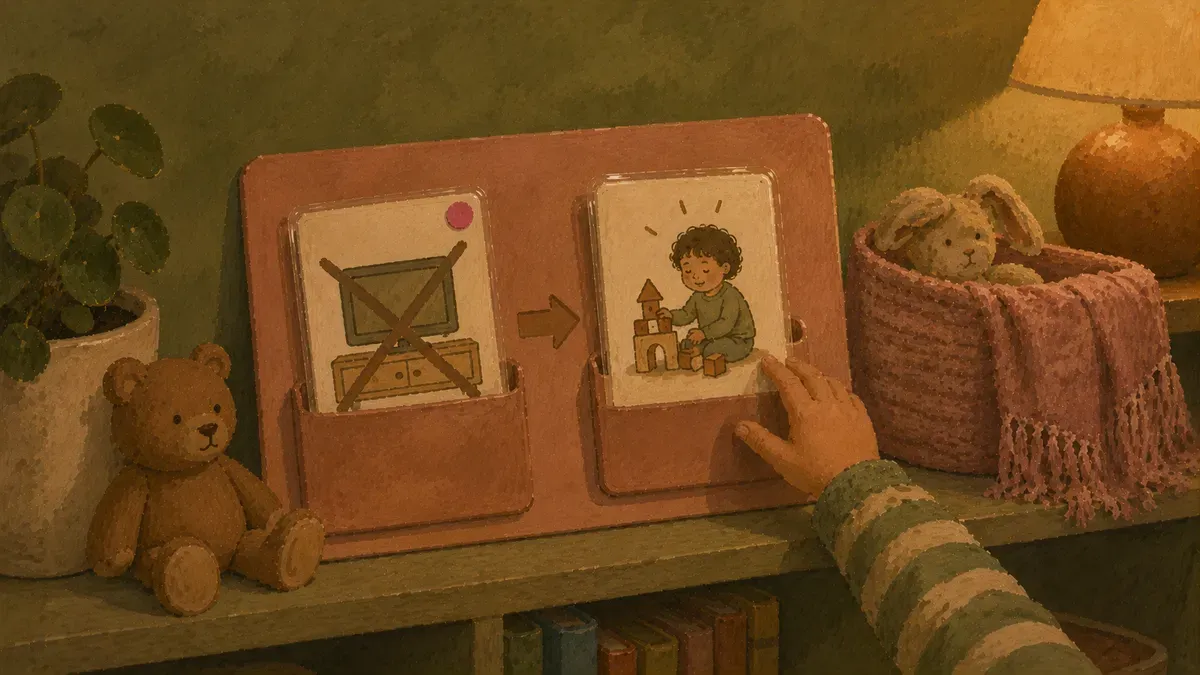
The fix I lean on is a flexible, generic transition story. Not “today we go to the library,” but “sometimes the plan changes, and that feels hard, and I can handle a new plan.” One story, written once, that fits a hundred schedule changes you couldn’t predict. You read the same calm script whether the change is a closed park or a swapped pickup. The specifics get filled in out loud; the structure stays the same.
That built-in flexibility is the whole point. A story that only works for one event covers one bad morning. A story about change itself covers the rest of them.
Parent Scripts to Say in the Moment
The story does the heavy lifting, but your voice in the moment matters just as much, and a couple of short lines on hand beats fumbling for words while a meltdown builds. Keep them plain and keep them honest.
Try these two, word for word:
- “The plan changed. That’s a hard one. We’re going to do it together.”
- “You don’t have to like it. We can be upset and still get through it.”
Notice neither line pretends the change is fine. Naming that it’s hard is the move, not talking your kid out of the feeling. For a lot of caregivers, the instinct is to cheerlead the upset away, and for a sensory kid mid-flood, that just piles on more input.
When the frustration boils all the way over and the new plan isn’t landing, that’s your cue to reach for a separate tool. An anger social story, the kind you read on calm days to build coping strategies for big mad feelings, gives a kid words for the storm before the next one hits. It won’t stop the meltdown happening now. It builds the self-regulation that makes the next one shorter. One script steadies the moment; the other plays the long game.
Using a Story to Steady Emotions and Behavior
A good transition story does three jobs in sequence: it gives the feeling a name, it puts the calmer choices in front of your kid, and then it asks for the next step. Walk those in order and the meltdown that was building has somewhere to go besides the floor.
Naming Feelings So the Child Can Regulate
When the plan changes and the floor drops out, a kid rarely knows what’s happening inside them. They just feel big and loud and stuck. Social stories for emotional regulation work partly because they hand the child the word before the wave crests. A line like “When my plan changes, my tummy feels tight and I might feel angry” sounds almost too simple. It isn’t.
Putting a name to the feeling actually quiets the part of the brain that’s sounding the alarm. There’s research on affect labeling showing that affect labeling, the act of naming an emotion, lowers activity in the amygdala, the brain’s threat response. The story does that labeling for the child before they can do it themselves.
Name the feeling out loud, every time, and you give your kid a handle to grab instead of a wave to drown in.
This is where story emotions pages earn their place. A page that shows a face going from calm to frustrated to overwhelmed lets your kid point instead of explain, which is the whole point when words are the first thing to leave during a swell of anxiety. Eli used to slam the page shut the first few times.
Then one Tuesday, he tapped the frustrated face before I’d said a word.
That tap was him catching the feeling early, which is the start of any real coping strategy.
Pairing the Story With Visual Supports
Naming the feeling opens the door. What you put next to the story decides whether your kid walks through it. A story read alone asks a lot of a dysregulated brain: hold the new plan in your head AND remember what to do about the feeling. That’s two heavy lifts at once. So you split them.
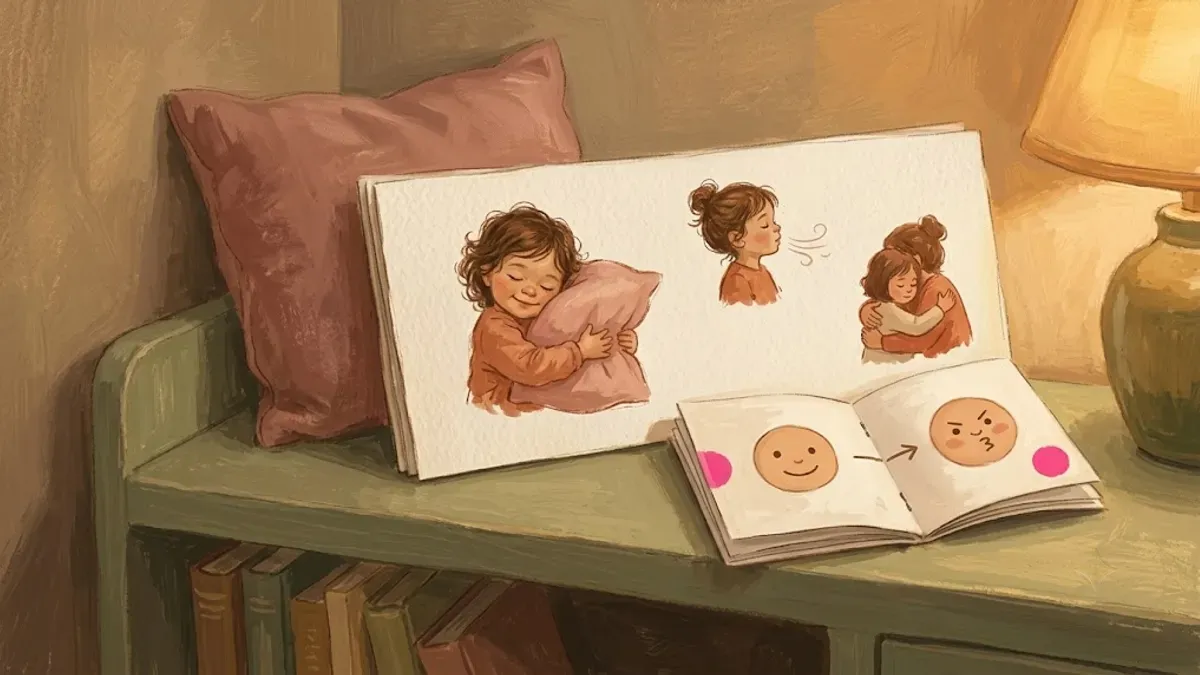
Prop a coping skills visual board right beside the story. The board shows the concrete options your kid can reach for right now:
- Squeeze the pillow
- Take five dragon breaths
- Ask for a hug
Next to that, a now-next board carries the new plan in two frames. Now: we put on shoes. Next: we go to Grandma’s instead of the park. The child sees the changed sequence as predictable information, not a mystery, and that visual narrative does the explaining so you don’t have to repeat it eight times.
Visual supports aren’t a nice extra here. They count as an evidence-based practice for autistic learners, who often process what they see faster than what they hear. Side by side, the calm-down choices and the new plan let your kid steer their own next move, which is the quiet beginning of independence.
Turning Calm Into Cooperation
Here’s the part people skip. They read the feelings page, the kid steadies, and then the grown-up jumps straight to “okay, shoes on, let’s go” and the standoff comes right back. Calm is not the same as cooperation. You still have to bridge the two.
That bridge is a following directions social story, and it only works once the body has come down a few notches.
The script names the smaller, doable thing: “When I am calm, I can listen to one instruction. I can do one step, then the next.” You’re not asking for compliance with the whole afternoon. You’re asking for one move.
That smaller ask matters because a kid coming out of overwhelm has almost nothing left in the tank. - One step: they can usually manage this.
- A list of five: pushes them back over the edge.
Social stories show real promise here: a systematic review in the ERIC database found them effective for following-direction and compliance goals across a broad range of autistic students.
If the friction is more about bodies and bumping than instructions, a personal space social story covers that flavor of the standoff instead. Either way, you’re building flexibility one accepted step at a time, not demanding the whole new plan at once. Calm alone doesn’t move a kid forward. What does it is one named step they can actually picture taking. Get those two in order and you move forward without the fight.
Real Transition Stories for the Days That Go Sideways
The theory only matters when the day actually falls apart, so here are the real moments a story earns its keep, sorted into the small swaps you hit weekly and the big one-offs that derail everything.
Everyday Swaps and Surprise Stops
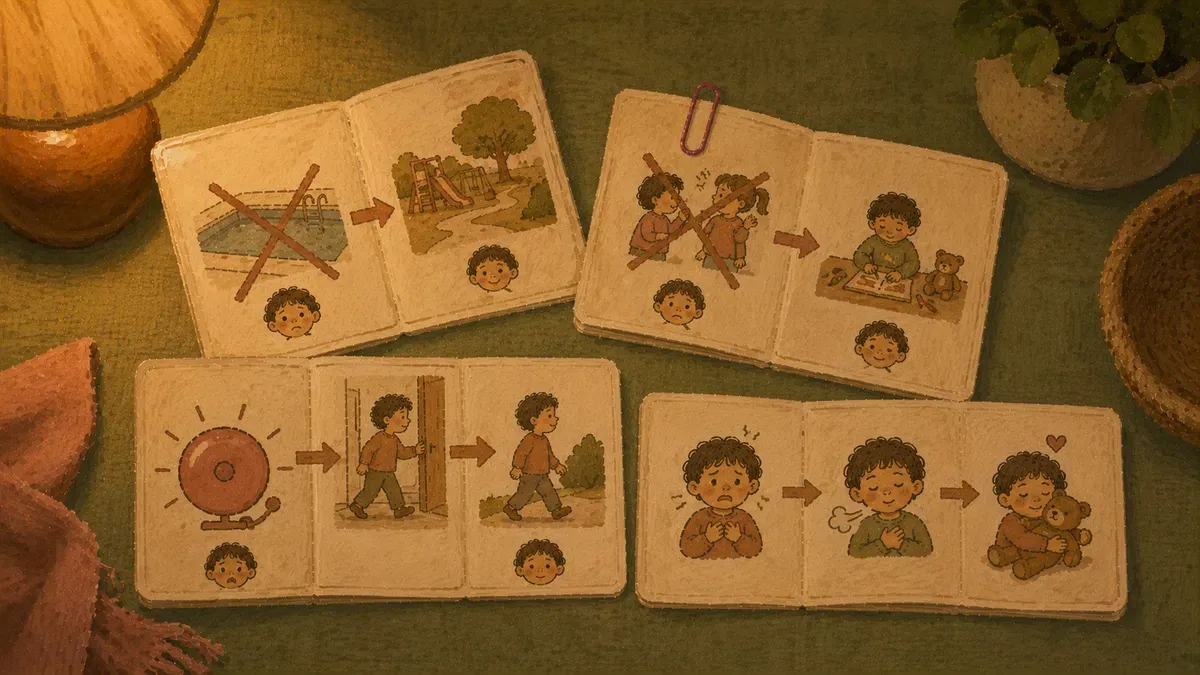
Most of what you’ll face isn’t dramatic. It’s the small stuff that piles up: the pool’s closed, grandma’s running late, you have to swing by the pharmacy before home. A short story for these day-to-day transitions doesn’t need to be elaborate. It needs to name the swap and give one honest next move.
Keep a few angles ready so you’re not writing from scratch at the worst moment:
- Cancelled activity (“Sometimes the thing we planned can’t happen today.”) Pair it with what you’re doing instead, so the schedule change lands as a swap, not a loss.
- Unexpected errand (“Sometimes we add a stop before we get home.”) One extra place, then the familiar route picks back up.
- Different person, a sub at daycare or a new babysitter, named as still-safe and still part of the plan.
- Wrong order, snack before bath instead of after, framed as the same pieces just shuffled.
For autistic children who track routine like a map, naming the surprise stop on paper does more than telling it out loud. The page holds still while the day moves. That’s the whole trick for these smaller unexpected events.
One-Off Events That Throw the Whole Day
Then there’s the rare disruption that flips the entire day sideways.
- Fire drill mid-morning.
- Canceled field trip.
- Dentist appointment moved up a week.
These major transitions hit harder because the day has no familiar shape left, and the worry spikes before anyone can explain a thing.
- Rehearsable: a fire drill, a moved appointment, events you can see coming, even loosely.
- Out of nowhere: no warning at all. The generic change story is your fallback for these.
A loud alarm and a line out the door are rehearsable, which is exactly why a fire drill social story read a few times beforehand turns a terror into a known script. You’re trading a surprise for predictable information: this loud thing happens, then we walk out, then we come back.
It holds up under pressure, too. In one pilot study, autistic children who read a digital story before an unexpected real-world change saw their average anxiety scores fall from 5.30 to 3.10 afterward. The day still goes sideways sometimes anyway. A story doesn’t promise a smooth ride. It gives your kid a map for the part of the day that lost its shape.
Writing and Personalizing Your Own Transition Story
Making that map is easier than it looks. You don’t need design skills or a laminator, just a frame to fill in and a few sentences set in your kid’s own world.
A Simple Frame You Can Fill In Fast
The blank page is where most of us freeze. Plenty of guides explain what a finished story should do, then leave you staring at an empty document with no idea where to start.
Here’s the frame I scribble on the back of an envelope:
- Name the situation in one plain line. “Sometimes our plans change.”
- Add a little detail about what changing looks like. “The pool was closed, so we went to the park instead.”
- Say how it might feel, without arguing with the feeling. “I might feel mad or confused. That’s okay.”
- Offer one thing the child can do. “I can take three breaths and look at my now-next board.”
- Close on something steady. “Plans change, and I can handle it.”
That order isn’t random. That order follows the sentence-type structure behind the method, where the directive line that tells the child what to do stays rare on purpose. Per the structure laid out in this clinical overview of Social Stories, coaching sentences are kept below one-third of the total, so the story describes far more than it instructs. If that ratio sounds fussy, it isn’t in practice. Mostly you’re describing, with one calm suggestion tucked in.
Keep the language first-person and the pictures simple. Real predictable information beats polish every time. If you want the full sentence-type breakdown, I walk through the carole gray method step by step.
Editable Templates vs. Free Printables
A free printable is the fast lane. You search, you print, you read it tonight, and for a one-off change that’s often plenty.
The catch is that a printed PDF is frozen. It says “the bus,” but your kid rides the gray van. It shows a stranger’s face where your child wants their own.
An editable template fixes that. You swap the words, drop in a photo of your actual park, and personalize it to the change your family is living this week. Autism Speaks offers free editable PowerPoint templates, built with the University of Washington READI Lab, specifically so you can add your child’s own pictures.
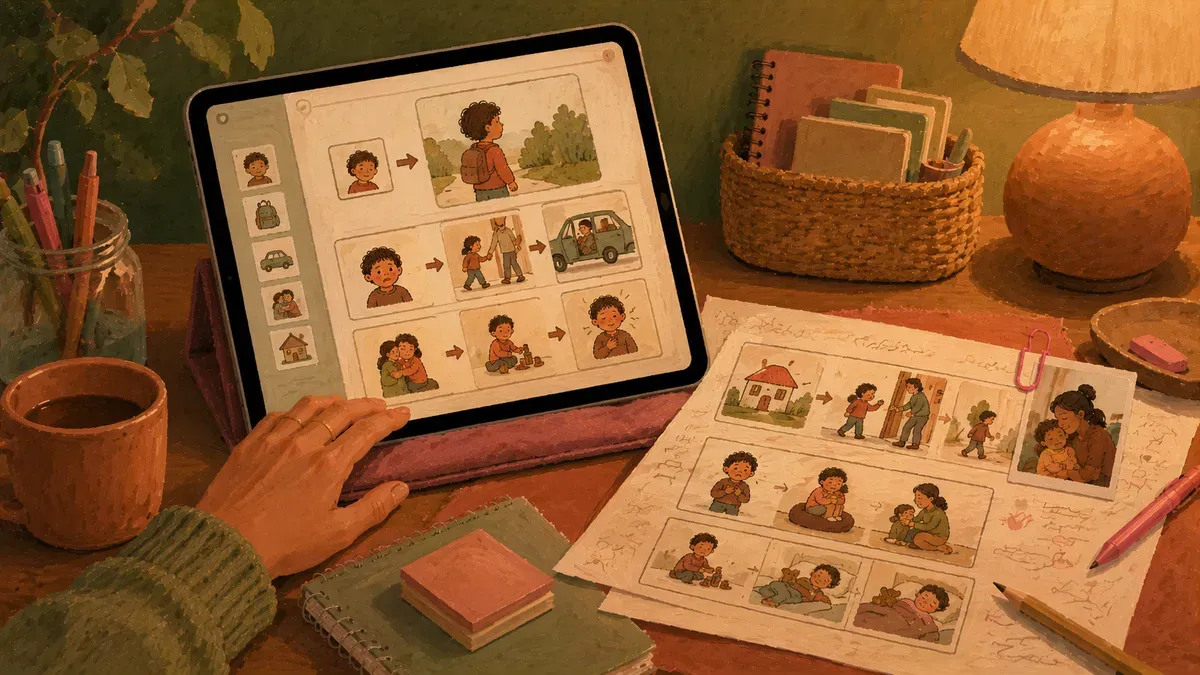
My honest take after years of both: print the free one when you’re out of time, but build a customizable version for the changes that keep coming back. I dig into why editable wins for repeat use in my piece on editable social story templates. When you’re ready for more, browse our complete library of social stories for a head start.
Found this useful? Save it for the next rough afternoon.
Questions parents ask me about this
How do I use a social story to help kids with transitions?
Read it together during a calm moment, not in the middle of a meltdown. The story names what will change, shows what feelings might come up, and offers one concrete next step. For recurring changes, read it the morning of or the night before so the information has time to settle.
At what age should I start using social stories for transitions?
Most kids can start benefiting around age 3 or 4, when they can follow a short narrative and understand basic picture cues. For children who are not yet reading, the pictures carry the meaning, so a story with clear illustrations works just as well. Follow your child's lead: if they engage with books at all, they can engage with a transition story.
How many times should my child read the story before it works?
There is no set number, and "works" looks different for every child. Some kids need to hear a story once before a specific change and that's enough. Others need it read daily for a week before a pattern sticks. Repetition builds the mental preview, so more reads before a hard transition generally means a smoother landing.
What do I do when there is no time to read the story before a surprise change?
Say the words out loud, even without the pages. A two-sentence verbal preview naming the change and one feeling it might bring is better than nothing. After the change, sit down with the story together to debrief, which helps your child file it away as something survivable for next time.
Do social stories actually work for autistic children?
The research says yes, particularly for reducing anxiety around unexpected events and for social and compliance goals. Results vary by child, how the story is written, and whether it's paired with other visual supports. They work best when they're specific to your child, read calmly ahead of time, and not used as a last-minute rescue once the moment has already escalated.
Should I read the same transition story for every kind of change?
A flexible generic story that covers any change is a reasonable catch-all, but targeted stories written for a specific recurring change, like a cancelled activity or an unexpected errand, tend to land better. Keep both: the generic version for truly out-of-nowhere moments, and specific ones for the changes that keep coming back.
Can I use a social story for transitions with a child who has ADHD and not autism?
Yes. Transition stories help any child who struggles with shifts in routine or unexpected changes, regardless of diagnosis. For kids with ADHD, shorter stories with one or two key pages tend to hold attention better. The same principles apply: name the change, name the feeling, offer one clear next step.
Written by
Nora Hayes
Mom of two and a former preschool aide. I share the screen-free sensory play and calm-down ideas I test at my own kitchen table, plus what the moms in my little meet-up swear by. A parent passing on what works, not a doctor or a therapist.
More about NoraKeep going
All Social Stories-
 Social Stories
Social Stories for Kids With Autism: 20 Essentials
Social stories for kids with autism, made simple. Master the 6-step method and build the 20 essentials every autistic child needs.
-
 Social Stories
Social Story Templates: Edit Them to Truly Fit Your Kid
Free PDF social stories rarely fit your child. Learn to edit social story templates in minutes so every word, photo, and step is truly yours.
-
 Social Stories
No Hitting Social Story for Hands That Won't Listen
Hands that hit, bite, and push aren't bad, they're overwhelmed. This no hitting social story teaches safe hands and what to do instead.
-
 Social Stories
Personal Space Social Story: Teach Hugs & Asking First
Hug by rule or by choice? This personal space social story teaches kids to ask first, say no, and read body bubbles. Start using it today.